The model was pretrained on 16kHz sampled speech audio with utterance and speaker contrastive loss. When using the model, make sure that your speech input is also sampled at 16kHz.
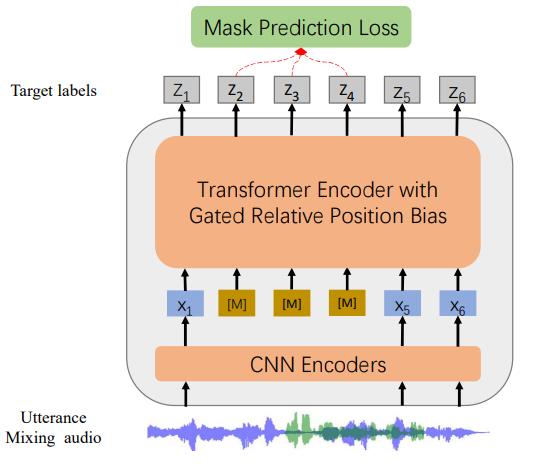
AbstractSelf-supervised learning (SSL) achieves great success in speech recognition, while limited exploration has been attempted for other speech processing tasks. As speech signal contains multi-faceted information including speaker identity, paralinguistics, spoken content, etc., learning universal representations for all speech tasks is challenging. In this paper, we propose a new pre-trained model, WavLM, to solve full-stack downstream speech tasks. WavLM is built based on the HuBERT framework, with an emphasis on both spoken content modeling and speaker identity preservation. We first equip the Transformer structure with gated relative position bias to improve its capability on recognition tasks. For better speaker discrimination, we propose an utterance mixing training strategy, where additional overlapped utterances are created unsupervisely and incorporated during model training. Lastly, we scale up the training dataset from 60k hours to 94k hours. WavLM Large achieves state-of-the-art performance on the SUPERB benchmark, and brings significant improvements for various speech processing tasks on their representative benchmarks.
1from transformers import Wav2Vec2FeatureExtractor, WavLMForXVector
2from datasets import load_dataset
3import torch
45dataset = load_dataset("hf-internal-testing/librispeech_asr_demo","clean", split="validation")6feature_extractor = Wav2Vec2FeatureExtractor.from_pretrained('microsoft/wavlm-base-sv')7model = WavLMForXVector.from_pretrained('microsoft/wavlm-base-sv')89# audio files are decoded on the fly10inputs = feature_extractor(dataset[:2]["audio"]["array"], return_tensors="pt")11embeddings = model(**inputs).embeddings
12embeddings = torch.nn.functional.normalize(embeddings, dim=-1).cpu()1314# the resulting embeddings can be used for cosine similarity-based retrieval15cosine_sim = torch.nn.CosineSimilarity(dim=-1)16similarity = cosine_sim(embeddings[0], embeddings[1])17threshold =0.86# the optimal threshold is dataset-dependent18if similarity < threshold:19print("Speakers are not the same!")