The first publicly available Qwen3.6-27B uncensored GGUF with native MTP speculative decoding.
Refusal-free at the weight level · Full MTP block grafted · ~70 t/s on RTX 3090 · No custom fork required
Published by Gastón Parravicini
Why this exists
When Qwen3.6-27B dropped, two things were true at the same time:
The only abliterated versions available had no MTP support — the draft heads were stripped during the merge, killing speculative decoding speed
The only MTP-enabled GGUFs were fully censored — original refusal behavior intact
Nobody had combined both. Doing it required writing custom patches to handle Qwen3.6's MTP tensor naming conventions and avoid GGUF metadata corruption. This release is the result of that work.
This was the first. It still has the most complete quant coverage.
What this release adds
Refusal suppression
Removed at the weight level using two-pass orthogonal-projection abliteration (abliterix + Optuna TPE). KL divergence of 0.024 vs the base model — well below the 0.05 threshold where quality degradation becomes measurable. General intelligence, reasoning, and tool use are fully intact.
Full MTP speculative decoding
The complete blk.64 MTP block — all 15 tensors — grafted from the official Unsloth release. MTP is baked into Qwen3.6-27B at training time, so the draft heads are native, not bolted on.
Config
Speed
Notes
No MTP
~45 t/s
baseline
MTP --spec-draft-n-max 3
~70 t/s
recommended
Draft acceptance rate
90–100%
context-dependent
Max tested context
150k tokens
RTX 3090, q4_0 KV
~55% speedup. No quality loss. No custom fork required — MTP support is now in llama.cpp mainline.
Quants
File
Size
VRAM
Notes
Q2_K
11 GB
12 GB
Fast, lower quality
Q3_K_M
13 GB
16 GB
Decent for 16GB GPUs
Q4_K_M
16 GB
24 GB
Recommended — best quality/speed tradeoff
Q5_K_M
19 GB
24 GB+
Noticeably better than Q4
Q6_K
21 GB
32 GB
High fidelity
Q8_0
28 GB
48 GB
Near-lossless
Mac users: memory is unified — M2 Max 32GB fits Q4_K_M comfortably.
All quants include the full MTP draft head block. Speculative decoding works across all tiers.
Requirements
MTP support is now in llama.cpp mainline. No custom fork needed.
PentAGI — autonomous multi-agent penetration testing, full tool call loop
Qwen Code — agentic coding with MCP servers (Context7, SearXNG)
OpenClaw — local agent framework with OpenAI-compatible API
Standard OpenAI function calling via --jinja chat template
The abliteration does not affect tool call behavior, function calling, or structured output generation.
Abliteration quality
Refusal suppression was done with orthogonal projection + Optuna TPE optimization. The result is one of the cleanest abliterations publicly available for this model:
Metric
This model
Typical abliteration
KL divergence vs base
0.024
0.04–0.10
Refusals (out of 100)
~2/100
varies
Quality threshold
< 0.05 ✅
often exceeded
Lower KL divergence = closer to the original model's output distribution = less quality loss. At 0.024, the abliteration is essentially invisible to downstream tasks.
Base model benchmarks
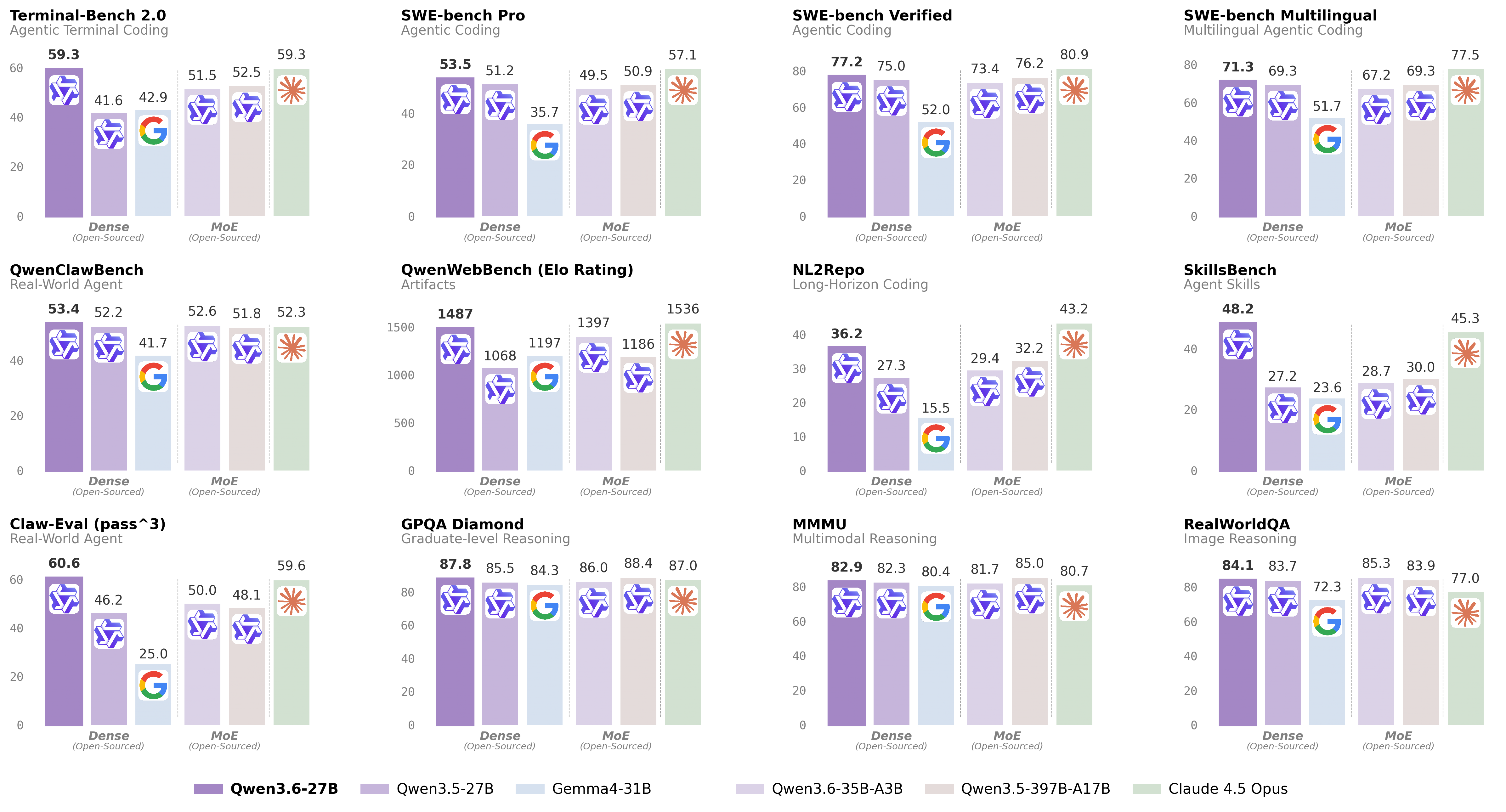
Capabilities are fully preserved. Abliteration removes refusal directions only — not reasoning, coding, or general intelligence.
Standard abliteration pipelines strip MTP tensors during the merge — there was no existing tool that preserved them. This required a custom multi-step process:
Downloadwangzhang/Qwen3.6-27B-abliterated BF16 safetensors — abliteration via two-pass orthogonal projection with Optuna TPE optimization (KL divergence 0.024)
Convert to GGUF Q8_0 using the llama.cpp converter
Graft the full blk.64 MTP block (15 tensors) from unsloth/Qwen3.6-27B-MTP-GGUF using a patched version of havenoammo's graft script
Three custom patches written to handle Qwen3.6's MTP tensor naming conventions and prevent duplicate KV metadata errors in the output GGUF
Quantize all tiers from the grafted Q8_0 using llama-quantize
Validate MTP activation in llama.cpp — confirmed draft acceptance rates above 90% across all context lengths tested
The three patches were the non-trivial part. Qwen3.6's tensor naming diverges from prior Qwen versions in ways that broke existing graft tooling. No existing public script handled this correctly at the time of release.
This model has had its safety guardrails removed at the weight level. It is intended for research, security testing, and unrestricted local inference. You are solely responsible for how you use it.