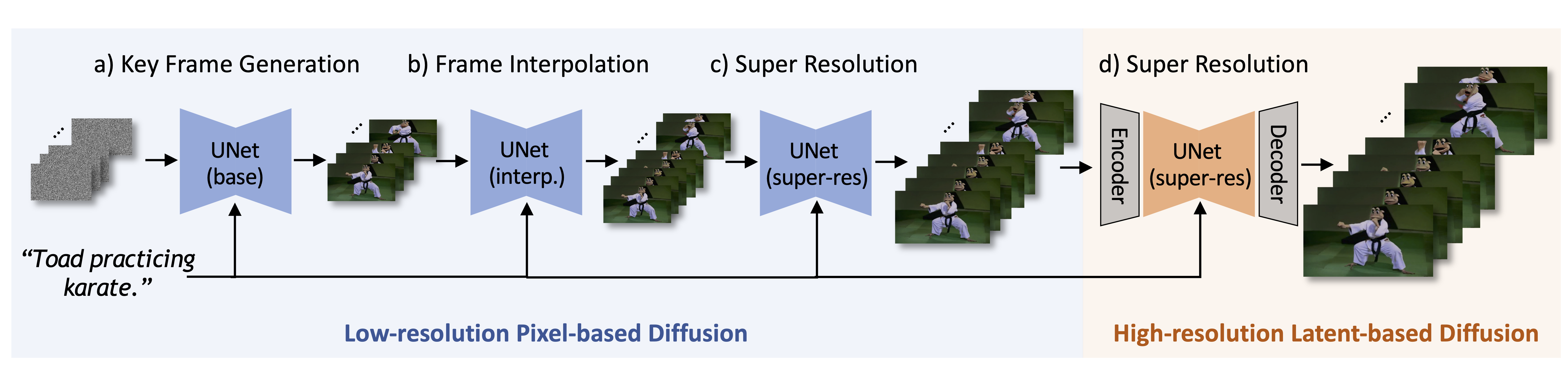
Pixel-based VDMs can generate motion accurately aligned with the textual prompt but typically demand expensive computational costs in terms of time and GPU memory, especially when generating high-resolution videos. Latent-based VDMs are more resource-efficient because they work in a reduced-dimension latent space. But it is challenging for such small latent space (e.g., 64×40 for 256×160 videos) to cover rich yet necessary visual semantic details as described by the textual prompt.
To marry the strength and alleviate the weakness of pixel-based and latent-based VDMs, we introduce Show-1, an efficient text-to-video model that generates videos of not only decent video-text alignment but also high visual quality.
This is the base model of Show-1 that generates videos with 8 keyframes at a resolution of 64x40. The model is finetuned from
DeepFloyd/IF-I-L-v1.0 on the
WebVid-10M dataset.
1git clone https://github.com/showlab/Show-1.git
2pip install -r requirements.txt
Run the following command to generate a video from a text prompt. By default, this will automatically download all the model weights from huggingface.
1git lfs install
2
3# base
4git clone https://huggingface.co/showlab/show-1-base
5# interp
6git clone https://huggingface.co/showlab/show-1-interpolation
7# sr1
8git clone https://huggingface.co/showlab/show-1-sr1
9# sr2
10git clone https://huggingface.co/showlab/show-1-sr2
11
If you make use of our work, please cite our paper.
1@misc{zhang2023show1,
2    title={Show-1: Marrying Pixel and Latent Diffusion Models for Text-to-Video Generation},
3    author={David Junhao Zhang and Jay Zhangjie Wu and Jia-Wei Liu and Rui Zhao and Lingmin Ran and Yuchao Gu and Difei Gao and Mike Zheng Shou},
4    year={2023},
5    eprint={2309.15818},
6    archivePrefix={arXiv},
7    primaryClass={cs.CV}
8}
This model card is maintained by
David Junhao Zhang and
Jay Zhangjie Wu. For any questions, please feel free to contact us or open an issue in the repository.