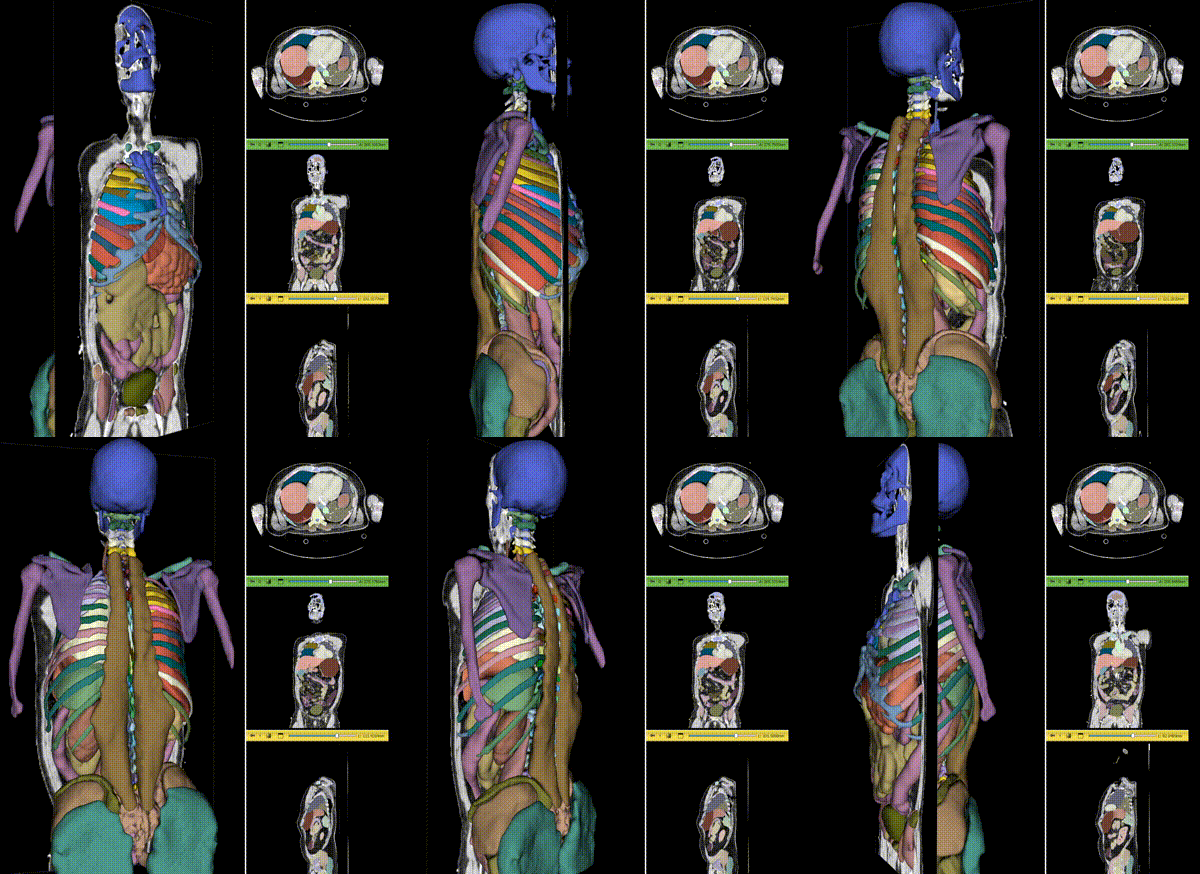
NV-Segment-CT is a specialized interactive foundation model for 3D medical imaging. It excels in providing accurate and adaptable segmentation analysis across anatomies and modalities. Utilizing a multi-head architecture, NV-Segment-CT adapts to varying conditions and anatomical areas, helping guide users' annotation workflow.
This model is for research purposes and not for clinical usage.
Training & Fine-tuning: Visit GitHub for training code, fine-tuning guides, continual learning examples, and comprehensive development documentation.
Core to NV-Segment-CT are three workflows:
Segment everything: Enables whole body exploration, crucial for understanding complex diseases affecting multiple organs and for holistic treatment planning.
Segment using class: Provides detailed sectional views based on specific classes, essential for targeted disease analysis or organ mapping, such as tumor identification in critical organs.
Segment point prompts: Enhances segmentation precision through user-directed, click-based selection. This interactive approach accelerates the creation of accurate ground-truth data, essential in medical imaging analysis.
For running the pipeline, NV-Segment-CT requires at least one prompt for segmentation. It supports label prompt, which is the index of the class for automatic segmentation. It also supports point-click prompts for binary interactive segmentation. Users can provide both prompts at the same time.
Here is a code snippet to showcase how to execute inference with this model.
The inputs must include the key image which contain the absolute path to the nii image file, and includes prompt keys of label_prompt, points and point_labels.
The label_prompt is a list of length B, which can perform B foreground objects segmentation, e.g. [2,3,4,5]. If B>1, Point prompts must NOT be provided.
The points is of shape [N, 3] like [[x1,y1,z1],[x2,y2,z2],...[xN,yN,zN]], representing N point coordinates IN THE ORIGINAL IMAGE SPACE of a single foreground object. point_labels is a list of length [N] like [1,1,0,-1,...], which
matches the points. 0 means background, 1 means foreground, -1 means ignoring this point. points and point_labels must pe provided together and match length.
B must be 1 if label_prompt and points are provided together. The inferer only supports SINGLE OBJECT point click segmentatation.
If no prompt is provided, the model will use everything_labels to segment 117 classes:
list(set([i+1 for i in range(132)]) - set([2,16,18,20,21,23,24,25,26,27,128,129,130,131,132]))
The points together with label_prompts for "Kidney", "Lung", "Bone" (class index [2, 20, 21]) are not allowed since those prompts will be divided into sub-categories (e.g. left kidney and right kidney). Use points for the sub-categories as defined in the inference.json.
To specify a new class for zero-shot segmentation, set the label_prompt to a value between 133 and 254. Ensure that points and point_labels are also provided; otherwise, the inference result will be a tensor of zeros.
NVIDIA believes Trustworthy AI is a shared responsibility and we have established policies and practices to enable development for a wide array of AI applications. When downloaded or used in accordance with our terms of service, developers should work with their internal model team to ensure this model meets requirements for the relevant industry and use case and addresses unforeseen product misuse. Please report security vulnerabilities or NVIDIA AI Concerns here.