In the wild, Q8_0 quantizations are fine, but Q4_0 quantizations are rarely pure e.g. the token embeddings are quantized with Q6_K, instead of Q4_0.
A pure Q4_0 quantization can be generated from a high precision (F32, F16, BFLOAT16) .gguf source with the llama-quantize utility from llama.cpp as follows:
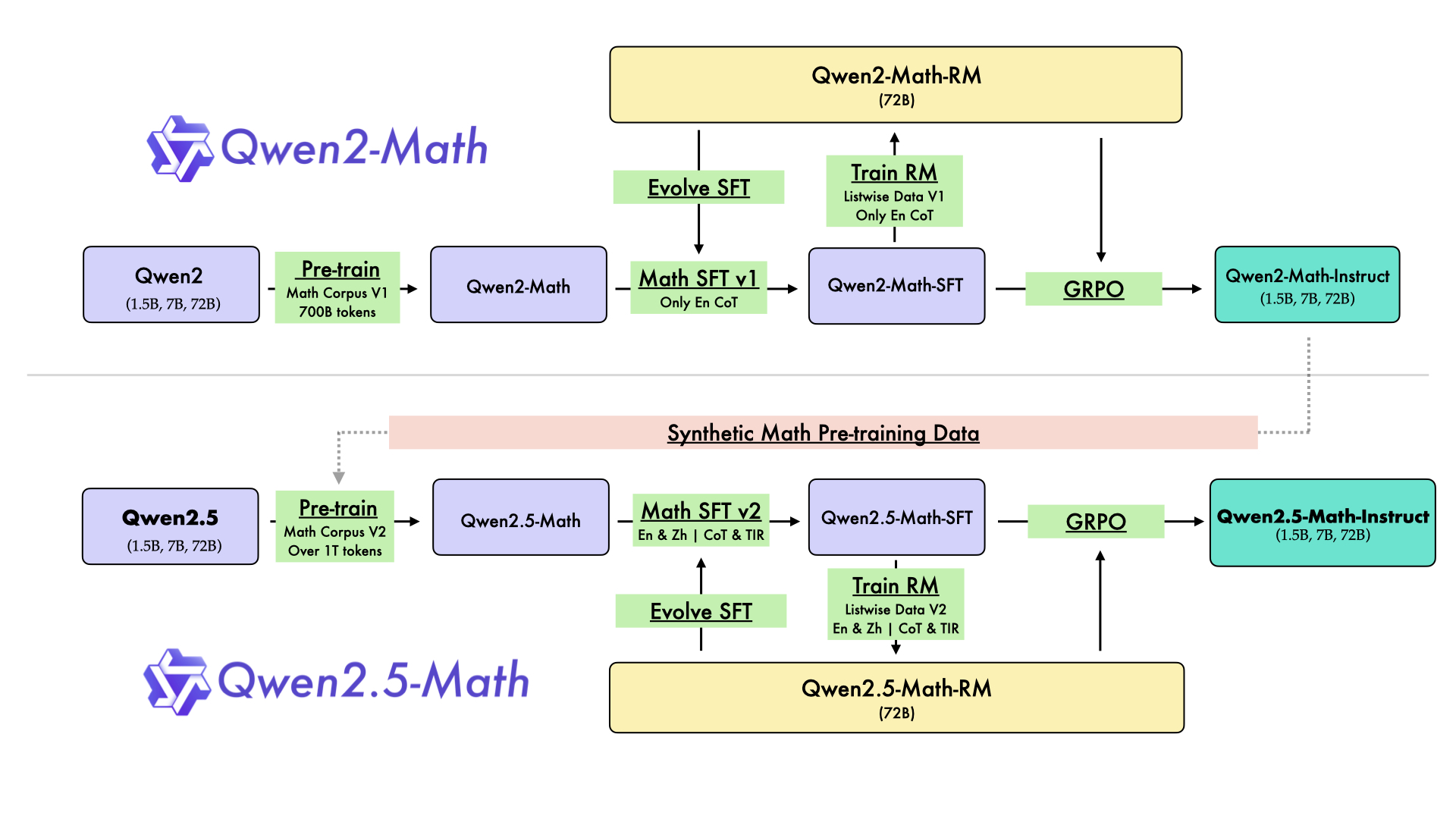
In August 2024, we released the first series of mathematical LLMs -
Qwen2-Math - of our Qwen family. A month later, we have upgraded it and open-sourced
Qwen2.5-Math series, including base models
Qwen2.5-Math-1.5B/7B/72B, instruction-tuned models
Qwen2.5-Math-1.5B/7B/72B-Instruct, and mathematical reward model
Qwen2.5-Math-RM-72B.
Unlike Qwen2-Math series which only supports using Chain-of-Thught (CoT) to solve English math problems, Qwen2.5-Math series is expanded to support using both CoT and Tool-integrated Reasoning (TIR) to solve math problems in both Chinese and English. The Qwen2.5-Math series models have achieved significant performance improvements compared to the Qwen2-Math series models on the Chinese and English mathematics benchmarks with CoT.
While CoT plays a vital role in enhancing the reasoning capabilities of LLMs, it faces challenges in achieving computational accuracy and handling complex mathematical or algorithmic reasoning tasks, such as finding the roots of a quadratic equation or computing the eigenvalues of a matrix. TIR can further improve the model's proficiency in precise computation, symbolic manipulation, and algorithmic manipulation. Qwen2.5-Math-1.5B/7B/72B-Instruct achieve 79.7, 85.3, and 87.8 respectively on the MATH benchmark using TIR.
For more details, please refer to our
blog post and
GitHub repo.