Ported from upstream commit
2769294,
pinned 2026-06-06.
Validated against the Transformers reference at transcribe.cpp commit
483c122
on 2026-06-06.
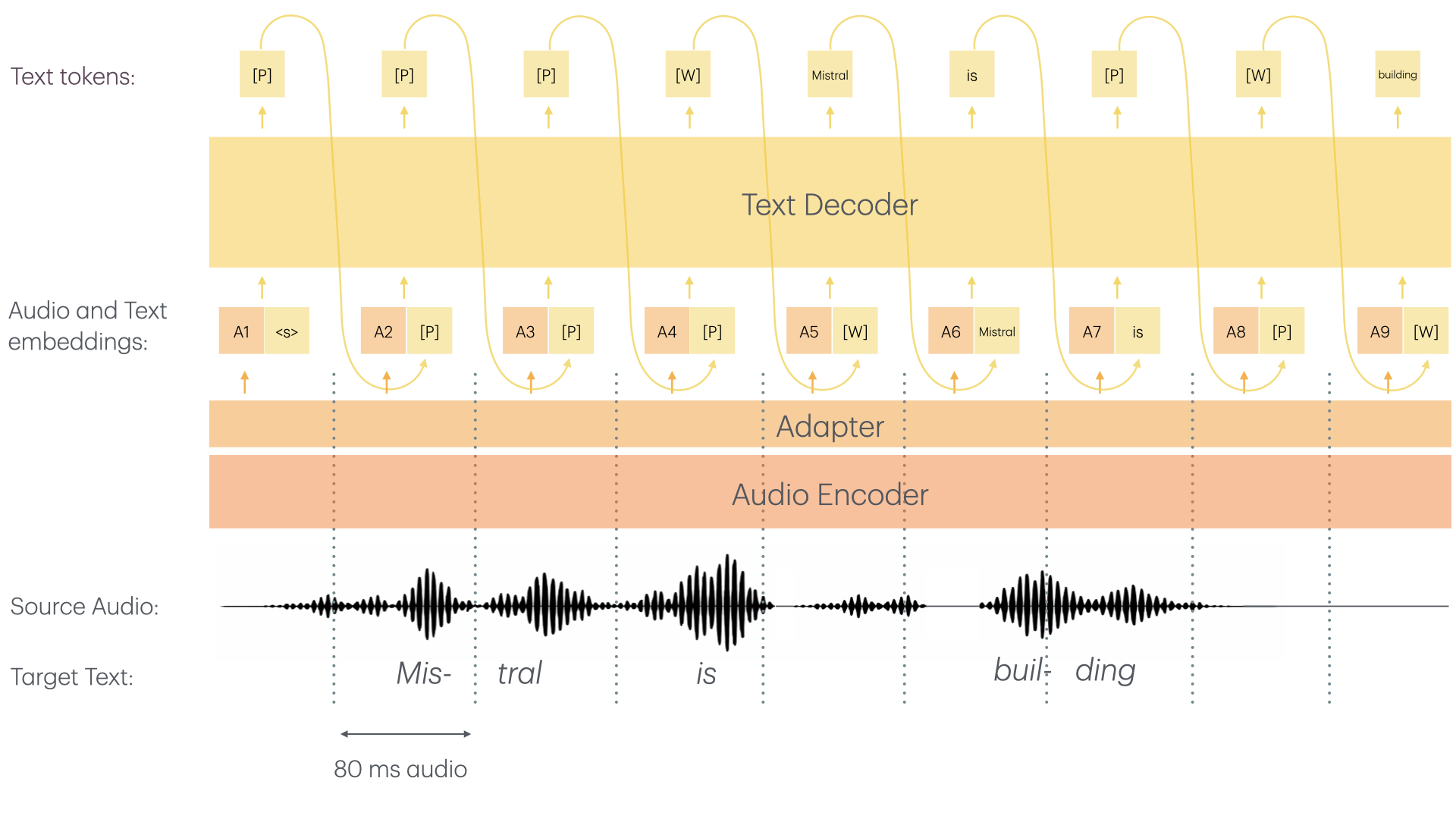
Streaming audio-LLM speech-to-text. A ~970M causal audio encoder (left-pad
causal conv stem + 32-layer sliding-window RoPE transformer) feeds a
4-frame-group projector whose audio embeddings are added onto a ~3.4B
Ministral decoder (26 layers, GQA 32/8, NEOX RoPE) with delay-token latency
conditioning, emitting one text token per 80 ms audio slot (12.5 Hz). Takes a
16 kHz mono WAV and supports both incremental streaming (configurable
latency/quality via --stream-chunk-ms and --stream-voxtral-delay) and offline
transcription with a byte-equal final transcript. Architecturally distinct
from the offline Voxtral 2507 family — own arch, streaming frontend, causal
encoder, additive audio fusion.
WER measured on the full LibriSpeech test-clean split (2620 utterances) with
the Whisper English text normalizer, offline path, batch size 8 on an NVIDIA
L40S. Same-machine HuggingFace transformers reference
(VoxtralRealtimeForConditionalGeneration, BF16, greedy): 2.08%; the BF16 GGUF
matches at 2.08%. Every shipped quant stays within bootstrap noise
(2.07-2.09%), so the quantization ladder is WER-neutral down to Q4_K_M. The
model is multilingual (13 languages, auto-detect); the published WER is
English only.
If your audio isn't already 16 kHz mono WAV, convert it first:
ffmpeg -i input.mp3 -ar 16000 -ac 1 output.wav
See the transcribe.cpp model page for performance
numbers, numerical validation, and reproduction steps.
License
Inherited from the base model: Apache-2.0. See the
upstream model card for full terms.
Original Model Card
The section below is reproduced from
mistralai/Voxtral-Mini-4B-Realtime-2602 at commit
2769294 for offline reference. The upstream card is the
authoritative source.
Voxtral Mini 4B Realtime 2602
Voxtral Mini 4B Realtime 2602 is a multilingual, realtime speech-transcription model and among the first open-source solutions to achieve accuracy comparable to offline systems with a delay of <500ms.
It supports 13 languages and outperforms existing open-source baselines across a range of tasks, making it ideal for applications like voice assistants and live subtitling.
Built with a natively streaming architecture and a custom causal audio encoder - it allows configurable transcription delays (240ms to 2.4s), enabling users to balance latency and accuracy based on their needs.
At a 480ms delay, it matches the performance of leading offline open-source transcription models, as well as realtime APIs.
As a 4B-parameter model, is optimized for on-device deployment, requiring minimal hardware resources.
It runs in realtime with on devices minimal hardware with throughput exceeding 12.5 tokens/second.
This model is released in BF16 under the Apache-2 license, ensuring flexibility for both research and commercial use.
The Voxtral Mini 4B Realtime model offers the following capabilities:
High-Quality Transcription: Transcribe audio to text with confidence.
Multilingual: Supports dozens of languages, making it perfect for multilingual transcription tasks.
Real-Time: Fast streaming ASR model, enabling real-time transcription use cases.
Configurable Transcription Delays: Customize the transcription delay to balance quality and latency, from 80ms to 2.4s.
Use Cases
Real-Time Transcription Purposes:
Private meeting transcriptions
Live subtitle creation
Real-time assistants with speech understanding
And more
Bringing real-time transcription capabilities to all.
Recommended Settings
We recommend deploying with the following best practices:
Always set the temperature to 0.0
A single text-token is worth 80ms. Hence, make sure to set your --max-model-len accordingly. To live-record a 1h meeting, you need to set --max-model-len >= 3600 / 0.8 = 45000.
In theory, you should be able to record with no limit; in practice, pre-allocations of RoPE parameters among other things limits --max-model-len.
For the best user experience, we recommend to simply instantiate vLLM with the default parameters which will automatically set a maximum model length of 131072 (~ca. 3h).
We strongly recommend using websockets to set up audio streaming sessions. For more info on how to do so, check Usage.
We recommend using a delay of 480ms as we found it to be the sweet spot of performance and low latency. If, however, you want to adapt the delay, you can change the "transcription_delay_ms": 480 parameter
in the tekken.json file to any multiple of 80ms between 80 and 1200, as well as 2400 as a standalone value.
Benchmark Results
We compare Voxtral Mini 4B Realtime to similar models - both offline models and realtime.
Voxtral Mini 4B Realtime is competitive to leading offline models and shows significant gains over existing open-source realtime solutions.
Fleurs
Model
Delay
AVG
Arabic
German
English
Spanish
French
Hindi
Italian
Dutch
Portuguese
Chinese
Japanese
Korean
Russian
Voxtral Mini Transcribe 2.0
Offline
5.90%
13.54%
3.54%
3.32%
2.63%
4.32%
10.33%
2.17%
4.78%
3.56%
7.30%
4.14%
12.29%
4.75%
Voxtral Mini 4B Realtime 2602
480 ms
8.72%
22.53%
6.19%
4.90%
3.31%
6.42%
12.88%
3.27%
7.07%
5.03%
10.45%
9.59%
15.74%
6.02%
160 ms
12.60%
24.33%
9.50%
6.46%
5.34%
9.75%
15.28%
5.59%
11.39%
10.01%
17.67%
19.17%
19.81%
9.53%
240 ms
10.80%
23.95%
8.15%
5.91%
4.59%
8.00%
14.26%
4.41%
9.23%
7.51%
13.84%
15.17%
17.56%
7.87%
960 ms
7.70%
20.32%
4.87%
4.34%
2.98%
5.68%
11.82%
2.46%
6.76%
4.57%
8.99%
6.80%
14.90%
5.56%
2400 ms
6.73%
14.71%
4.15%
4.05%
2.71%
5.23%
10.73%
2.37%
5.91%
3.93%
8.48%
5.50%
14.30%
5.41%
Long-form English
Model
Delay
Meanwhile (<10m)
E-21 (<10m)
E-22 (<10m)
TEDLIUM (<20m)
Voxtral Mini Transcribe 2.0
Offline
4.08%
9.81%
11.69%
2.86%
Voxtral Mini 4B Realtime 2602
480ms
5.05%
10.23%
12.30%
3.17%
Short-form English
Model
Delay
CHiME-4
GigaSpeech 2k Subset
AMI IHM
SwitchBoard
CHiME-4 SP
GISpeech 2k Subset
Voxtral Mini Transcribe 2.0
Offline
10.39%
6.81%
14.43%
11.54%
10.42%
1.74%
Voxtral Mini 4B Realtime 2602
480ms
10.50%
7.35%
15.05%
11.65%
12.41%
1.73%
Usage
The model can also be deployed with the following libraries:
[!Tip]
We've worked hand-in-hand with the vLLM team to have production-grade support for Voxtral Mini 4B Realtime 2602 with vLLM.
Special thanks goes out to Joshua Deng, Yu Luo, Chen Zhang, Nick Hill, Nicolò Lucchesi, Roger Wang, and Cyrus Leung
for the amazing work and help on building a production-ready audio streaming and realtime system in vLLM.
[!Warning]
Due to its novel architecture, Voxtral Realtime is currently only support in vLLM. We very much welcome community contributions
to add the architecture to Transformers and Llama.cpp.
We've worked hand-in-hand with the vLLM team to have production-grade support for Voxtral Mini 4B Realtime 2602 with vLLM.
vLLM's new Realtime API is perfectly suited to
run audio streaming sessions with the model.
Installation
Make sure to install vllm from the nightly pypi package.
See here for a full installation guide.
You can set --max-num-batched-tokens to balance throughput and latency, higher means higher throughput but higher latency.
You can reduce the default --max-model-len to allocate less memory for the pre-computed RoPE frequencies,
if you are certain that you won't have to transcribe for more than X hours. By default the model uses a --max-model-len of 131072 (> 3h).
Client
After serving vllm, you should see that the model is compatible with vllm's new realtime endpoint:
[!Warning]
Running Voxtral-Realtime on-device with ExecuTorch is not throughly tested and hence
there might be some sharp edges. If you encounter any problems, please file a bug report directly on
ExecuTorch's GitHub
ExecuTorch enables you to deploy Voxtral-Realtime locally—either on-device or on your laptop.
You must not use this model in a manner that infringes, misappropriates, or otherwise violates any third party’s rights, including intellectual property rights.