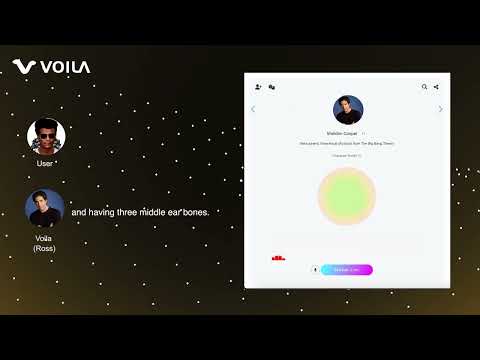
Voila is a new family of large voice-language foundation models aiming to lift human-AI interaction experiences to the next level. Breaking away from the constraints of traditional voice AI systems—high latency, loss of vocal nuances, and mechanical responses—Voila employs an innovative end-to-end model design and a novel hierarchical Transformer architecture. This approach enables real-time, autonomous, and rich voice interactions, with latency as low as 195 ms, surpassing average human response times. Combining advanced voice and language modeling, Voila offers customizable, persona-driven engagements and excels in a range of audio tasks from ASR and TTS to speech translation across six languages. With the online web demo, Voila invites you to explore a transformative, natural dialogue experience between human and AI.
We publish the following two datasets: Voila Benchmark and Voila Voice Library. Voila-Benchmark is a novel speech evaluation benchmark, while Voila Voice Library provides millions of pre-built and customizable voices.
We introduce a novel speech evaluation benchmark called the VoilaBenchmark. The Voila Benchmark is constructed by sampling from five widely used language model evaluation datasets: MMLU, MATH, OpenAI HumanEval, NQ-Open, and GSM8k. We compare our results with SpeechGPT and Moshi.
Model
Voila Benchmark
SpeechGPT
13.29
Moshi
11.45
Voila
30.56
(higher is better)
For detailed scores of Voila Benchmark on each specific domain, please refer to our paper (Section 5.1 "Evaluation of Voila Benchmark").
2. Evaluation of ASR
As Voila supports multiple tasks, including Automatic Speech Recognition (ASR), Text-to-Speech(TTS), and spoken question answering, we also evaluate the performance of ASR and TTS.
For ASR, we assess performance on the LibriSpeech test-clean dataset, using Word Error Rate (WER) as our metric. Voila attains a word error rate (WER) of 4.8%, outperforming the 5.7% reported by Moshi. In scenarios where both models utilize LibriSpeech training data, Voila achieves an impressive WER of 2.7%.
Model
LibriSpeech test-clean (WER)
Whisper large v2
2.7
Whisper large v3
2.2
FastConformer
3.6
VoxtLM
2.7
Moshi
5.7
Voila (w/o LibriSpeech train split)
4.8
Voila (with LibriSpeech train split)
2.7
(lower is better)
3. Evaluation of TTS
For TTS, we follow the evaluation metrics proposed in Vall-E, which involves transcribing the generated audio using HuBERT-Large.
Voila once again leads with a WER of 3.2% (and 2.8% when using LibriSpeech training data).
Model
LibriSpeech test-clean (WER)
YourTTS
7.7
Vall-E
5.9
Moshi
4.7
Voila (w/o LibriSpeech train split)
3.2
Voila (with LibriSpeech train split)
2.8
(lower is better)
📝 Citation
If you find our work helpful, please cite us.
@article{voila2025,
  author    = {Yemin Shi, Yu Shu, Siwei Dong, Guangyi Liu, Jaward Sesay, Jingwen Li, Zhiting Hu},
  title     = {Voila: Voice-Language Foundation Models for Real-Time Autonomous Interaction and Voice Roleplay},
  eprint={2505.02707},
  archivePrefix={arXiv},
  primaryClass={cs.CL},
  year      = {2025}
}