


Views
No views yet
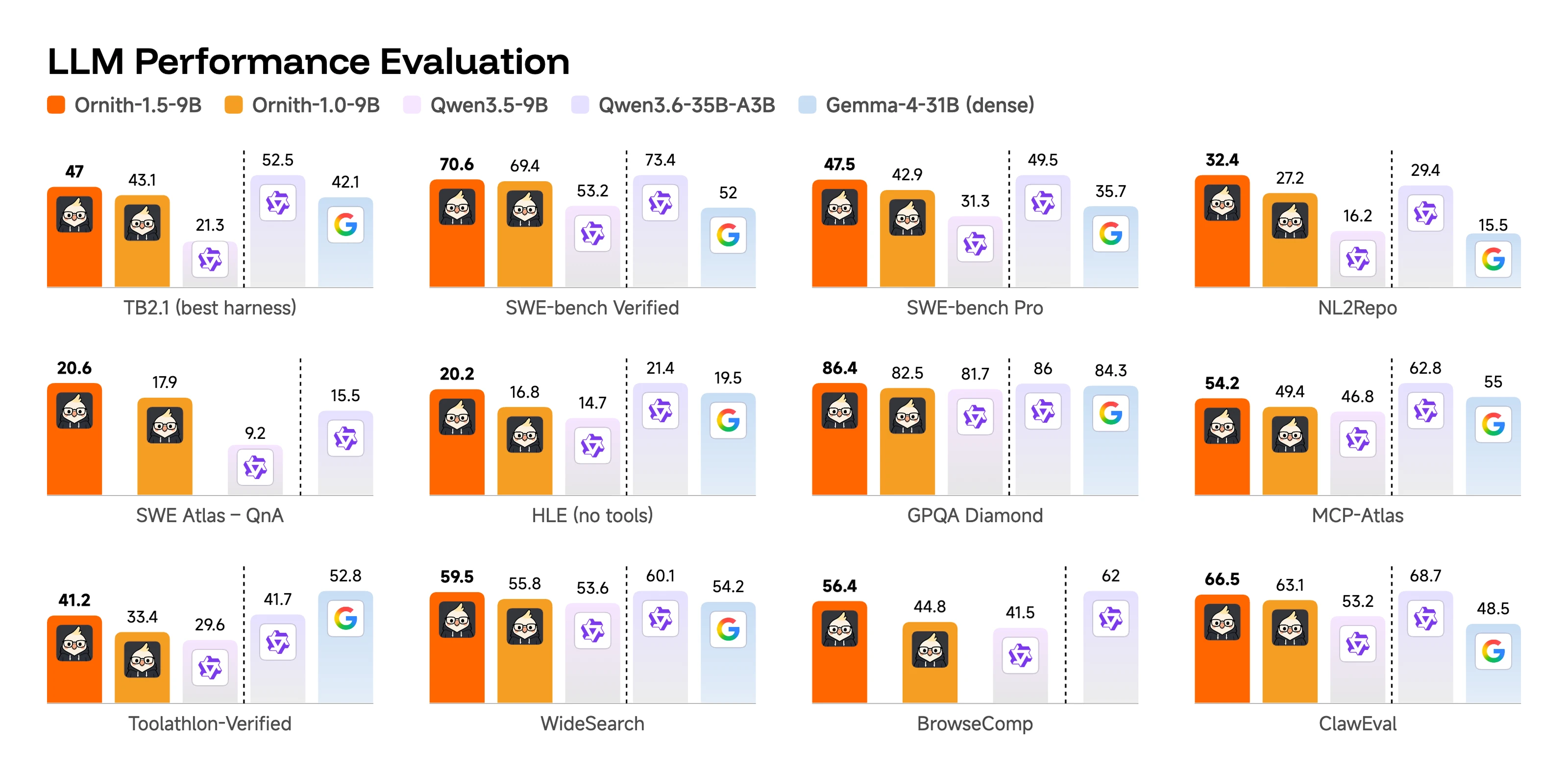
Ornith-1.5 extends the self-scaffolding framework introduced in Ornith-1.0 into a more complete self-improvement loop:
The model proposes new tasks, generates task-specific scaffolds, and produces solution rollouts for reinforcement learning, continuously creating new learning experiences from which it can improve.
[!TIP] Highly Recommended: Always keep reasoning/thinking enabled.
Ornith thoroughly plans and reasons through code edits before execution, ensuring an efficient and clean output.
Unlike baseline Qwen models, which frequently execute blindly and backtrack after generating broken code.
| Filename | Size | Quants |
|---|---|---|
| Ornith-1.5-9B-MXFP4_Q8_0_F16-Imatrix.gguf | 11.4 GB | MXFP4 + Q8_0 + F16 |
| Ornith-1.5-9B-MXFP4_Q8_0-Imatrix.gguf | 9.53 GB | MXFP4 + Q8_0 |
| Ornith-1.5-9B-MXFP4-Only-Imatrix.gguf | 4.77 GB | MXFP4 Only |
[!NOTE] TheMXFP4quantized layers include imatrix data, using this commit on-top of llama.cpp.
MXFP4) compress the backbone layers uniformly, which degrades the delicate reasoning capabilities of advanced agent models.MXFP4 + Q8_0 + F16)Ornith-1.5-9B-MXFP4_Q8_0_F16-Imatrix.gguf - Designed for maximum quality preservation, this layout implements a strict 3-Tier Precision Matrix:token_embd.weight, output.weight - Protects the critical input/output vocabulary mappings. Dramatically prevents text degradation.ssm_alpha, ssm_beta - Protects the integrity of the Mamba state-space calculations across long-range context tokens.ssm_out, *._shexp - Keeps the attention mechanics, and all trailing shared experts at high quality, to protect the logical research loops.ffn_down_exps, ffn_gate_exps, ffn_up_exps - Shrink the massive background expert parameters directly to MXFP4.MXFP4 + Q8_0)Ornith-1.5-9B-MXFP4_Q8_0-Imatrix.gguf - Designed for a slightly leaner memory profile, this layout utilizes 2-Tier Precision:Q8_0 format.MXFP4.MXFP4)Ornith-1.5-9B-MXFP4-Only-Imatrix.gguf - Using only MXFP4, this shrinks the model down to 4.77 GB. The quality is not the best, but it can still do decent work.MXFP4, for speed and a low VRAM footprint.llama-quantize utilizing the following manual recipe parameters:1# Requires python3.12, with `pip install --upgrade transformers`
2python convert_hf_to_gguf.py "Ornith-1.5-9B/" --outtype f16 --outfile "Ornith-1.5-9B_F16.gguf"1llama-quantize \
2 --tensor-type ".*_shexp\.weight=Q8_0" \
3 --tensor-type "token_embd\.weight=F16" \
4 --tensor-type "^output\.weight=F16" \
5 --tensor-type "blk\..*\.(ssm_alpha|ssm_beta)\.weight=F16" \
6 --tensor-type "blk\..*\.(ffn_down_exps|ffn_gate_exps|ffn_up_exps)\.weight=MXFP4" \
7 --imatrix "imatrix.gguf" \
8 "Ornith-1.5-9B_F16.gguf" \
9 "Ornith-1.5-9B-MXFP4_Q8_0_F16-Imatrix.gguf" \
10 Q8_01llama-quantize \
2 --tensor-type ".*_shexp\.weight=Q8_0" \
3 --tensor-type "blk\..*\.(ffn_down_exps|ffn_gate_exps|ffn_up_exps)\.weight=MXFP4" \
4 --imatrix "imatrix.gguf" \
5 "Ornith-1.5-9B_F16.gguf" \
6 "Ornith-1.5-9B-MXFP4_Q8_0-Imatrix.gguf" \
7 Q8_01llama-quantize \
2 --tensor-type ".*_shexp\.weight=MXFP4" \
3 --tensor-type "token_embd\.weight=MXFP4" \
4 --tensor-type "^output\.weight=MXFP4" \
5 --tensor-type "blk\..*\.(ssm_alpha|ssm_beta|ssm_out|attn_gate|attn_qkv|ffn_down|ffn_gate|ffn_up|attn_k|attn_q|attn_v|attn_output)\.weight=MXFP4" \
6 --tensor-type "blk\..*\.(ffn_down_exps|ffn_gate_exps|ffn_up_exps)\.weight=MXFP4" \
7 --imatrix "imatrix.gguf" \
8 "Ornith-1.5-9B_F16.gguf" \
9 "Ornith-1.5-9B-MXFP4-Only-Imatrix.gguf" \
10 MXFP4_MOEllama-server Configuration (config.ini)1# --- Samplers (Dynamic & Expressive) ---
2# Establishes the foundational pooling and filtering layers to balance creativity with logical precision.
3temperature = 0.60
4top-k = 35
5top-p = 0.93
6min-p = 0.10
7top-n-sigma = 0.60
8
9# --- Penalties (Prevent Syntax & Reasoner Corruption) ---
10# Excluded from the pipeline to protect recurring folder paths and directory prefixes from corruption.
11#repeat-penalty = 1.05
12#presence-penalty = 1.1
13
14# --- DRY Sampler (Protects Indentation & Structural Boilerplate) ---
15# Intelligently limits phrase duplication and structural looping without punishing syntax punctuation or code dividers.
16dry-multiplier = 0.8
17dry-base = 1.75
18dry-allowed-length = 3
19dry-penalty-last-n = 1024
20dry-sequence-breaker = [ "\n", "```\n", ":", "\t", "\"", "|", "-", "}", "]", "/", "\\" ]
21
22# --- Enforced Execution Graph ---
23# Clears the vast vocabulary tail early for speed and lets DRY safely block path duplication loops in a wide pool,
24# while temp prepares multi-token schemas so a late-stage Top-N-Sigma can slice out single-character spelling typos.
25samplers = top_k;top_p;min_p;dry;temp;top_n_sigma[!TIP] Accuracy Tips:
- Small amounts of details are mis-remembered during long context windows (>100k).
- Use
cache-type-k = f16as anything lower suffers from mis-remembered details (at any context size).- If you must use
q8_0for kv cache, or theMXFP4 + Q8_0or theMXFP4 Onlyvariants, try tweakingtop-n-sigmato increase accuracy.
[!NOTE] Compared to Ornith-1.0-9B, I have the values tuned for higher quality output.
1# --- Reasoning ---
2chat-template-kwargs = { "enable_thinking":true }
3reasoning = on
4reasoning-format = auto
5reasoning-budget = 32768256k context window.fit-ctx = 262144[!TIP] For Maximum Quality at 100k+ Context:
Use the MXFP4 + Q8_0 + F16 split-quantized version.
- Preserved at F16:
token_embd.weight,output.weight,*.ssm_alpha.weight, and*.ssm_beta.weight.- Why this matters: Keeping these critical layers at full precision prevents the model from dropping most of the fine details during extreme "needle-in-a-haystack" retrieval tasks (large context windows).
- What to avoid: If
output.weightor the embedding layers are quantized toQ8_0or lower, logit precision rounds off, causing the model to lose accuracy and forget specific details in long-context scenarios, more often.
top_n_sigma to the end.1slots = 1
2parallel = 1
3no-warmup = true
4
5flash-attn = on
6mlock = false
7no-mmap = true
8context-shift = false
9
10batch-size = 2048
11ubatch-size = 256
12
13fit = on
14fit-target = 1024
15cache-ram = 4096
16main-gpu = 0
17split-mode = layer
18n-gpu-layers = 999
19n-cpu-moe = 0
20tensor-split = 16,0
21override-tensor = (token_embd)=CUDA0,(vision|vpm|nextn)=CPU
22
23fit-ctx = 262144
24cache-type-k = q8_0
25cache-type-v = q8_0
26
27jinja = true
28chat-template = jinja
29chat-template-file = chat_template.jinja1context-shift = false
2cache-type-k = f16
3cache-type-v = f16Ornith-1.5 base model.1@misc{ornith_1_5,
2 title = {{Ornith-1.5}: From Self-Scaffolding to Self-Improvement},
3 url = {https://ornith.ai/ornith_1_5.html},
4 author = {{Ornith Team}},
5 year = {2026}
6}

