


Views
No views yet
Visual Question Answering for Autonomous Driving Dmytro Khursenko, Czech Technical University in Prague, Faculty of Electrical Engineering, 2026. Supervised by Ing. David Hurych, Ph.D. (Valeo) and doc. Georgios Tolias, Ph.D. (CTU FEE).
📄 Thesis PDF expected by end of June 2026, following successful defense (CTU FEE).
This checkpoint contains fully merged weights — the LoRA adapter is already merged into the base model. Load and use it directly withAutoModel.Note: to reproduce the oracle results, pass annotated test images (GT bounding boxes rendered as red circles + class labels + dimmed background) as input. Using plain images will give the same results as the LoRA-25k baseline (Final 0.560).
| Model | HF repo | Final |
|---|---|---|
| LoRA-25k | dkhursen/InternVL2-2b-LoRA-25k-drivelm | 0.560 |
| LoRA-300k | dkhursen/InternVL2-2b-LoRA-300k-drivelm | 0.493 |
| LoRA-25k + DL-PL 10% ⭐ | dkhursen/InternVL2-2b-LoRA-25k_plus_DL-PL-10pct | 0.589 |
| LoRA-25k + Oracle annotation (this model) | dkhursen/InternVL2-2b-LoRA-25k-drivelm-offline-redcircle-ctag-bkgd | 0.775 |
| Metric | Score |
|---|---|
| Final | 0.775 |
| Accuracy | 0.853 |
| ChatGPT | 0.725 |
| Language | 0.779 |
| BLEU-1 | 0.908 |
| BLEU-2 | 0.879 |
| BLEU-3 | 0.849 |
| BLEU-4 | 0.819 |
| ROUGE-L | 0.891 |
| CIDEr | 5.817 |
| Match | 0.793 |
| Coord | 0.758 |
Score definitions (all table values normalised to [0, 1])
- Accuracy — exact-match on MCQ (A/B/C/D) and Yes/No questions; strict letter-only format required
- Language — mean of BLEU-1–4, ROUGE-L, and CIDEr/10
- ChatGPT — GPT-3.5-turbo semantic similarity judge (0–100 scale, ÷100 in Final)
- Match —
(F1_coord × 100 + GPT_match) / 2on prediction answers (0–100 scale, ÷100 in Final); blends spatial coordinate F1 with a GPT judge- Coord — pure coordinate token F1 at L1 < 16 px; diagnostic only, not included in Final
- Final —
0.4 × (GPT/100) + 0.2 × Language + 0.2 × (Match/100) + 0.2 × AccuracyFull metric breakdown: evaluation/README.md
Note on evaluation scope. All scores are measured on the custom i.i.d. local test split (3,340 QA pairs) using the local DriveLM evaluation script. The official DriveLM evaluation server was not used as the primary reporting source: it returns only aggregate scores without per-metric breakdown, the infrastructure was intermittently unreliable (model output parsing errors could not be diagnosed directly — only via GitHub issues), and ChatGPT/Match metrics depend on OpenAI API calls that fail when the API quota for the billing period is exhausted.
| Visual Annotation | Final | Acc | ChatGPT | Lang | Match | Coord |
|---|---|---|---|---|---|---|
| None (raw image) | 0.560 | 0.826 | 0.589 | 0.459 | 0.338 | 0.015 |
| Red BBox + CTags + Bkgd | 0.772 | 0.848 | 0.726 | 0.827 | 0.778 | 0.740 |
| Red BBox + CTags | 0.655 | 0.832 | 0.684 | 0.589 | 0.568 | 0.393 |
| Red BBox | 0.634 | 0.743 | 0.740 | 0.741 | 0.419 | 0.112 |
| Red Circle + CTags + Bkgd (this checkpoint) | 0.775 | 0.853 | 0.725 | 0.779 | 0.793 | 0.758 |
| Red Circle + CTags | 0.624 | 0.727 | 0.728 | 0.695 | 0.430 | 0.141 |
| Red Circle | 0.646 | 0.793 | 0.729 | 0.761 | 0.443 | 0.158 |
| Red Midpoint + CTags + Bkgd | 0.771 | 0.858 | 0.716 | 0.826 | 0.780 | 0.736 |
| Red Midpoint + CTags | 0.757 | 0.862 | 0.724 | 0.785 | 0.742 | 0.677 |
| Red Midpoint | 0.653 | 0.799 | 0.735 | 0.746 | 0.463 | 0.199 |
| Model | Final | Acc | ChatGPT | Lang | B1 | B2 | B3 | B4 | RL | CIDEr | Match | Coord |
|---|---|---|---|---|---|---|---|---|---|---|---|---|
| Mini-DA† | 0.606 | 0.898 | 0.668 | 0.416 | 0.596 | 0.564 | 0.533 | 0.503 | 0.651 | 0.470 | 0.381 | 0.000 |
| LoRA-25k (base of this model) | 0.560 | 0.826 | 0.589 | 0.459 | 0.732 | 0.668 | 0.606 | 0.547 | 0.714 | 0.230 | 0.338 | 0.015 |
| LoRA-25k + DL-PL 10% | 0.589 | 0.836 | 0.676 | 0.451 | 0.719 | 0.654 | 0.589 | 0.525 | 0.710 | 0.222 | 0.304 | 0.013 |
| LoRA-25k + DL-PL 30% | 0.548 | 0.832 | 0.605 | 0.434 | 0.695 | 0.625 | 0.554 | 0.483 | 0.692 | 0.201 | 0.264 | 0.008 |
| LoRA-25k + DL-PL 50% | 0.532 | 0.832 | 0.584 | 0.433 | 0.691 | 0.622 | 0.551 | 0.481 | 0.699 | 0.171 | 0.230 | 0.007 |
| LoRA-25k + DL-PL 100% | 0.511 | 0.805 | 0.544 | 0.430 | 0.687 | 0.616 | 0.543 | 0.470 | 0.695 | 0.165 | 0.232 | 0.007 |
| LoRA-300k | 0.493 | 0.339 | 0.706 | 0.412 | 0.607 | 0.552 | 0.501 | 0.452 | 0.676 | 0.323 | 0.303 | 0.006 |
| Without annotation | With Red Circle + CTags + Background |
|---|---|
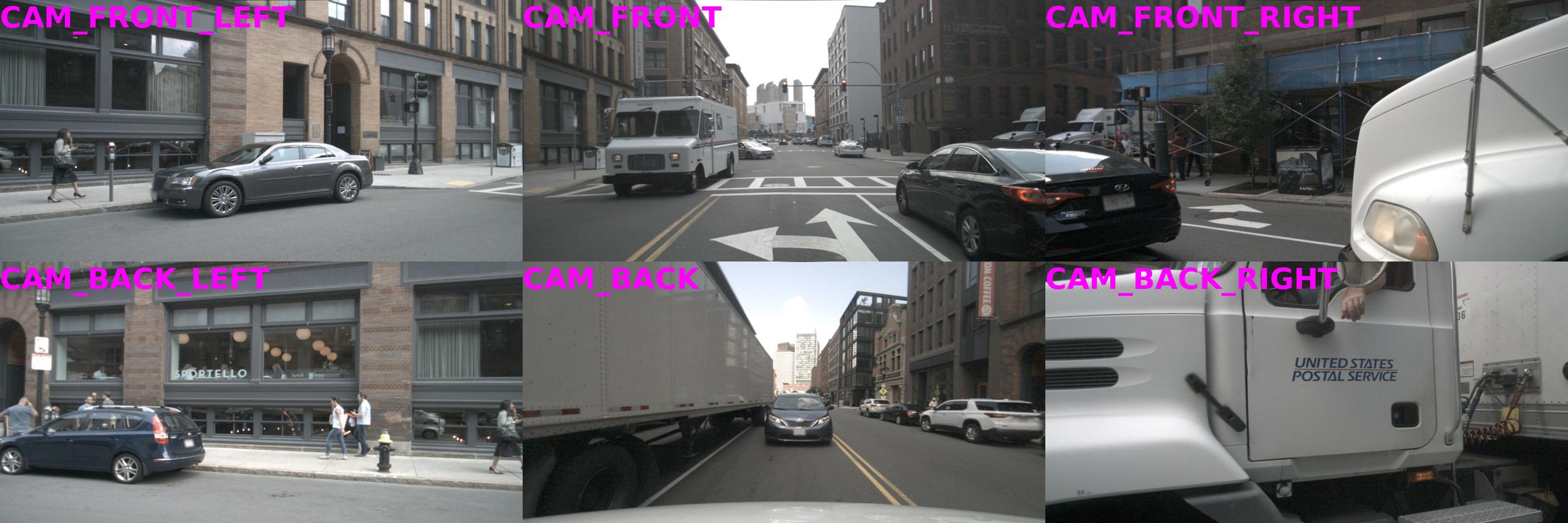 | 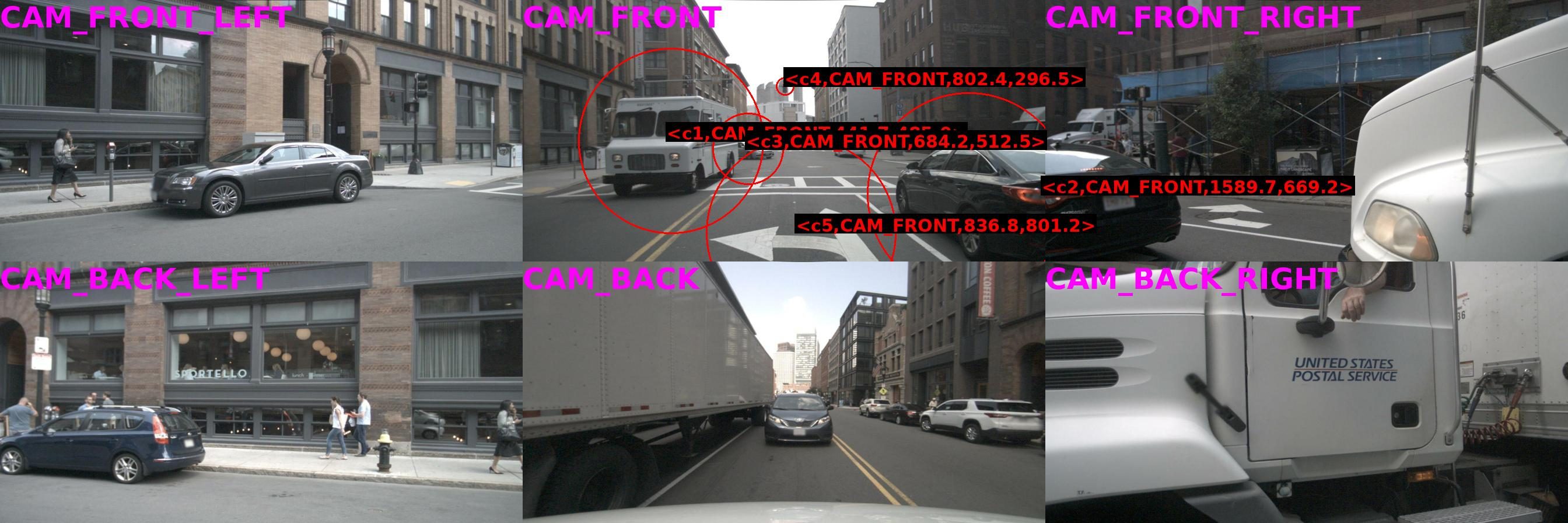 |
| Metric | Raw image (LoRA-25k) | + Red Circle + CTags + Background |
|---|---|---|
| Final | 0.560 | 0.775 |
| Accuracy | 0.826 | 0.853 |
| ChatGPT | 0.589 | 0.725 |
| Language | 0.459 | 0.779 |
| Match | 0.338 | 0.793 |
| Coord | 0.015 | 0.758 |
dkhursen/InternVL2-2b-LoRA-25k-drivelm. The difference is at inference time only: the test images include ground-truth visual annotations.| Parameter | Value |
|---|---|
| Base model | OpenGVLab/InternVL2-2B |
| Fine-tuning method | LoRA (merged into weights in this checkpoint) |
| LoRA rank | 16 |
| LoRA alpha | 32 |
| LoRA dropout | 0.05 |
| LoRA target modules | all linear layers in the LLM (backbone and MLP frozen) |
| Learning rate | 4e-5 (cosine, warmup 0.03) |
| Effective batch size | 64 (8 GPU × 4 × grad-acc 2) |
| Epochs | 10 |
| Max sequence length | 8192 |
| Precision | bfloat16 |
| Hardware | 8 × NVIDIA A100 40 GB |
configs/finetune/internvl2_2b_lora.yaml1import torch
2from PIL import Image
3from transformers import AutoTokenizer, AutoModel
4import torchvision.transforms as T
5from torchvision.transforms.functional import InterpolationMode
6
7MODEL_ID = "dkhursen/InternVL2-2b-LoRA-25k-drivelm-offline-redcircle-ctag-bkgd"
8# For oracle results: pass a test image with GT bounding boxes rendered as
9# red circles + class-name labels + dimmed background.
10# For standard use: any plain driving scene image works (results = LoRA-25k baseline).
11IMAGE_PATH = "path/to/annotated_scene.jpg"
12QUESTION = "<image>\nWhat are the important objects in the current scene? Those objects will be considered for the future reasoning and driving decision."
13
14IMAGENET_MEAN = (0.485, 0.456, 0.406)
15IMAGENET_STD = (0.229, 0.224, 0.225)
16
17
18def build_transform(input_size):
19 return T.Compose([
20 T.Lambda(lambda img: img.convert("RGB") if img.mode != "RGB" else img),
21 T.Resize((input_size, input_size), interpolation=InterpolationMode.BICUBIC),
22 T.ToTensor(),
23 T.Normalize(mean=IMAGENET_MEAN, std=IMAGENET_STD),
24 ])
25
26
27def find_closest_aspect_ratio(aspect_ratio, target_ratios, width, height, image_size):
28 best_ratio_diff = float("inf")
29 best_ratio = (1, 1)
30 area = width * height
31 for ratio in target_ratios:
32 ratio_diff = abs(aspect_ratio - ratio[0] / ratio[1])
33 if ratio_diff < best_ratio_diff:
34 best_ratio_diff = ratio_diff
35 best_ratio = ratio
36 elif ratio_diff == best_ratio_diff:
37 if area > 0.5 * image_size * image_size * ratio[0] * ratio[1]:
38 best_ratio = ratio
39 return best_ratio
40
41
42def dynamic_preprocess(image, min_num=1, max_num=12, image_size=448, use_thumbnail=False):
43 orig_width, orig_height = image.size
44 aspect_ratio = orig_width / orig_height
45 target_ratios = sorted(
46 {(i, j)
47 for n in range(min_num, max_num + 1)
48 for i in range(1, n + 1)
49 for j in range(1, n + 1)
50 if min_num <= i * j <= max_num},
51 key=lambda x: x[0] * x[1],
52 )
53 best_ratio = find_closest_aspect_ratio(
54 aspect_ratio, target_ratios, orig_width, orig_height, image_size
55 )
56 target_w = image_size * best_ratio[0]
57 target_h = image_size * best_ratio[1]
58 cols = best_ratio[0]
59 resized = image.resize((target_w, target_h))
60 tiles = []
61 for i in range(best_ratio[0] * best_ratio[1]):
62 col = i % cols
63 row = i // cols
64 box = (col * image_size, row * image_size,
65 (col + 1) * image_size, (row + 1) * image_size)
66 tiles.append(resized.crop(box))
67 if use_thumbnail and len(tiles) != 1:
68 tiles.append(image.resize((image_size, image_size)))
69 return tiles
70
71
72def load_image(image_path, input_size=448, max_num=12):
73 image = Image.open(image_path).convert("RGB")
74 transform = build_transform(input_size)
75 tiles = dynamic_preprocess(image, image_size=input_size, use_thumbnail=True, max_num=max_num)
76 return torch.stack([transform(tile) for tile in tiles])
77
78
79tokenizer = AutoTokenizer.from_pretrained(MODEL_ID, trust_remote_code=True, use_fast=False)
80model = AutoModel.from_pretrained(
81 MODEL_ID,
82 torch_dtype=torch.bfloat16,
83 low_cpu_mem_usage=True,
84 trust_remote_code=True,
85).eval().cuda()
86
87pixel_values = load_image(IMAGE_PATH, max_num=12).to(torch.bfloat16).cuda()
88generation_config = {"max_new_tokens": 512, "do_sample": False}
89
90response = model.chat(tokenizer, pixel_values, QUESTION, generation_config)
91print("Answer:", response)1git clone https://github.com/dmitrykhursen/VQA-AD-CTU
2cd VQA-AD-CTU
3bash scripts/setup_env.sh && source vqa-ad-ctu-env/bin/activate
4
5# Run inference (edit MODEL= inside the script; use annotated images path for IMAGES_ROOT)
6sbatch scripts/05_inference.sh
7
8# Evaluate
9bash scripts/06_evaluate.sh inference/outputs/<MODEL>/local_test.json| Resource | Link |
|---|---|
| Code & scripts | github.com/dmitrykhursen/VQA-AD-CTU |
| Demo gallery | dmitrykhursen.github.io/VQA-AD-CTU |
| Pseudo-label dataset | dkhursen/drivelm-pseudo-labels |
| Best online checkpoint | dkhursen/InternVL2-2b-LoRA-25k_plus_DL-PL-10pct |
| Base model | OpenGVLab/InternVL2-2B |
| DriveLM benchmark | github.com/OpenDriveLab/DriveLM |
| nuScenes dataset | nuscenes.org |
1@mastersthesis{khursenko2026vqa,
2  author     = {Khursenko, Dmytro},
3  title      = {Visual Question Answering for Autonomous Driving},
4  school     = {Czech Technical University in Prague, Faculty of Electrical Engineering},
5  year       = {2026},
6  supervisor = {Hurych, David and Tolias, Georgios}
7}1@inproceedings{sima2024drivelm,
2 title = {DriveLM: Driving with Graph Visual Question Answering},
3 author = {Sima, Chonghao and Renz, Katrin and Chitta, Kashyap and others},
4 booktitle = {European Conference on Computer Vision (ECCV)},
5 year = {2024}
6}