paligemma-3b-ft-tablevqa-896-lora is a fine-tuned version of the google/paligemma-3b-ft-docvqa-896 model,
trained specifically on the table-vqa dataset published by Crédit Mutuel Arkéa. This model leverages the
LoRA (Low-Rank Adaptation) technique, which significantly reduces the computational complexity of fine-tuning while maintaining high performance. The model operates
in bfloat16 precision for efficiency, making it an ideal solution for resource-constrained environments.
This model is designed for multilingual environments (French and English) and excels in table-based visual question-answering (VQA) tasks. It is highly suitable for
extracting information from tables in documents, making it a strong candidate for applications in financial reporting, data analysis, or administrative document processing.
The model was fine-tuned over a span of 7 days using a single A100 40GB GPU.
Key Features
Language: Multilingual capabilities, optimized for French and English.
Model Type: Multi-modal (image-text-to-text).
Precision: bfloat16 for resource efficiency.
Training Duration: 7 days on A100 40GB GPU.
Fine-Tuning Method: LoRA (Low-Rank Adaptation).
Domain: Table-based visual question answering.
Model Architecture
This model was built on top of google/paligemma-3b-ft-docvqa-896, using its pre-trained multi-modal
capabilities to process both text and images (e.g., document tables). LoRA was applied to reduce the size and complexity of fine-tuning while preserving accuracy,
allowing the model to excel in specific tasks such as table understanding and VQA.
Usage
You can use this model for visual question answering with table-based data by following the steps below:
python
1from transformers import AutoProcessor, PaliGemmaForConditionalGeneration
2from PIL import Image
3import requests
4import torch
5device ="cuda"if torch.cuda.is_available()else"cpu"67model_id ="cmarkea/paligemma-3b-ft-tablevqa-896-lora"89# Sample image for inference10url ="https://datasets-server.huggingface.co/cached-assets/cmarkea/table-vqa/--/c26968da3346f92ab6bfc5fec85592f8250e23f5/--/default/train/22/image/image.jpg?Expires=1728915081&Signature=Zkrd9ZWt5b9XtY0UFrgfrTuqo58DHWIJ00ZwXAymmL-mrwqnWWmiwUPelYOOjPZZdlP7gAvt96M1PKeg9a2TFm7hDrnnRAEO~W89li~AKU2apA81M6AZgwMCxc2A0xBe6rnCPQumiCGD7IsFnFVwcxkgMQXyNEL7bEem6cT0Cief9DkURUDCC-kheQY1hhkiqLLUt3ITs6o2KwPdW97EAQ0~VBK1cERgABKXnzPfAImnvjw7L-5ZXCcMJLrvuxwgOQ~DYPs456ZVxQLbTxuDwlxvNbpSKoqoAQv0CskuQwTFCq2b5MOkCCp9zoqYJxhUhJ-aI3lhyIAjmnsL4bhe6A__&Key-Pair-Id=K3EI6M078Z3AC3"11image = Image.open(requests.get(url, stream=True).raw)1213# Load the fine-tuned model and processor14model = PaliGemmaForConditionalGeneration.from_pretrained(15 model_id,16 torch_dtype=torch.bfloat16,17 device_map=device,18).eval()1920processor = AutoProcessor.from_pretrained("google/paligemma-3b-ft-docvqa-896")2122# Input prompt for table VQA23prompt ="How many rows are in this table?"24model_inputs = processor(text=prompt, images=image, return_tensors="pt").to(model.device)2526# Generate the answer27input_len = model_inputs["input_ids"].shape[-1]28with torch.inference_mode():29 generation = model.generate(**model_inputs, max_new_tokens=100, do_sample=False)30 generation = generation[0][input_len:]31 decoded = processor.decode(generation, skip_special_tokens=True)32print(decoded)
Performance
The model's performance was evaluated on 200 question-answer pairs, extracted from 100 tables from the test set of the
table-vqa dataset. For each table, two pairs were selected: one in French and the other in English.
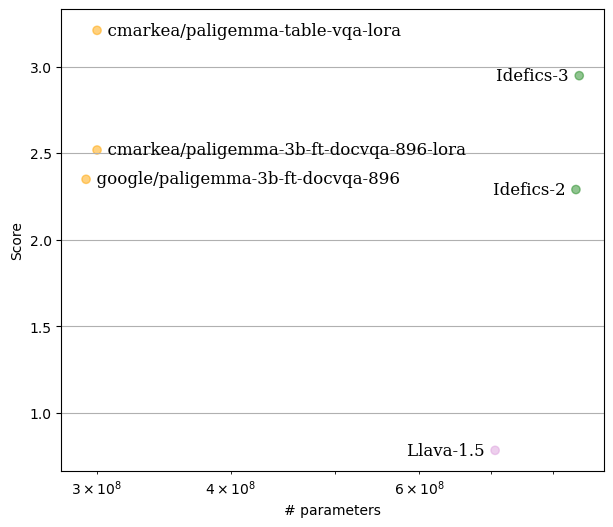
To evaluate the model’s responses, the LLM-as-Juries framework was employed using three judge models (GPT-4o, Gemini1.5 Pro,
and Claude 3.5-Sonnet). The evaluation was based on a scale from 0 to 5, tailored to the VQA context, ensuring accurate judgment of the model’s performance.
Here’s a visualization of the results:
constellation
In comparison, this model outperforms HuggingFaceM4/Idefics3-8B-Llama3 in terms of accuracy and efficiency,
despite having a smaller parameter size.