


Views
No views yet
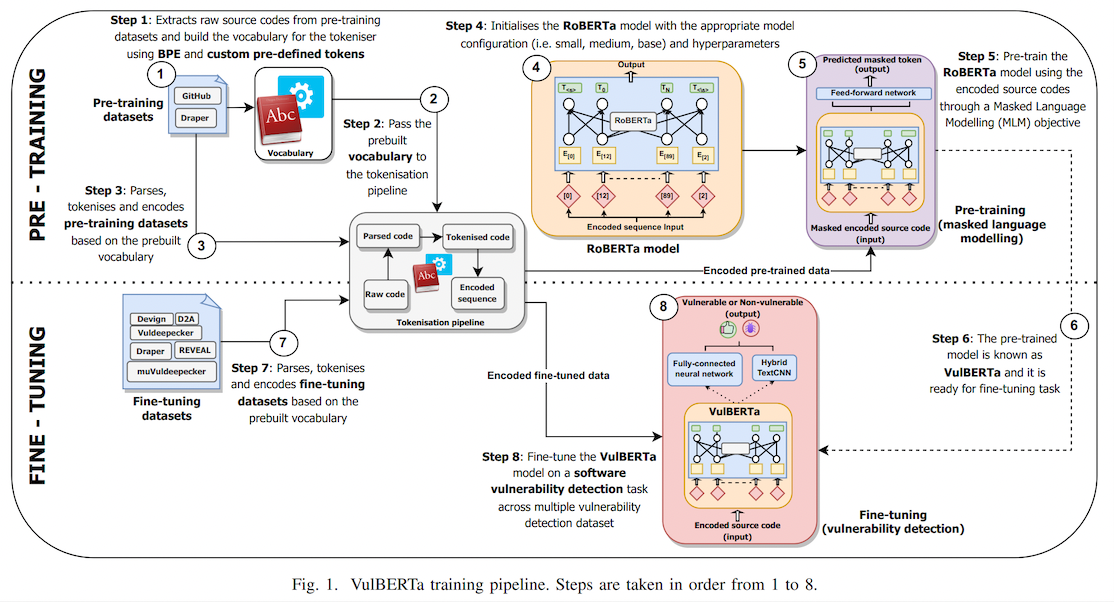
This paper presents presents VulBERTa, a deep learning approach to detect security vulnerabilities in source code. Our approach pre-trains a RoBERTa model with a custom tokenisation pipeline on real-world code from open-source C/C++ projects. The model learns a deep knowledge representation of the code syntax and semantics, which we leverage to train vulnerability detection classifiers. We evaluate our approach on binary and multi-class vulnerability detection tasks across several datasets (Vuldeepecker, Draper, REVEAL and muVuldeepecker) and benchmarks (CodeXGLUE and D2A). The evaluation results show that VulBERTa achieves state-of-the-art performance and outperforms existing approaches across different datasets, despite its conceptual simplicity, and limited cost in terms of size of training data and number of model parameters.
pip install libclangtrust_remote_code=True when instantiating the model.
Example:from transformers import pipeline
pipe = pipeline("text-classification", model="claudios/VulBERTa-MLP-Devign", trust_remote_code=True, return_all_scores=True)
pipe("static void filter_mirror_setup(NetFilterState *nf, Error **errp)\n{\n MirrorState *s = FILTER_MIRROR(nf);\n Chardev *chr;\n chr = qemu_chr_find(s->outdev);\n if (chr == NULL) {\n error_set(errp, ERROR_CLASS_DEVICE_NOT_FOUND,\n \"Device '%s' not found\", s->outdev);\n qemu_chr_fe_init(&s->chr_out, chr, errp);")
>> [[{'label': 'LABEL_0', 'score': 0.014685827307403088},
{'label': 'LABEL_1', 'score': 0.985314130783081}]]1@INPROCEEDINGS{hanif2022vulberta,
2 author={Hanif, Hazim and Maffeis, Sergio},
3 booktitle={2022 International Joint Conference on Neural Networks (IJCNN)},
4 title={VulBERTa: Simplified Source Code Pre-Training for Vulnerability Detection},
5 year={2022},
6 volume={},
7 number={},
8 pages={1-8},
9 doi={10.1109/IJCNN55064.2022.9892280}
10
11}