


Views
No views yet
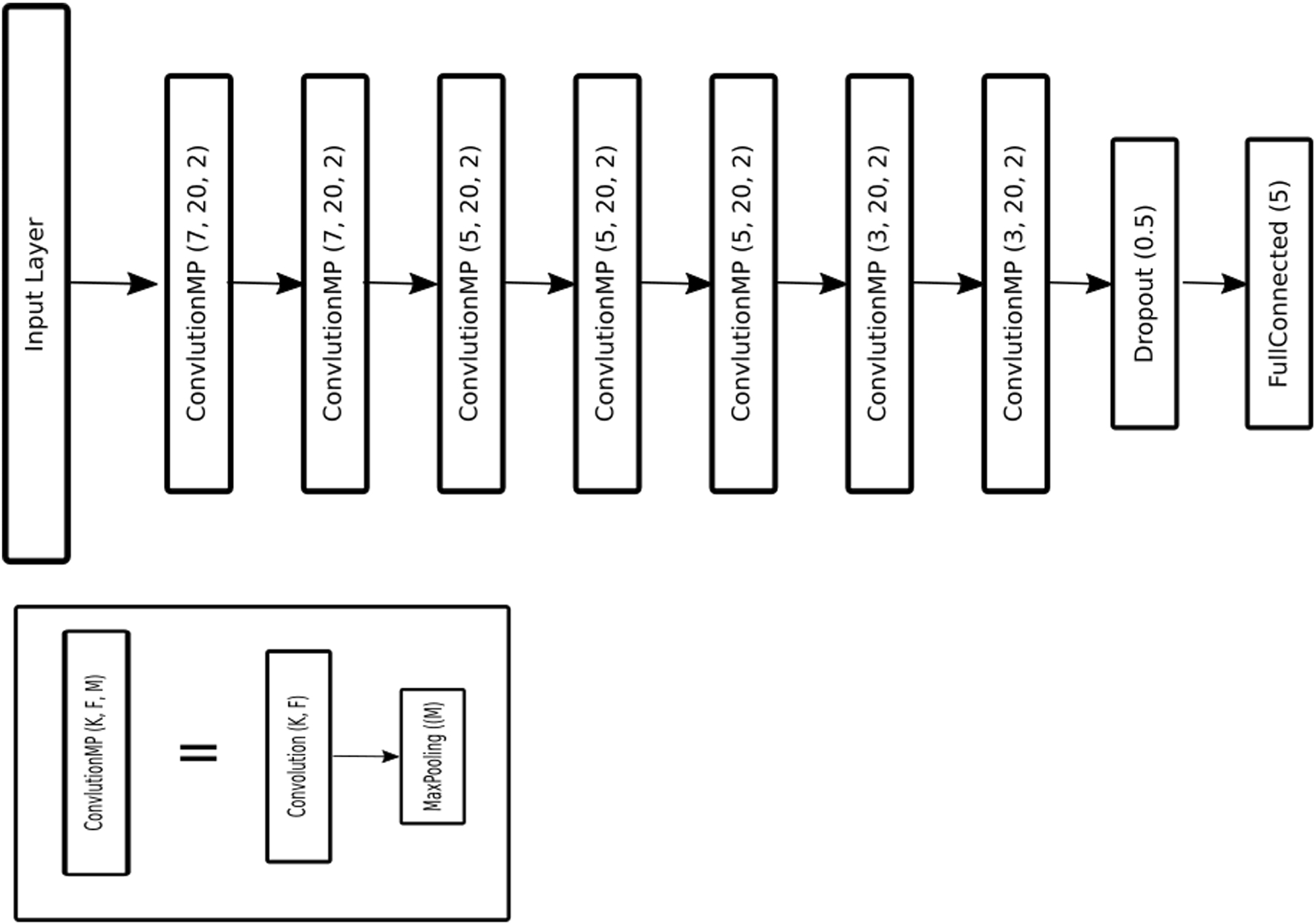
Architecture-only repository. Documents thebraindecode.models.SleepStagerBlanco2020class. No pretrained weights are distributed here. Instantiate the model and train it on your own data.
pip install braindecode1from braindecode.models import SleepStagerBlanco2020
2
3model = SleepStagerBlanco2020(
4 n_chans=2,
5 sfreq=100,
6 input_window_seconds=30.0,
7 n_outputs=5,
8)
| Parameter | Type | Description |
|---|---|---|
n_conv_chans | int | Number of convolutional channels. Set to 20 in [Blanco2020]. |
n_groups | int | Number of groups for the convolution. Set to 2 in [Blanco2020] for 2 Channel EEG. controls the connections between inputs and outputs. n_channels and n_conv_chans must be divisible by n_groups. |
drop_prob | float | Dropout rate before the output dense layer. |
apply_batch_norm | bool | If True, apply batch normalization after both temporal convolutional layers. |
return_feats | bool | If True, return the features, i.e. the output of the feature extractor (before the final linear layer). If False, pass the features through the final linear layer. |
n_channels | int | Alias for n_chans. |
n_classes | int | Alias for n_outputs. |
input_size_s | float | Alias for input_window_seconds. |
activation: nn.Module, default=nn.ReLU | — | Activation function class to apply. Should be a PyTorch activation module class like nn.ReLU or nn.ELU. Default is nn.ReLU. |
1@article{aristimunha2025braindecode,
2  title   = {Braindecode: a deep learning library for raw electrophysiological data},
3  author  = {Aristimunha, Bruno and others},
4  journal = {Zenodo},
5  year    = {2025},
6  doi     = {10.5281/zenodo.17699192},
7}