GliZNet (Generalized Zero-Shot Network) is a zero-shot text classification model that processes the input text and all candidate labels jointly in a single forward pass, achieving O(1) inference complexity regardless of the number of labels.
GliZNet encodes text and labels together in one sequence, extracts each label's representation from its [LAB] separator token, builds a label-specific text summary via cross-attention, and scores each pair with a bilinear head. A hybrid loss combining one-vs-negatives softmax (primary, with additive margin), auxiliary focal loss, and a partial VICReg regularizer (variance + covariance terms only — the invariance term is dropped, leaving a pure label-repulsion objective) sharpens discrimination between semantically similar labels.
Paper: GliZNet: A Novel Architecture for Zero-Shot Text Classification
Alex Kameni (Ivalua / Massy, France)
microsoft/deberta-v3-base (~184M) or answerdotai/ModernBERT-base (~150M)
Scoring head
Bilinear (nn.Bilinear(D, D, 1))
Max sequence length
512 tokens
Label separator token
[LAB]
Label representation
[LAB] token hidden state
Training precision
bfloat16
Model type ID
gliznet
Architecture Summary
mermaid
1flowchart TD
2 A["Input sequence\n[CLS] <text> [SEP] <label_1> [LAB] <label_2> [LAB] … [PAD]"]3 A --> B["DeBERTa-v3-base\nContextual hidden states"]4 B --> C["Label repr\n[LAB] token hidden state per label"]5 B --> D["Label-specific text repr\nCross-attention: label queries text tokens"]6 C --> E["Bilinear scoring head\nlogit = Bilinear(text_repr, label_repr)"]7 D --> E
8 E --> F["One-vs-negatives loss (+ margin)\n+ focal loss\n+ label repulsion\n(training only)"]
Usage
With ZeroShotClassificationPipeline
python
1import torch
2from gliznet.model import GliZNetForSequenceClassification
3from gliznet.tokenizer import GliZNETTokenizer
4from gliznet.predictor import ZeroShotClassificationPipeline
56model = GliZNetForSequenceClassification.from_pretrained("alexneakameni/gliznet-deberta-v3-base")7model = model.to(torch.bfloat16)8tokenizer = GliZNETTokenizer.from_pretrained("alexneakameni/gliznet-deberta-v3-base")910pipeline = ZeroShotClassificationPipeline(11 model, tokenizer,12 classification_type="multi-label",# or "multi-class"13 device="cuda",14)1516text ="Scientists discover a new exoplanet orbiting a distant star."17labels =["astronomy","politics","cooking","space exploration","finance"]1819result = pipeline(text, labels)20for ls insorted(result.labels, key=lambda x:-x.score):21print(f" {ls.label:<25}{ls.score:.3f}")
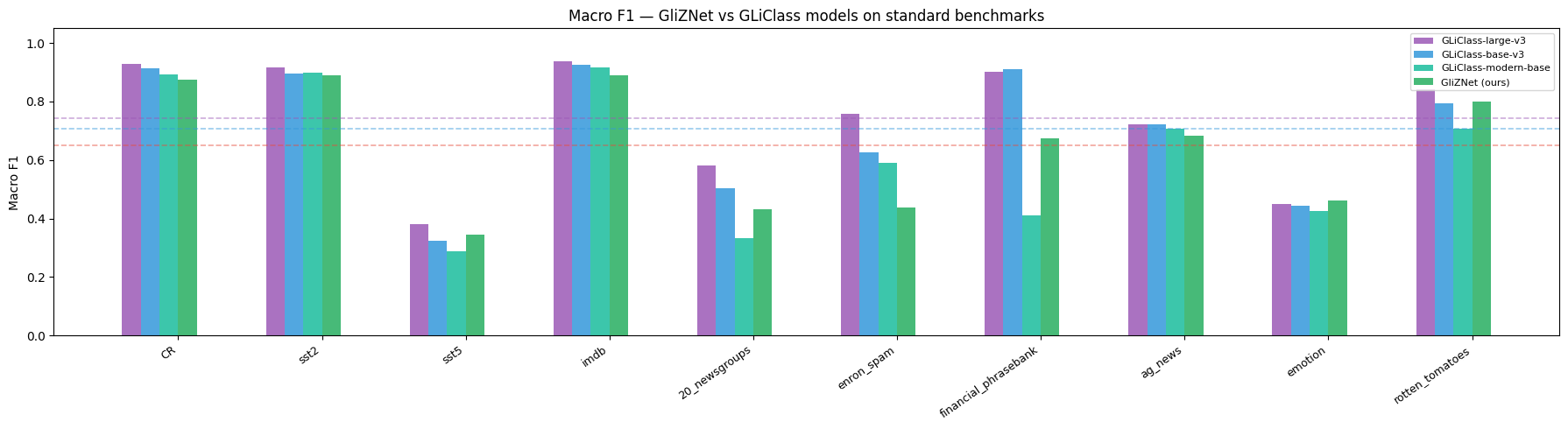
Evaluated on the GLiClass benchmark — 10 standard text-classification datasets reported as macro F1.
GLiClass variants are the closest published competitors; all encode text and labels jointly in a single forward pass.
GliZNet Performance
Macro F1 on GLiClass benchmark datasets
Dataset
GliZNet ModernBERT-Base (ours)
GliZNet DeBERTa-v3-Base (ours)
GLiClass-large-v3
GLiClass-base-v3
GLiClass-modern-base
CR
0.8902
0.9001
0.9281
0.9127
0.8936
SST-2
0.8710
0.8858
0.9176
0.8959
0.8982
SST-5
0.4227
0.3387
0.3798
0.3236
0.2885
IMDb
0.8866
0.9037
0.9366
0.9248
0.9154
20-Newsgroups
0.3981
0.4862
0.5806
0.5045
0.3342
Enron Spam
0.4317
0.5892
0.7574
0.6252
0.5903
Financial PhraseBank
0.8037
0.7970
0.9023
0.9094
0.4121
AG News
0.7800
0.7384
0.7229
0.7209
0.7069
Emotion
0.4042
0.5135
0.4504
0.4450
0.4249
Rotten Tomatoes
0.7456
0.7357
0.8411
0.7943
0.7060
AVERAGE
0.6634
0.6888
0.7417
0.7056
0.6170
Δ GliZNet-ModernBERT vs GLiClass-large: −0.0783 · Δ vs GLiClass-base: −0.0422 · Δ vs GLiClass-modern-base: +0.0464
Δ GliZNet-DeBERTa vs GLiClass-large: −0.0529 · Δ vs GLiClass-base: −0.0168 · Δ vs GLiClass-modern-base: +0.0718
Both GliZNet variants are base-size models trained on synthetic data with a single-stage pipeline. GliZNet-DeBERTa surpasses GLiClass-base on AG News, Emotion, and SST-5. GliZNet-ModernBERT excels on SST-5 (+0.0991 vs GLiClass-base) and AG News (+0.0591).
The lmask tensor (label mask) assigns 0 to text tokens and unique integers 1…n to each label's tokens, allowing the model to pool each label independently.
Limitations
Trained on synthetic English data; performance on specialized domains (legal, medical) or non-English text may degrade.
Best results when all candidate labels fit within 1024 tokens. Very large label sets should be batched.
The model does not produce calibrated probabilities; scores are bilinear compatibility values passed through a sigmoid.
Citation
bibtex
1@article{kameni2025gliznet,
2  title   = {GliZNet: A Novel Architecture for Zero-Shot Text Classification},
3  author  = {Alex Kameni},
4  year    = {2025},
5  note    = {Preprint. Code: https://github.com/KameniAlexNea/zero-shot-classification}
6}