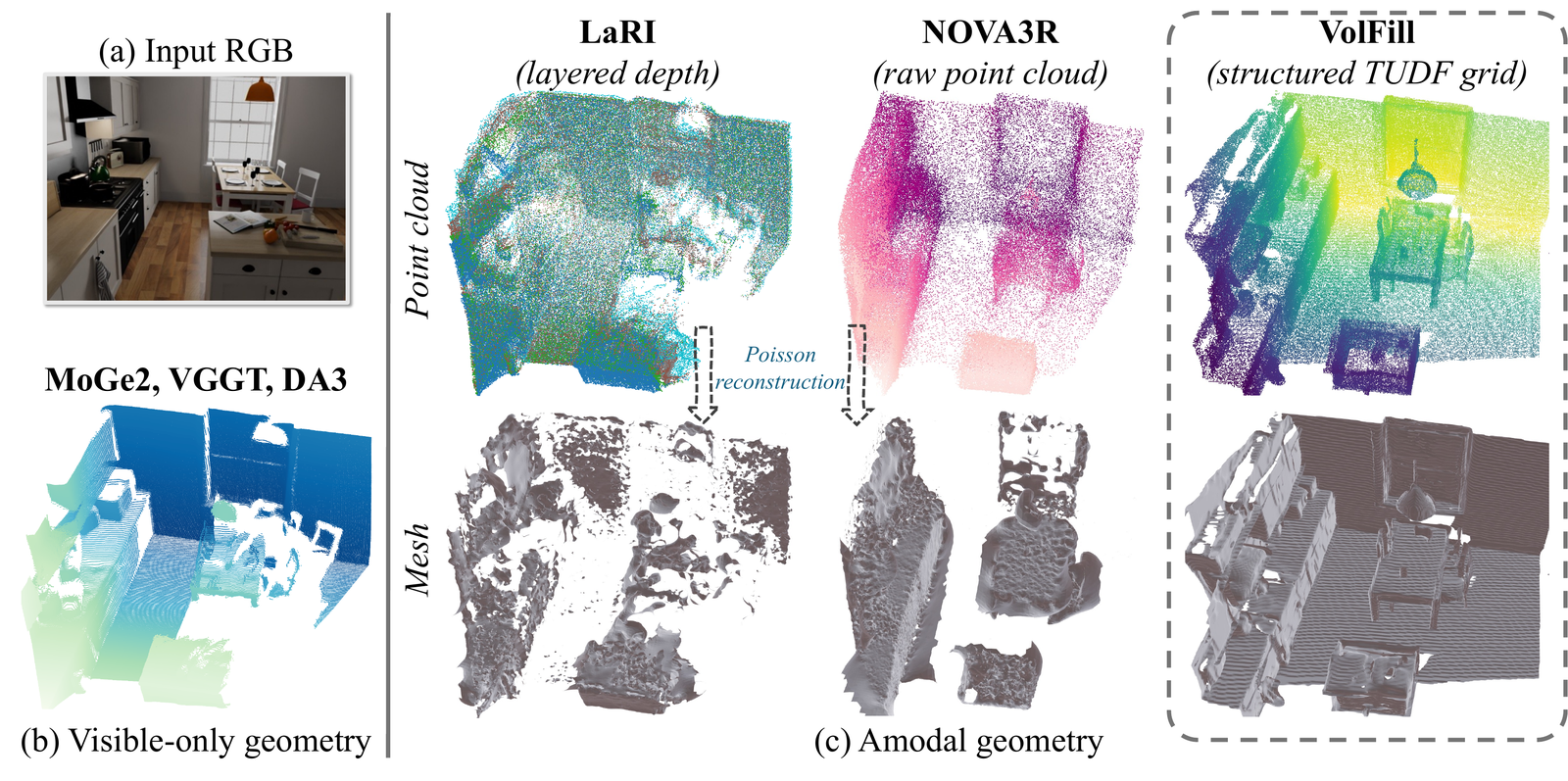
VolFill is a two-stage latent generative model. A hybrid 3D VAE (sparse
encoder → dense bottleneck → hybrid dense-to-sparse decoder) compresses the 256³
TUDF to a compact 16³×16ch latent, and a latent Diffusion Transformer trained
with flow matching generates that latent — conditioned on (a) frozen MoGe-v2
image features as a global geometric prior and (b) a visible-geometry latent that
anchors the occluded regions. At inference the model encodes the visible region,
samples the DiT for 50 Euler steps with CFG = 3.0, and decodes to a TUDF that is
thresholded into a point cloud or mesh.
Install the inference code from the
GitHub repo
(CUDA 13.0 / RTX 40-series), then everything in this model repo downloads
automatically:
1# CLI — all weights/config/stats auto-download from this repo
2python -m volfill.amodal.inference_latent_visible \
3    --hf_repo TuanNgo/VolFill --input_path image.jpg --output ./results/
1from PIL import Image
2from volfill.amodal.inference_latent_visible import LatentTUDFVisibleInference
3
4infer  = LatentTUDFVisibleInference.from_pretrained("TuanNgo/VolFill")
5result = infer(Image.open("image.jpg").convert("RGB"))
6# result["tudf"]: (1, 1, 256, 256, 256) predicted TUDF in [-1, 1]
See the GitHub README for installation, point-cloud visualization, and local /
Google-Drive checkpoint options.
1@article{ngo2026volfill,
2  title   = {VolFill: Single-View Amodal 3D Scene Reconstruction with Volumetric Flow Matching},
3  author  = {Ngo, Tuan Duc and Gan, Chuang and Kalogerakis, Evangelos},
4  journal = {arXiv preprint arXiv:2605.31466},
5  year    = {2026}
6}
Released under the MIT License. Built on
LaRI, reuses sparse-conv modules from
TRELLIS, and uses
MoGe-v2 as the visible geometry prior.