A chat between a curious user and an artificial intelligence assistant. The assistant gives helpful, detailed, and polite answers to the user's questions. USER: {prompt} ASSISTANT:
Compatibility
These quantised GGUFv2 files are compatible with llama.cpp from August 27th onwards, as of commit d0cee0d
They are also compatible with many third party UIs and libraries - please see the list at the top of this README.
Explanation of quantisation methods
Click to see details
The new methods available are:
GGML_TYPE_Q2_K - "type-1" 2-bit quantization in super-blocks containing 16 blocks, each block having 16 weight. Block scales and mins are quantized with 4 bits. This ends up effectively using 2.5625 bits per weight (bpw)
GGML_TYPE_Q3_K - "type-0" 3-bit quantization in super-blocks containing 16 blocks, each block having 16 weights. Scales are quantized with 6 bits. This end up using 3.4375 bpw.
GGML_TYPE_Q4_K - "type-1" 4-bit quantization in super-blocks containing 8 blocks, each block having 32 weights. Scales and mins are quantized with 6 bits. This ends up using 4.5 bpw.
GGML_TYPE_Q5_K - "type-1" 5-bit quantization. Same super-block structure as GGML_TYPE_Q4_K resulting in 5.5 bpw
GGML_TYPE_Q6_K - "type-0" 6-bit quantization. Super-blocks with 16 blocks, each block having 16 weights. Scales are quantized with 8 bits. This ends up using 6.5625 bpw
Refer to the Provided Files table below to see what files use which methods, and how.
very large, extremely low quality loss - not recommended
Note: the above RAM figures assume no GPU offloading. If layers are offloaded to the GPU, this will reduce RAM usage and use VRAM instead.
How to download GGUF files
Note for manual downloaders: You almost never want to clone the entire repo! Multiple different quantisation formats are provided, and most users only want to pick and download a single file.
The following clients/libraries will automatically download models for you, providing a list of available models to choose from:
LM Studio
LoLLMS Web UI
Faraday.dev
In text-generation-webui
Under Download Model, you can enter the model repo: TheBloke/wizard-vicuna-13B-GGUF and below it, a specific filename to download, such as: wizard-vicuna-13b.Q4_K_M.gguf.
Then click Download.
On the command line, including multiple files at once
I recommend using the huggingface-hub Python library:
pip3 install huggingface-hub
Then you can download any individual model file to the current directory, at high speed, with a command like this:
Windows Command Line users: You can set the environment variable by running set HF_HUB_ENABLE_HF_TRANSFER=1 before the download command.
Example llama.cpp command
Make sure you are using llama.cpp from commit d0cee0d or later.
./main -ngl 32 -m wizard-vicuna-13b.Q4_K_M.gguf --color -c 2048 --temp 0.7 --repeat_penalty 1.1 -n -1 -p "A chat between a curious user and an artificial intelligence assistant. The assistant gives helpful, detailed, and polite answers to the user's questions. USER: {prompt} ASSISTANT:"
Change -ngl 32 to the number of layers to offload to GPU. Remove it if you don't have GPU acceleration.
Change -c 2048 to the desired sequence length. For extended sequence models - eg 8K, 16K, 32K - the necessary RoPE scaling parameters are read from the GGUF file and set by llama.cpp automatically.
If you want to have a chat-style conversation, replace the -p <PROMPT> argument with -i -ins
How to load this model in Python code, using ctransformers
First install the package
Run one of the following commands, according to your system:
shell
1# Base ctransformers with no GPU acceleration2pip install ctransformers
3# Or with CUDA GPU acceleration4pip install ctransformers[cuda]5# Or with AMD ROCm GPU acceleration (Linux only)6CT_HIPBLAS=1 pip install ctransformers --no-binary ctransformers
7# Or with Metal GPU acceleration for macOS systems only8CT_METAL=1 pip install ctransformers --no-binary ctransformers
Simple ctransformers example code
python
1from ctransformers import AutoModelForCausalLM
23# Set gpu_layers to the number of layers to offload to GPU. Set to 0 if no GPU acceleration is available on your system.4llm = AutoModelForCausalLM.from_pretrained("TheBloke/wizard-vicuna-13B-GGUF", model_file="wizard-vicuna-13b.Q4_K_M.gguf", model_type="llama", gpu_layers=50)56print(llm("AI is going to"))
How to use with LangChain
Here are guides on using llama-cpp-python and ctransformers with LangChain:
I've had a lot of people ask if they can contribute. I enjoy providing models and helping people, and would love to be able to spend even more time doing it, as well as expanding into new projects like fine tuning/training.
If you're able and willing to contribute it will be most gratefully received and will help me to keep providing more models, and to start work on new AI projects.
Donaters will get priority support on any and all AI/LLM/model questions and requests, access to a private Discord room, plus other benefits.
Patreon special mentions: Alicia Loh, Stephen Murray, K, Ajan Kanaga, RoA, Magnesian, Deo Leter, Olakabola, Eugene Pentland, zynix, Deep Realms, Raymond Fosdick, Elijah Stavena, Iucharbius, Erik Bjäreholt, Luis Javier Navarrete Lozano, Nicholas, theTransient, John Detwiler, alfie_i, knownsqashed, Mano Prime, Willem Michiel, Enrico Ros, LangChain4j, OG, Michael Dempsey, Pierre Kircher, Pedro Madruga, James Bentley, Thomas Belote, Luke @flexchar, Leonard Tan, Johann-Peter Hartmann, Illia Dulskyi, Fen Risland, Chadd, S_X, Jeff Scroggin, Ken Nordquist, Sean Connelly, Artur Olbinski, Swaroop Kallakuri, Jack West, Ai Maven, David Ziegler, Russ Johnson, transmissions 11, John Villwock, Alps Aficionado, Clay Pascal, Viktor Bowallius, Subspace Studios, Rainer Wilmers, Trenton Dambrowitz, vamX, Michael Levine, 준교 김, Brandon Frisco, Kalila, Trailburnt, Randy H, Talal Aujan, Nathan Dryer, Vadim, 阿明, ReadyPlayerEmma, Tiffany J. Kim, George Stoitzev, Spencer Kim, Jerry Meng, Gabriel Tamborski, Cory Kujawski, Jeffrey Morgan, Spiking Neurons AB, Edmond Seymore, Alexandros Triantafyllidis, Lone Striker, Cap'n Zoog, Nikolai Manek, danny, ya boyyy, Derek Yates, usrbinkat, Mandus, TL, Nathan LeClaire, subjectnull, Imad Khwaja, webtim, Raven Klaugh, Asp the Wyvern, Gabriel Puliatti, Caitlyn Gatomon, Joseph William Delisle, Jonathan Leane, Luke Pendergrass, SuperWojo, Sebastain Graf, Will Dee, Fred von Graf, Andrey, Dan Guido, Daniel P. Andersen, Nitin Borwankar, Elle, Vitor Caleffi, biorpg, jjj, NimbleBox.ai, Pieter, Matthew Berman, terasurfer, Michael Davis, Alex, Stanislav Ovsiannikov
Thank you to all my generous patrons and donaters!
And thank you again to a16z for their generous grant.
June Lee's repo was also HF format. The reason I've made this is that the original repo was in float32, meaning it required 52GB disk space, VRAM and RAM.
This model was converted to float16 to make it easier to load and manage.
I've had a lot of people ask if they can contribute. I enjoy providing models and helping people, and would love to be able to spend even more time doing it, as well as expanding into new projects like fine tuning/training.
If you're able and willing to contribute it will be most gratefully received and will help me to keep providing more models, and to start work on new AI projects.
Donaters will get priority support on any and all AI/LLM/model questions and requests, access to a private Discord room, plus other benefits.
Patreon special mentions: Aemon Algiz, Dmitriy Samsonov, Nathan LeClaire, Trenton Dambrowitz, Mano Prime, David Flickinger, vamX, Nikolai Manek, senxiiz, Khalefa Al-Ahmad, Illia Dulskyi, Jonathan Leane, Talal Aujan, V. Lukas, Joseph William Delisle, Pyrater, Oscar Rangel, Lone Striker, Luke Pendergrass, Eugene Pentland, Sebastain Graf, Johann-Peter Hartman.
Thank you to all my generous patrons and donaters!
I am a big fan of the ideas behind WizardLM and VicunaLM. I particularly like the idea of WizardLM handling the dataset itself more deeply and broadly, as well as VicunaLM overcoming the limitations of single-turn conversations by introducing multi-round conversations. As a result, I combined these two ideas to create WizardVicunaLM. This project is highly experimental and designed for proof of concept, not for actual usage.
Benchmark
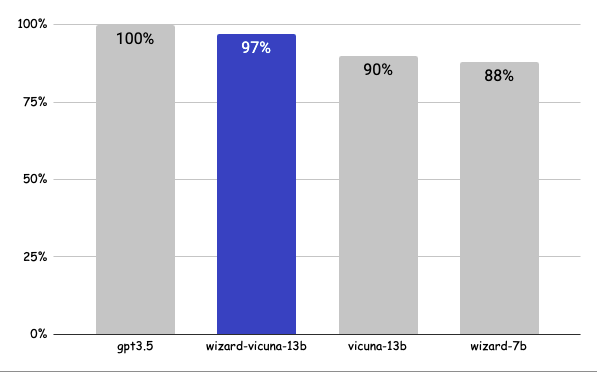
Approximately 7% performance improvement over VicunaLM
Detail
The questions presented here are not from rigorous tests, but rather, I asked a few questions and requested GPT-4 to score them. The models compared were ChatGPT 3.5, WizardVicunaLM, VicunaLM, and WizardLM, in that order.
We adopted the approach of WizardLM, which is to extend a single problem more in-depth. However, instead of using individual instructions, we expanded it using Vicuna's conversation format and applied Vicuna's fine-tuning techniques.
Turning a single command into a rich conversation is what we've done here.
After creating the training data, I later trained it according to the Vicuna v1.1 training method.
Detailed Method
First, we explore and expand various areas in the same topic using the 7K conversations created by WizardLM. However, we made it in a continuous conversation format instead of the instruction format. That is, it starts with WizardLM's instruction, and then expands into various areas in one conversation using ChatGPT 3.5.
After that, we applied the following model using Vicuna's fine-tuning format.
Training Process
Trained with 8 A100 GPUs for 35 hours.
Weights
You can see the dataset we used for training and the 13b model in the huggingface.
Conclusion
If we extend the conversation to gpt4 32K, we can expect a dramatic improvement, as we can generate 8x more, more accurate and richer conversations.
License
The model is licensed under the LLaMA model, and the dataset is licensed under the terms of OpenAI because it uses ChatGPT. Everything else is free.
Author
JUNE LEE - He is active in Songdo Artificial Intelligence Study and GDG Songdo.