WARNING: This README may contain inaccuracies. It was generated automatically by forking <a href=/TheBloke/WizardCoder-Python-34B-V1.0-GGUF>TheBloke/WizardCoder-Python-34B-V1.0-GGUF and piping the README through sed. Errors should be reported to jartine, and do not reflect TheBloke. You can also support his work on Patreon.
About llamafile
llamafile is a new format introduced by Mozilla Ocho on Nov 20th 2023. It uses Cosmopolitan Libc to turn LLM weights into runnable llama.cpp binaries that run on the stock installs of six OSes for both ARM64 and AMD64. llamafile offers numerous advantages over GGML, such as better tokenisation, and support for special tokens. It is also supports metadata, and is designed to be extensible.
Here is an incomplate list of clients and libraries that are known to support llamafile:
llama.cpp. The source project for llamafile. Offers a CLI and a server option.
text-generation-webui, the most widely used web UI, with many features and powerful extensions. Supports GPU acceleration.
KoboldCpp, a fully featured web UI, with GPU accel across all platforms and GPU architectures. Especially good for story telling.
LM Studio, an easy-to-use and powerful local GUI for Windows and macOS (Silicon), with GPU acceleration.
LoLLMS Web UI, a great web UI with many interesting and unique features, including a full model library for easy model selection.
Faraday.dev, an attractive and easy to use character-based chat GUI for Windows and macOS (both Silicon and Intel), with GPU acceleration.
ctransformers, a Python library with GPU accel, LangChain support, and OpenAI-compatible AI server.
llama-cpp-python, a Python library with GPU accel, LangChain support, and OpenAI-compatible API server.
candle, a Rust ML framework with a focus on performance, including GPU support, and ease of use.
They are also compatible with many third party UIs and libraries - please see the list at the top of this README.
Explanation of quantisation methods
Click to see details
The new methods available are:
GGML_TYPE_Q2_K - "type-1" 2-bit quantization in super-blocks containing 16 blocks, each block having 16 weight. Block scales and mins are quantized with 4 bits. This ends up effectively using 2.5625 bits per weight (bpw)
GGML_TYPE_Q3_K - "type-0" 3-bit quantization in super-blocks containing 16 blocks, each block having 16 weights. Scales are quantized with 6 bits. This end up using 3.4375 bpw.
GGML_TYPE_Q4_K - "type-1" 4-bit quantization in super-blocks containing 8 blocks, each block having 32 weights. Scales and mins are quantized with 6 bits. This ends up using 4.5 bpw.
GGML_TYPE_Q5_K - "type-1" 5-bit quantization. Same super-block structure as GGML_TYPE_Q4_K resulting in 5.5 bpw
GGML_TYPE_Q6_K - "type-0" 6-bit quantization. Super-blocks with 16 blocks, each block having 16 weights. Scales are quantized with 8 bits. This ends up using 6.5625 bpw
Refer to the Provided Files table below to see what files use which methods, and how.
very large, extremely low quality loss - not recommended
Note: the above RAM figures assume no GPU offloading. If layers are offloaded to the GPU, this will reduce RAM usage and use VRAM instead.
How to download llamafile files
Note for manual downloaders: You almost never want to clone the entire repo! Multiple different quantisation formats are provided, and most users only want to pick and download a single file.
The following clients/libraries will automatically download models for you, providing a list of available models to choose from:
LM Studio
LoLLMS Web UI
Faraday.dev
In text-generation-webui
Under Download Model, you can enter the model repo: jartine/WizardCoder-Python-34B-V1.0-llamafile and below it, a specific filename to download, such as: wizardcoder-python-34b-v1.0.q4_K_M.llamafile.
Then click Download.
On the command line, including multiple files at once
I recommend using the huggingface-hub Python library:
pip3 install huggingface-hub>=0.17.1
Then you can download any individual model file to the current directory, at high speed, with a command like this:
./main -ngl 32 -m wizardcoder-python-34b-v1.0.q4_K_M.llamafile --color -c 4096 --temp 0.7 --repeat_penalty 1.1 -n -1 -p "Below is an instruction that describes a task. Write a response that appropriately completes the request.\n\n### Instruction:\n{prompt}\n\n### Response:"
Change -ngl 32 to the number of layers to offload to GPU. Remove it if you don't have GPU acceleration.
Change -c 4096 to the desired sequence length. For extended sequence models - eg 8K, 16K, 32K - the necessary RoPE scaling parameters are read from the llamafile file and set by llama.cpp automatically.
If you want to have a chat-style conversation, replace the -p <PROMPT> argument with -i -ins
How to load this model from Python using ctransformers
First install the package
bash
1# Base ctransformers with no GPU acceleration2pip install ctransformers>=0.2.24
3# Or with CUDA GPU acceleration4pip install ctransformers[cuda]>=0.2.24
5# Or with ROCm GPU acceleration6CT_HIPBLAS=1 pip install ctransformers>=0.2.24 --no-binary ctransformers
7# Or with Metal GPU acceleration for macOS systems8CT_METAL=1 pip install ctransformers>=0.2.24 --no-binary ctransformers
Simple example code to load one of these llamafile models
python
1from ctransformers import AutoModelForCausalLM
23# Set gpu_layers to the number of layers to offload to GPU. Set to 0 if no GPU acceleration is available on your system.4llm = AutoModelForCausalLM.from_pretrained("jartine/WizardCoder-Python-34B-V1.0-llamafile", model_file="wizardcoder-python-34b-v1.0.q4_K_M.llamafile", model_type="llama", gpu_layers=50)56print(llm("AI is going to"))
How to use with LangChain
Here's guides on using llama-cpp-python or ctransformers with LangChain:
I've had a lot of people ask if they can contribute. I enjoy providing models and helping people, and would love to be able to spend even more time doing it, as well as expanding into new projects like fine tuning/training.
If you're able and willing to contribute it will be most gratefully received and will help me to keep providing more models, and to start work on new AI projects.
And thank you again to mozilla for their generous grant.
Original model card: WizardLM's WizardCoder Python 34B V1.0
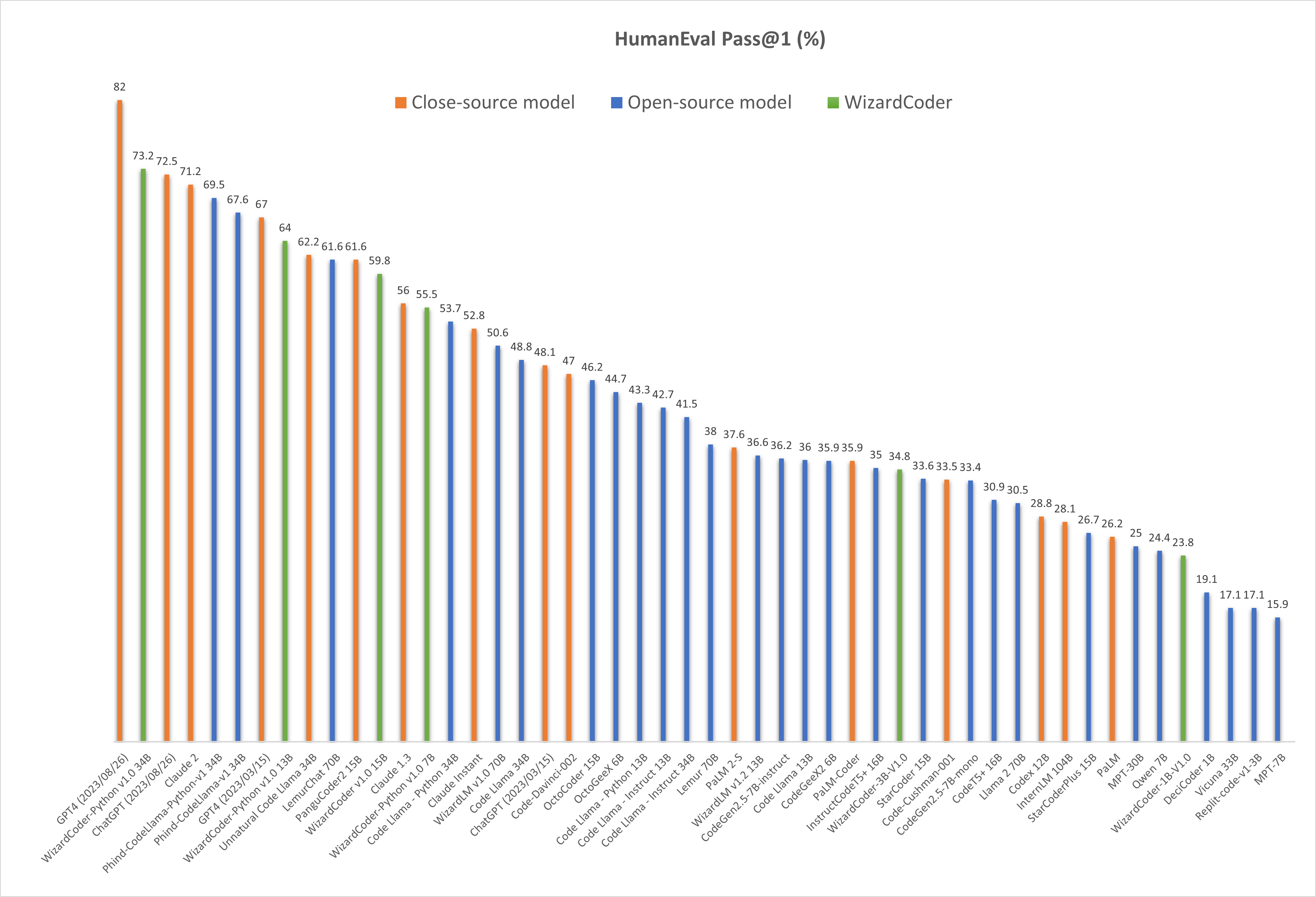
🔥🔥🔥[2023/08/26] We released WizardCoder-Python-34B-V1.0 , which achieves the 73.2 pass@1 and surpasses GPT4 (2023/03/15), ChatGPT-3.5, and Claude2 on the HumanEval Benchmarks.
[2023/06/16] We released WizardCoder-15B-V1.0 , which achieves the 57.3 pass@1 and surpasses Claude-Plus (+6.8), Bard (+15.3) and InstructCodeT5+ (+22.3) on the HumanEval Benchmarks.
❗Note: There are two HumanEval results of GPT4 and ChatGPT-3.5. The 67.0 and 48.1 are reported by the official GPT4 Report (2023/03/15) of OpenAI. The 82.0 and 72.5 are tested by ourselves with the latest API (2023/08/26).
Our WizardMath-70B-V1.0 model slightly outperforms some closed-source LLMs on the GSM8K, including ChatGPT 3.5, Claude Instant 1 and PaLM 2 540B.
Our WizardMath-70B-V1.0 model achieves 81.6 pass@1 on the GSM8k Benchmarks, which is 24.8 points higher than the SOTA open-source LLM, and achieves 22.7 pass@1 on the MATH Benchmarks, which is 9.2 points higher than the SOTA open-source LLM.
Comparing WizardCoder-Python-34B-V1.0 with Other LLMs.
🔥 The following figure shows that our WizardCoder-Python-34B-V1.0 attains the second position in this benchmark, surpassing GPT4 (2023/03/15, 73.2 vs. 67.0), ChatGPT-3.5 (73.2 vs. 72.5) and Claude2 (73.2 vs. 71.2).
"Below is an instruction that describes a task. Write a response that appropriately completes the request.\n\n### Instruction:\n{instruction}\n\n### Response:"
Please cite the repo if you use the data, method or code in this repo.
@article{luo2023wizardcoder,
  title={WizardCoder: Empowering Code Large Language Models with Evol-Instruct},
  author={Luo, Ziyang and Xu, Can and Zhao, Pu and Sun, Qingfeng and Geng, Xiubo and Hu, Wenxiang and Tao, Chongyang and Ma, Jing and Lin, Qingwei and Jiang, Daxin},
  journal={arXiv preprint arXiv:2306.08568},
  year={2023}
}