"PoseLess: Depth-Free Vision-to-Joint Control via Direct Image Mapping with VLM" (
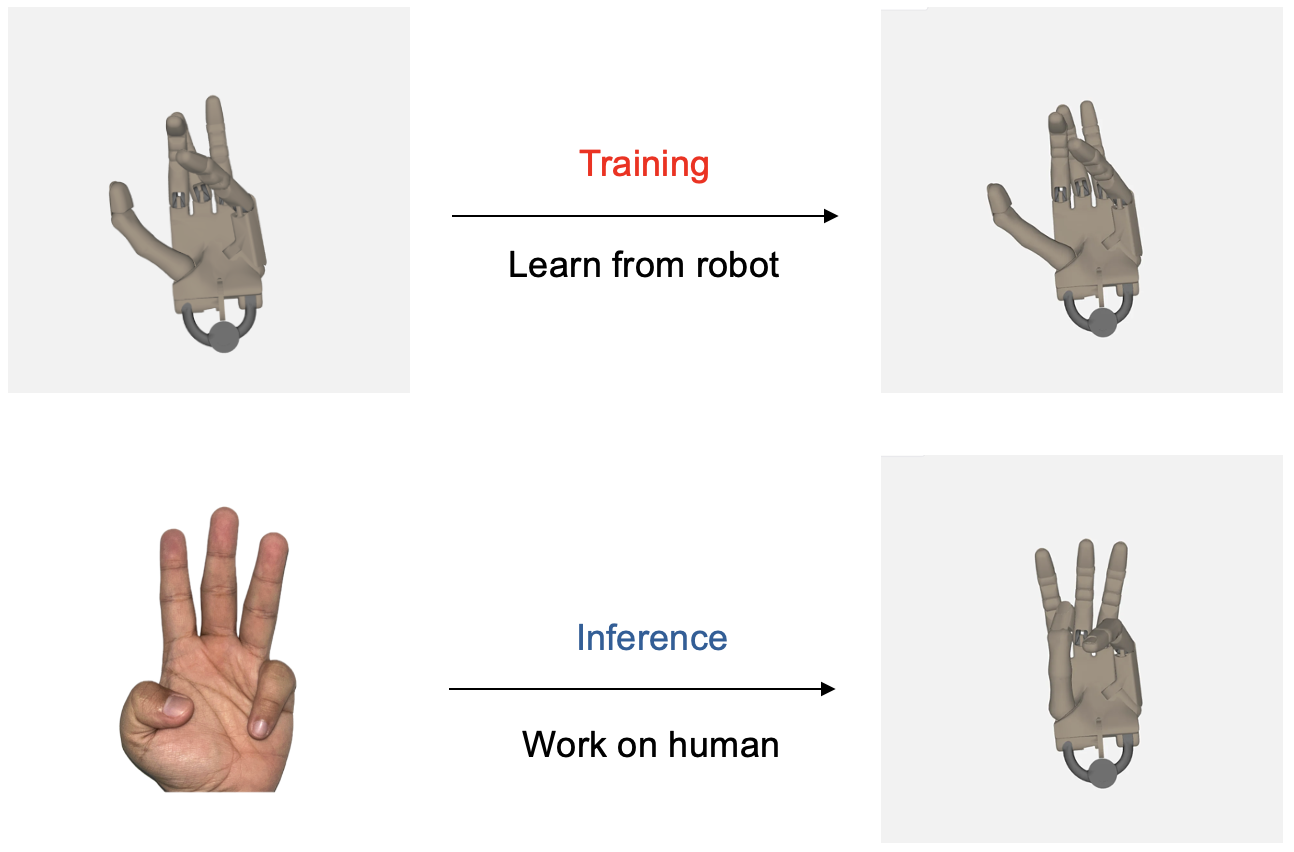
Paper) introduces a novel framework for robot hand control that eliminates the need for explicit pose estimation by directly mapping 2D images to joint angles using projected representations. Our approach leverages synthetic training data generated through randomized joint configurations, enabling zero-shot generalization to real-world scenarios and cross-morphology transfer from robotic to human hands. By projecting visual inputs and employing a transformer-based decoder, PoseLess achieves robust, low-latency control while addressing challenges such as depth ambiguity and data scarcity. Experimental results demonstrate competitive performance in joint angle prediction accuracy without relying on any human-labelled dataset
1import torch
2from PIL import Image
3from transformers import AutoProcessor, Qwen2_5_VLForConditionalGeneration
4from qwen_vl_utils import process_vision_info
5
6# 1. Load model and processor
7device = "cuda" if torch.cuda.is_available() else "cpu"
8model_path = "homebrewltd/Poseless-3B"
9
10model = Qwen2_5_VLForConditionalGeneration.from_pretrained(
11    model_path,
12    trust_remote_code=True,
13    torch_dtype=torch.bfloat16
14).eval().to(device)
15
16processor = AutoProcessor.from_pretrained(
17    model_path,
18    min_pixels=256*28*28,
19    max_pixels=1280*28*28,
20    trust_remote_code=True
21)
22
23# 2. Prepare your image
24image = Image.open("your_hand_image.png").convert("RGB")
25
26# 3. Create messages
27SYSTEM_PROMPT = """You are a specialized Vision Language Model designed to accurately estimate joint angles from hand pose images. Your task is to analyze images of a human or robotic hand and output precise angle measurements for each joint. Output joint angles in radians.
28Output Format:
29<lh_WRJ2>angle</lh_WRJ2><lh_WRJ1>angle</lh_WRJ1><lh_FFJ4>angle</lh_FFJ4><lh_FFJ3>angle</lh_FFJ3><lh_FFJ2>angle</lh_FFJ2><lh_FFJ1>angle</lh_FFJ1><lh_MFJ4>angle</lh_MFJ4><lh_MFJ3>angle</lh_MFJ3><lh_MFJ2>angle</lh_MFJ2><lh_MFJ1>angle</lh_MFJ1><lh_RFJ4>angle</lh_RFJ4><lh_RFJ3>angle</lh_RFJ3><lh_RFJ2>angle</lh_RFJ2><lh_RFJ1>angle</lh_RFJ1><lh_LFJ5>angle</lh_LFJ5><lh_LFJ4>angle</lh_LFJ4><lh_LFJ3>angle</lh_LFJ3><lh_LFJ2>angle</lh_LFJ2><lh_LFJ1>angle</lh_LFJ1><lh_THJ5>angle</lh_THJ5><lh_THJ4>angle</lh_THJ4><lh_THJ3>angle</lh_THJ3><lh_THJ2>angle</lh_THJ2><lh_THJ1>angle</lh_THJ1>
30"""
31
32messages = [
33    {"role": "system", "content": f"{SYSTEM_PROMPT}"},
34    {
35        "role": "user",
36        "content": [
37            {
38                "type": "image",
39                "image": image,
40                "min_pixels": 1003520,
41                "max_pixels": 1003520,
42            },
43            {"type": "text", "text": "<Pose>"},
44        ],
45    },
46]
47
48# 4. Process and get predictions
49text = processor.apply_chat_template(messages, tokenize=False, add_generation_prompt=True)
50image_inputs, video_inputs = process_vision_info(messages)
51inputs = processor(text=[text], images=image_inputs, videos=video_inputs, padding=True, return_tensors="pt").to(device)
52
53# 5. Generate output
54generated_ids = model.generate(**inputs, max_new_tokens=1024)
55generated_ids_trimmed = [out_ids[len(in_ids):] for in_ids, out_ids in zip(inputs.input_ids, generated_ids)]
56output_text = processor.batch_decode(generated_ids_trimmed, skip_special_tokens=True, clean_up_tokenization_spaces=False)[0]
57
58print(output_text)  # This will show the joint angles in XML format