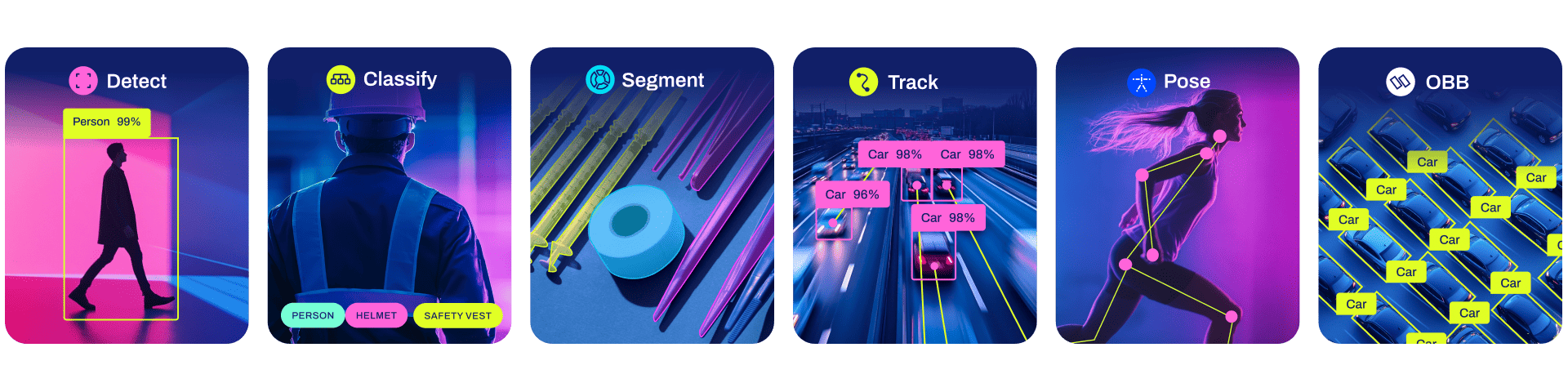
UltralyticsYOLO11 is a cutting-edge, state-of-the-art (SOTA) model that builds upon the success of previous YOLO versions and introduces new features and improvements to further boost performance and flexibility. YOLO11 is designed to be fast, accurate, and easy to use, making it an excellent choice for a wide range of object detection and tracking, instance segmentation, image classification and pose estimation tasks.
We hope that the resources here will help you get the most out of YOLO. Please browse the Ultralytics Docs for details, raise an issue on GitHub for support, questions, or discussions, become a member of the Ultralytics Discord, Reddit and Forums!
yolo can be used for a variety of tasks and modes and accepts additional arguments, i.e. imgsz=640. See the YOLO CLI Docs for examples.
Python
YOLO may also be used directly in a Python environment, and accepts the same arguments as in the CLI example above:
python
1from ultralytics import YOLO
23# Load a model4model = YOLO("yolo11n.pt")56# Train the model7train_results = model.train(8 data="coco8.yaml",# path to dataset YAML9 epochs=100,# number of training epochs10 imgsz=640,# training image size11 device="cpu",# device to run on, i.e. device=0 or device=0,1,2,3 or device=cpu12)1314# Evaluate model performance on the validation set15metrics = model.val()1617# Perform object detection on an image18results = model("path/to/image.jpg")19results[0].show()2021# Export the model to ONNX format22path = model.export(format="onnx")# return path to exported model
YOLO11 Detect, Segment and Pose models pretrained on the COCO dataset are available here, as well as YOLO11 Classify models pretrained on the ImageNet dataset. Track mode is available for all Detect, Segment and Pose models.
Ultralytics YOLO supported tasks
All Models download automatically from the latest Ultralytics release on first use.
Detection (COCO)
See Detection Docs for usage examples with these models trained on COCO, which include 80 pre-trained classes.
mAPtest values are for single-model multiscale on DOTAv1 dataset. Reproduce by yolo val obb data=DOTAv1.yaml device=0 split=test and submit merged results to DOTA evaluation.
Speed averaged over DOTAv1 val images using an Amazon EC2 P4d instance. Reproduce by yolo val obb data=DOTAv1.yaml batch=1 device=0|cpu
Integrations
Our key integrations with leading AI platforms extend the functionality of Ultralytics' offerings, enhancing tasks like dataset labeling, training, visualization, and model management. Discover how Ultralytics, in collaboration with Roboflow, ClearML, Comet, Neural Magic and OpenVINO, can optimize your AI workflow.
Experience seamless AI with Ultralytics HUB ⭐, the all-in-one solution for data visualization, YOLO11 🚀 model training and deployment, without any coding. Transform images into actionable insights and bring your AI visions to life with ease using our cutting-edge platform and user-friendly Ultralytics App. Start your journey for Free now!
We love your input! Ultralytics YOLO would not be possible without help from our community. Please see our Contributing Guide to get started, and fill out our Survey to send us feedback on your experience. Thank you 🙏 to all our contributors!
Ultralytics offers two licensing options to accommodate diverse use cases:
AGPL-3.0 License: This OSI-approved open-source license is ideal for students and enthusiasts, promoting open collaboration and knowledge sharing. See the LICENSE file for more details.
Enterprise License: Designed for commercial use, this license permits seamless integration of Ultralytics software and AI models into commercial goods and services, bypassing the open-source requirements of AGPL-3.0. If your scenario involves embedding our solutions into a commercial offering, reach out through Ultralytics Licensing.
Contact
For Ultralytics bug reports and feature requests please visit GitHub Issues. Become a member of the Ultralytics Discord, Reddit, or Forums for asking questions, sharing projects, learning discussions, or for help with all things Ultralytics!