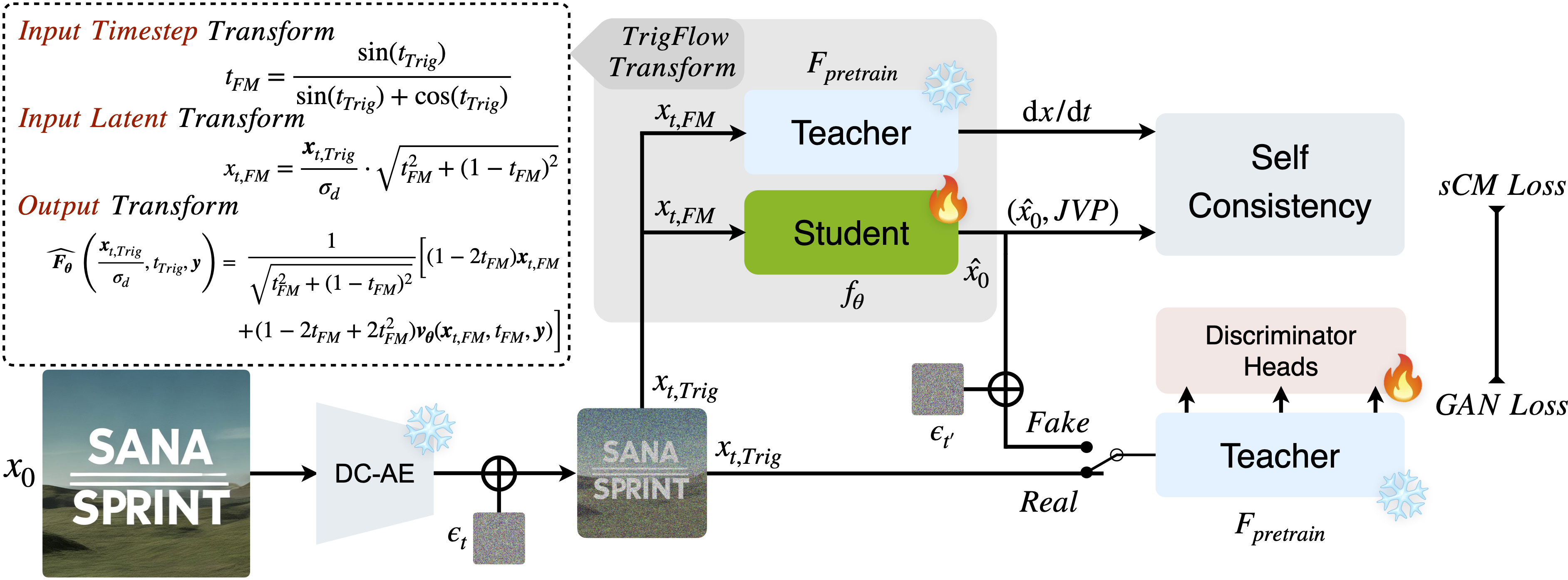
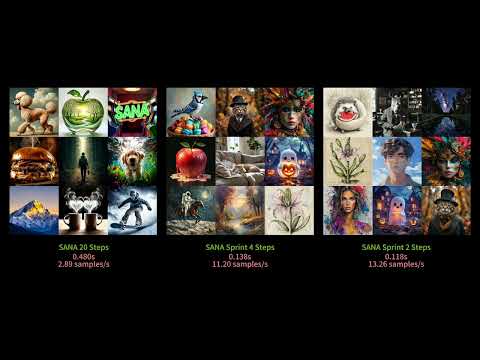
SANA-Sprint is an ultra-efficient diffusion model for text-to-image (T2I) generation, reducing inference steps from 20 to 1-4 while achieving state-of-the-art performance.
Key innovations include:
(1) A training-free approach for continuous-time consistency distillation (sCM), eliminating costly retraining;
(2) A unified step-adaptive model for high-quality generation in 1-4 steps; and
(3) ControlNet integration for real-time interactive image generation.
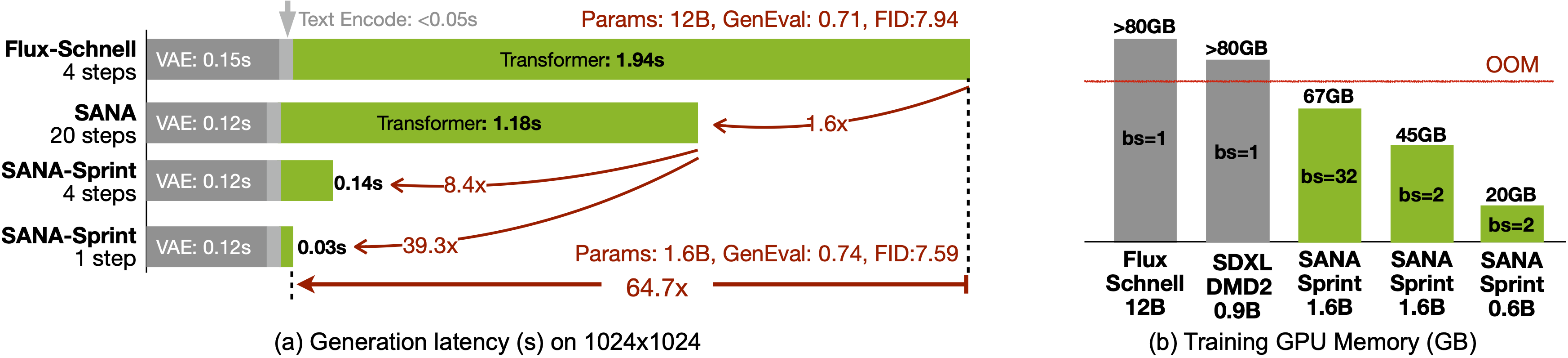
SANA-Sprint achieves 7.59 FID and 0.74 GenEval in just 1 step — outperforming FLUX-schnell (7.94 FID / 0.71 GenEval) while being 10× faster (0.1s vs 1.1s on H100).
With latencies of 0.1s (T2I) and 0.25s (ControlNet) for 1024×1024 images on H100, and 0.31s (T2I) on an RTX 4090, SANA-Sprint is ideal for AI-powered consumer applications (AIPC).
For research purposes, we recommend our
generative-models Github repository (
https://github.com/NVlabs/Sana), which is more suitable for both training and inference
MIT Han-Lab provides free SANA-Sprint inference.
1from diffusers import SanaSprintPipeline
2import torch
3
4pipeline = SanaSprintPipeline.from_pretrained(
5    "Efficient-Large-Model/Sana_Sprint_0.6B_1024px_diffusers",
6    torch_dtype=torch.bfloat16
7)
8pipeline.to("cuda:0")
9
10prompt = "a tiny astronaut hatching from an egg on the moon"
11
12image = pipeline(prompt=prompt, num_inference_steps=2).images[0]
13image.save("sana_sprint.png")
The model is intended for research purposes only. Possible research areas and tasks include
-
Generation of artworks and use in design and other artistic processes.
-
Applications in educational or creative tools.
-
Research on generative models.
-
Safe deployment of models which have the potential to generate harmful content.
-
Probing and understanding the limitations and biases of generative models.
Excluded uses are described below.
The model was not trained to be factual or true representations of people or events, and therefore using the model to generate such content is out-of-scope for the abilities of this model.
While the capabilities of image generation models are impressive, they can also reinforce or exacerbate social biases.