This repo contains the full precision source code, in "safe tensors" format to generate GGUFs, GPTQ, EXL2, AWQ, HQQ and other formats.
The source code can also be used directly.
This model is for CODING and programming in all major programming languages and many minor ones too.
This model is based on Qwen3-Coder-30B-A3B-Instruct (MOE, 128 experts, 10 activated), with Brainstorm 20X
(by DavidAU) - details at bottom of this page.
The Brainstorm adapter will improve general performance and "out of the box" thinking.
This creates a model of 53B parameters, 84 layers and 1011 tensors.
This version has the NATIVE context of 256k.
I modified the default experts to 10, from the base of 8 (activated) - found this works better with coding and Brainstorm in general.
You can change the number of expert activated - see below in help section.
This is a non-reasoning/non-thinking block model.
I have included an optional system prompt to invoke "thinking" in this model, if you want to activate it.
For coding, programming set expert to:
6-8 for general work.
10 for moderate work. [default]
12-16 for complex work, long projects, complex coding.
Suggest min context window 4k to 8k.
And for longer context, and/or multi-turn -> increase experts by 1-2 to help with longer context/multi turn understanding.
Recommended settings - general:
Rep pen 1.05 to 1.1 ; however rep pen of 1 will work well (may need to raise it for lower quants/fewer activated experts)
Temp .3 to .6 (+- .2)
Topk of 20, 40 or 100
Topp of .95 / min p of .05
Suggest min context window 4k to 8k.
System prompt (optional) to focus the model better.
This is the refined version -V1.4- from this project (see this repo for all settings, details, system prompts, example generations etc etc):
For additional settings, tool use, and other model settings.
Summary of root model below, followed by FULL HELP SECTION, then info on Brainstorm 40x.
OPTIONAL SYSTEM PROMPT - INVOKE "Thinking":
Enable deep thinking subroutine. You are a deep thinking AI, you may use extremely long chains of thought to deeply consider the problem and deliberate with yourself via systematic reasoning processes to help come to a correct solution prior to answering. You should enclose your thoughts and internal monologue inside ###ponder### ###/ponder### tags, and then provide your solution or response to the problem.
Use this to INVOKE "thinking" block(s) in the model. These will be a lot shorter than 1000s of tokens generally in most "thinking" models.
In you use this prompt, you may need to raise "rep pen" to 1.08 to 1.1, to prevent "loops" in the "thought block(s)" ; especially in lower quants.
If you change "ponder" to a different word/phrase this will affect model "thinking" too.
QUANTS
Special Thanks to Team Mradermacher, and Nightmedia for the quants:
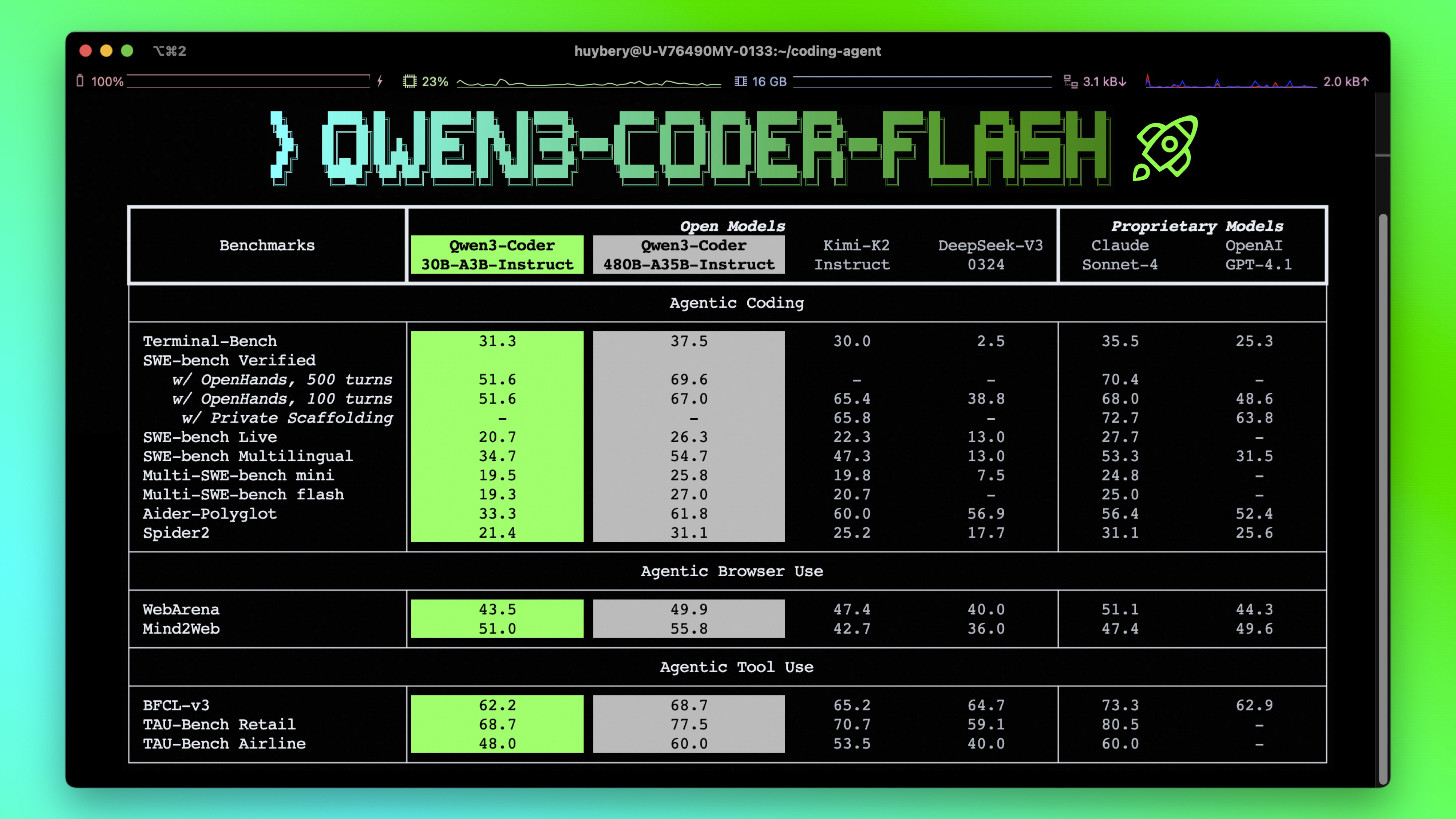
Qwen3-Coder is available in multiple sizes. Today, we're excited to introduce Qwen3-Coder-30B-A3B-Instruct. This streamlined model maintains impressive performance and efficiency, featuring the following key enhancements:
Significant Performance among open models on Agentic Coding, Agentic Browser-Use, and other foundational coding tasks.
Long-context Capabilities with native support for 256K tokens, extendable up to 1M tokens using Yarn, optimized for repository-scale understanding.
Agentic Coding supporting for most platform such as Qwen Code, CLINE, featuring a specially designed function call format.
image/jpeg
Model Overview
Qwen3-Coder-30B-A3B-Instruct has the following features:
Type: Causal Language Models
Training Stage: Pretraining & Post-training
Number of Parameters: 30.5B in total and 3.3B activated
Number of Layers: 48
Number of Attention Heads (GQA): 32 for Q and 4 for KV
Number of Experts: 128
Number of Activated Experts: 8
Context Length: 262,144 natively.
NOTE: This model supports only non-thinking mode and does not generate <think></think> blocks in its output. Meanwhile, specifying enable_thinking=False is no longer required.
For more details, including benchmark evaluation, hardware requirements, and inference performance, please refer to our blog, GitHub, and Documentation.
Quickstart
We advise you to use the latest version of transformers.
With transformers<4.51.0, you will encounter the following error:
KeyError: 'qwen3_moe'
The following contains a code snippet illustrating how to use the model generate content based on given inputs.
python
1from transformers import AutoModelForCausalLM, AutoTokenizer
23model_name ="Qwen/Qwen3-Coder-30B-A3B-Instruct"45# load the tokenizer and the model6tokenizer = AutoTokenizer.from_pretrained(model_name)7model = AutoModelForCausalLM.from_pretrained(8 model_name,9 torch_dtype="auto",10 device_map="auto"11)1213# prepare the model input14prompt ="Write a quick sort algorithm."15messages =[16{"role":"user","content": prompt}17]18text = tokenizer.apply_chat_template(19 messages,20 tokenize=False,21 add_generation_prompt=True,22)23model_inputs = tokenizer([text], return_tensors="pt").to(model.device)2425# conduct text completion26generated_ids = model.generate(27**model_inputs,28 max_new_tokens=6553629)30output_ids = generated_ids[0][len(model_inputs.input_ids[0]):].tolist()3132content = tokenizer.decode(output_ids, skip_special_tokens=True)3334print("content:", content)
Note: If you encounter out-of-memory (OOM) issues, consider reducing the context length to a shorter value, such as 32,768.
For local use, applications such as Ollama, LMStudio, MLX-LM, llama.cpp, and KTransformers have also supported Qwen3.
Agentic Coding
Qwen3-Coder excels in tool calling capabilities.
You can simply define or use any tools as following example.
python
1# Your tool implementation2defsquare_the_number(num:float)->dict:3return num **245# Define Tools6tools=[7{8"type":"function",9"function":{10"name":"square_the_number",11"description":"output the square of the number.",12"parameters":{13"type":"object",14"required":["input_num"],15"properties":{16'input_num':{17'type':'number',18'description':'input_num is a number that will be squared'19}20},21}22}23}24]2526import OpenAI
27# Define LLM28client = OpenAI(29# Use a custom endpoint compatible with OpenAI API30 base_url='http://localhost:8000/v1',# api_base31 api_key="EMPTY"32)3334messages =[{'role':'user','content':'square the number 1024'}]3536completion = client.chat.completions.create(37 messages=messages,38 model="Qwen3-Coder-30B-A3B-Instruct",39 max_tokens=65536,40 tools=tools,41)4243print(completion.choice[0])
Best Practices
To achieve optimal performance, we recommend the following settings:
Sampling Parameters:
We suggest using temperature=0.7, top_p=0.8, top_k=20, repetition_penalty=1.05.
Adequate Output Length: We recommend using an output length of 65,536 tokens for most queries, which is adequate for instruct models.
For all settings used for this model (including specifics for its "class"), including example generation(s) and for advanced settings guide (which many times addresses any model issue(s)), including methods to improve model performance for all use case(s) as well as chat, roleplay and other use case(s) please see:
However I went in a completely different direction from what was outlined in this paper.
What is "Brainstorm" ?
The reasoning center of an LLM is taken apart, reassembled, and expanded.
In this case for this model: 40 times
Then these centers are individually calibrated. These "centers" also interact with each other.
This introduces subtle changes into the reasoning process.
The calibrations further adjust - dial up or down - these "changes" further.
The number of centers (5x,10x etc) allow more "tuning points" to further customize how the model reasons so to speak.
The core aim of this process is to increase the model's detail, concept and connection to the "world",
general concept connections, prose quality and prose length without affecting instruction following.
This will also enhance any creative use case(s) of any kind, including "brainstorming", creative art form(s) and like case uses.
Here are some of the enhancements this process brings to the model's performance:
Prose generation seems more focused on the moment to moment.
Sometimes there will be "preamble" and/or foreshadowing present.
Fewer or no "cliches"
Better overall prose and/or more complex / nuanced prose.
A greater sense of nuance on all levels.
Coherence is stronger.
Description is more detailed, and connected closer to the content.
Simile and Metaphors are stronger and better connected to the prose, story, and character.
Sense of "there" / in the moment is enhanced.
Details are more vivid, and there are more of them.
Prose generation length can be long to extreme.
Emotional engagement is stronger.
The model will take FEWER liberties vs a normal model: It will follow directives more closely but will "guess" less.
The MORE instructions and/or details you provide the more strongly the model will respond.
Depending on the model "voice" may be more "human" vs original model's "voice".
Other "lab" observations:
This process does not, in my opinion, make the model 5x or 10x "smarter" - if only that was true!
However, a change in "IQ" was not an issue / a priority, and was not tested or calibrated for so to speak.
From lab testing it seems to ponder, and consider more carefully roughly speaking.
You could say this process sharpens the model's focus on it's task(s) at a deeper level.
The process to modify the model occurs at the root level - source files level. The model can quanted as a GGUF, EXL2, AWQ etc etc.