FAIPL-1.0-SD には AGPL に似た条項があります。改変したモデルを
Web サービスなどネットワーク越しに利用させる場合、利用者が対応する
ソースコード(モデルを含む)を受け取れる手段を用意する義務があります。
If you modify this software and allow users to interact with it through
a computer network, you must ensure they have a reasonable way to receive
the corresponding source code from you
A place where trained LoRAs and the datasets behind them live together.
Most LoRA repositories publish only the .safetensors. Here you also get
the original training images and the training config files, so you can see
how a result was reached — not just the result.
⚠️ Licenses differ per file. There is no single license covering this
repository. In particular, models (.safetensors) and datasets (.zip)
are under different terms. See License before use.
📗 HibikiMei.zip is CC BY-NC 4.0
(attribution, non-commercial). Training and practice are fine.
For commercial use, please ask first (sg26@aicu.jp).
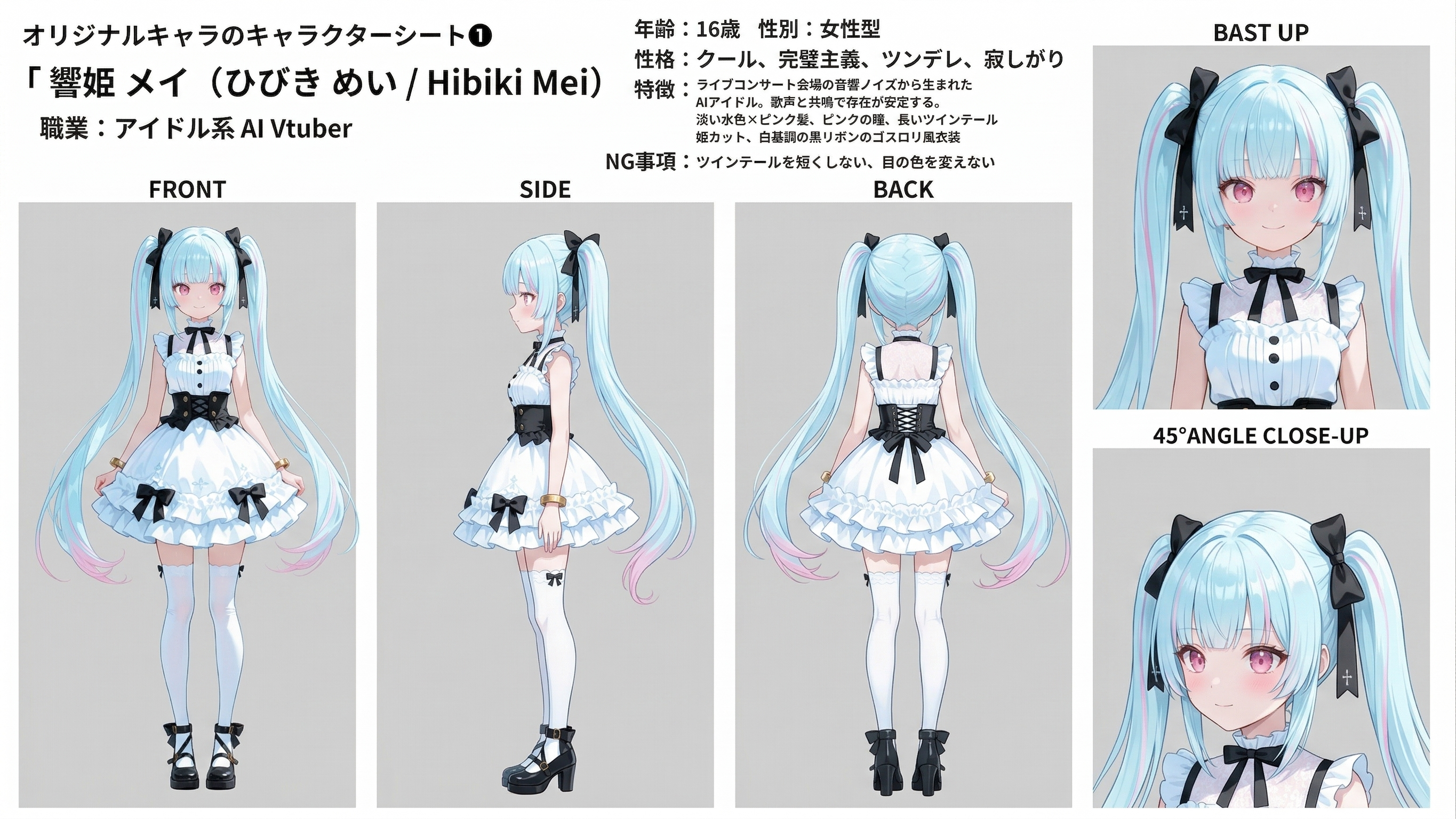
📘 HibikiMei (響姫メイ)
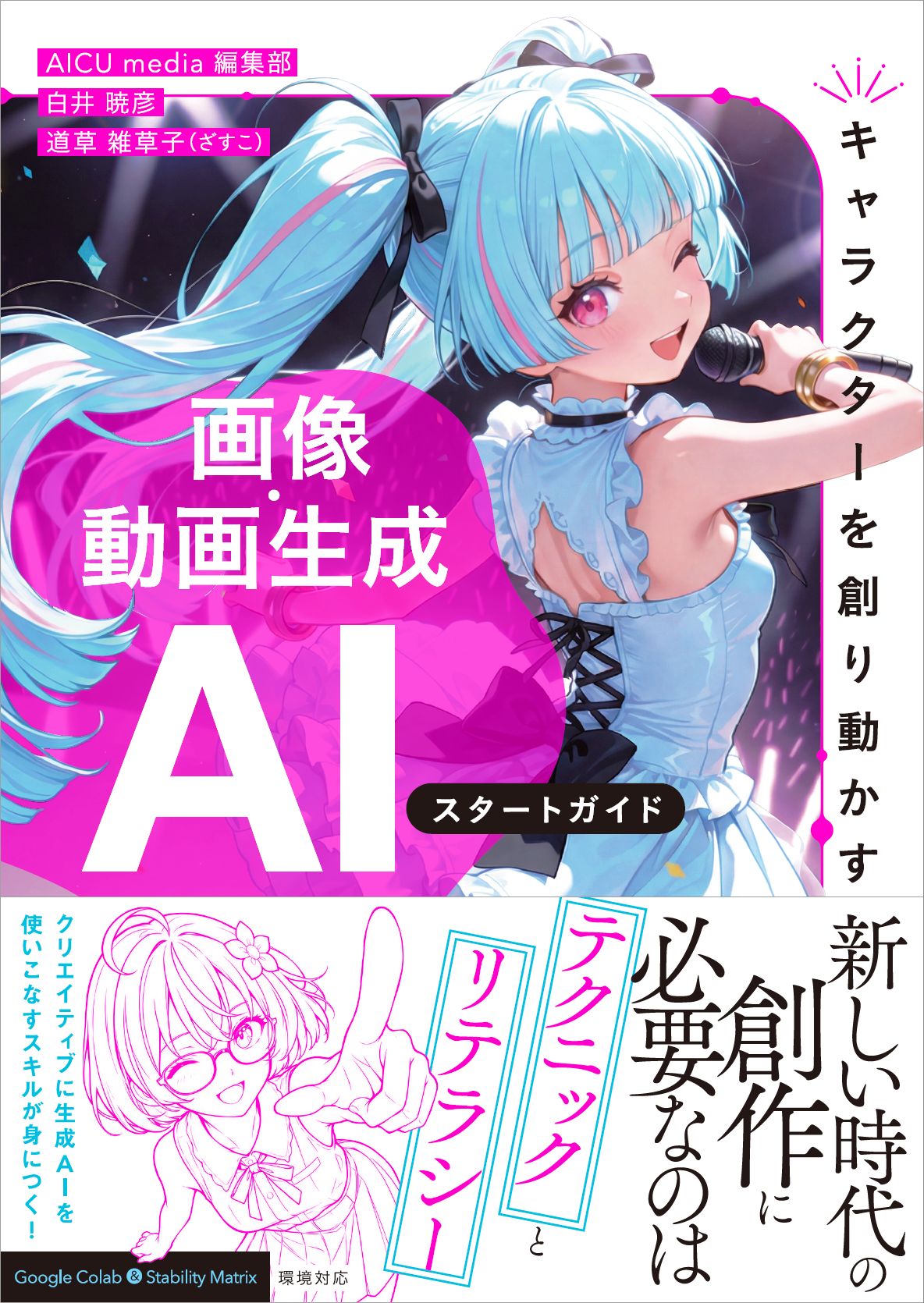
Companion material for the Japanese book
Character Creation & Animation: A Starter Guide to Image & Video Generative AI
(SB Creative, September 2026). It continues section 4-5, "Arranging outputs with LoRA."
What's in the dataset
HibikiMei dataset
All 25 images in HibikiMei.zip. Front, profile, back, full body, expression
variations and pose variations. This is a concrete answer to
"what should a character LoRA dataset actually look like?" — use it as a
reference when preparing your own.
Captions are omitted on purpose. The book walks through starting from
auto-captioning and correcting by hand — learning to caption is part of the exercise.
Start with j.aicu.ai/LoRA26. Running the cells top to bottom takes you from
dataset download through model fetch to a finished LoRA.
LTS presets
Defaults shipped in LoRA26. These values are known to run end to end.
Preset
project_name
Base model
Resolution
batch
dim/alpha
unet_lr
HibikiMei (default)
HibikiMei
Sierunami v1
1024
1
32/16
1e-4
9shoku
9shoku0219
AnyLora
512
2
16/8
5e-4
The LTS notebook pins sd-scripts to tag v0.10.5 and is built so numpy is
never downgraded — no runtime restart required. First install takes about
five minutes on a T4 (289 s measured).
Using your own character
The 25 images in HibikiMei.zip double as a reference for how many images and
what variety you need.
Item
Guideline
Count
20–50 images (around 30 is comfortable)
Resolution
1024×1024 for SDXL; 512×512 is for SD1.5
Variety
Mix angles, expressions and poses
Background
Plain (white or grey) recommended
Format
PNG preferred; go easy on JPEG compression
Two mistakes account for most failures:
Only front-facing shots → the LoRA only produces front views. Include back and profile.
Busy backgrounds → the model learns the background along with the character.
Captions
Captions are deliberately not included, so you go through the loop of
auto-generating and then correcting them by hand.
Auto-generate with WD14 Tagger (threshold around 0.35)
Add the trigger word to every image, at the front of the tag list
Delete what you don't want baked in — background tags like white background,
framing tags like upper body; you can specify those in the prompt later
Add per-image tags — smile, peace sign, and so on
Troubleshooting
Symptom
Cause
Fix
Character doesn't appear
Undertrained
Increase epochs
Face or outfit falls apart
Overtrained
Reduce epochs
Background is baked in
Background tags left in captions
Remove them
Only one pose comes out
Not enough variety
Add angles, expressions, poses
Where it runs
Environment
Training
Notes
Google Colab free (T4)
Yes
Time-limited, but enough to start
Colab paid
Yes
Faster, looser limits
Local, 12GB+ VRAM
Yes
Comfortable at default settings
Local, 8GB VRAM
Maybe
Lower the resolution or batch size
No GPU (CPU only)
No
Not practical
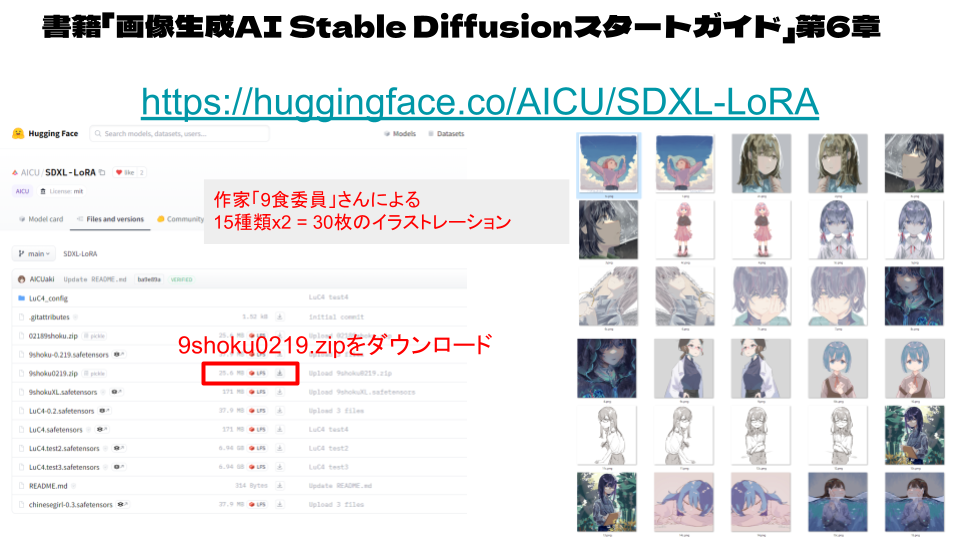
📗 9shoku (9食委員)
Companion material for the previous book A Starter Guide to Stable Diffusion
(SBXL), chapter 6.
File
Contents
9shoku0219.zip / 02189shoku.zip
Training dataset (24.4MB each). 15 designs × 2 = 30 illustrations by the artist 9shoku
The 14 training images in LuC4_dataset.zip. A red-haired male character
across casual wear, Japanese dress, chibi style and seasonal variations.
Where HibikiMei locks the design down with turnaround sheets, this set
converges through situational variety — two different approaches to the
same problem.
File
Contents
LuC4.safetensors
SDXL LoRA (162.6MB)
LuC4-0.2.safetensors
Lightweight version (36.1MB)
LuC4_config/config_file.toml
The actual training config used for this LoRA
LuC4_config/sample_prompt.toml
Sample prompts used during training
The training images live in AICU/LuC4
(LuC4_dataset.zip). Caption .txt files are included, so after captioning
HibikiMei yourself you can compare against a worked example.
config_file.toml may be the most useful file in this repository.
It is published so you can copy a configuration that is known to have worked,
instead of guessing hyperparameters from scratch.
⚠️ LuC4.test2.safetensors and LuC4.test3.safetensors (6.6GB each) are
intermediate files from testing — checkpoint-sized rather than LoRA-sized.
For normal use take LuC4.safetensors above.
📔 ShiraiLoRA
File
Contents
ShiraiLoRA.zip
Photographs and generated images of Dr. Akihiko Shirai (3.3MB)
Provided by the subject himself, who has granted permission for use as
course material. No third-party likenesses are included.
⚠️ These are nonetheless images of a real person's face.
Do not use them for impersonation, fabricated statements or actions,
or defamation. For any purpose beyond training and experimentation,
and for commercial use, contact coloso@aicu.ai first.
📕 The book
Character Creation & Animation: A Starter Guide to Image & Video Generative AI
Written in Japanese. Covers image generation fundamentals, arranging outputs
with LoRA, and video generation with ComfyUI, across 320 full-color B5 pages.
The HibikiMei material here accompanies section 4-5.
FAIPL-1.0-SD requires derived models to carry the same license, and
Sierunami v1's Civitai settings likewise disallow relicensing. Ship the
license text when you redistribute.
ℹ️ FAIPL-1.0-SD contains a Prohibited Uses section for compatibility with
the Stable Diffusion license. Its publisher states plainly that, because of
that section, it is not a free software license.
Datasets (.zip)
Datasets are not covered by FAIPL-1.0-SD. FAIPL explicitly excludes them
from its own definition of "source code":
it does not include any datasets used to train a model
Treat the contents of each .zip as the copyrighted work of its author.
🚧 Being confirmed. Training and practice OK; redistribution and commercial use by inquiry
Deltamon.zip
AICU
🚧 Same as above
ShiraiLoRA.zip
Akihiko Shirai (provided and permitted by the subject)
Beyond training and experimentation, by inquiry
Licensing and attribution for HibikiMei.zip
HibikiMei.zip (25 training illustrations of HibikiMei) is released under
CC BY-NC 4.0 by its author
Zasuko (道草 雑草子), under the AICU PPP joint-development framework.
A separate commercial license for HibikiMei and Shibuya Rhyth has been granted
to the book Character Creation & Animation: A Starter Guide to Image & Video
Generative AI (SB Creative).
For non-commercial use, include the following attribution:
AICU media 編集部・白井 暁彦・道草 雑草子(ざすこ)
(AICU media editorial team, Akihiko Shirai, Zasuko)
ℹ️ The only dataset distributed in this repository is HibikiMei
(HibikiMei.zip). No dataset for Shibuya Rhyth is published here — she
appears in the book's worked examples.
Using it for training
The 25 illustrations themselves are CC BY-NC 4.0. With the attribution above
you may use them freely for non-commercial purposes — working through the
book is squarely within that.
On the LoRA you train from them: CC BY-NC 4.0 carries no ShareAlike clause.
That said, whether training is an act requiring permission under copyright is
still unsettled across jurisdictions — chapter 6 of the book discusses the 2025
UK High Court finding that model weights are not a copy of the training images.
If you are unsure, use this split:
Train it, experiment, post results on social media → fine
Redistribute the 25 illustrations, modified or not → non-commercial, with attribution
Build a business on the LoRA or its output → talk to us first (sg26@aicu.jp)
📕 On use in published works. HibikiMei was created as a joint project
between AICU and Zasuko, and publication rights for the book are consolidated
under the contract with SB Creative. If you are considering use in a book,
e-book or magazine — even a non-commercial one — please contact us first
(sg26@aicu.jp). That arrangement sits alongside, and separate from,
the CC BY-NC 4.0 grant.
Images you generate are yours
FAIPL-1.0-SD excludes output from the license:
The output of this software is not covered by this license,
and no contributor claims any rights to it.
There is no license restriction on selling or publishing images you generate.
Restrictions apply when you redistribute the model file itself.
Serving the model over a network carries extra duties
FAIPL-1.0-SD includes an AGPL-like clause. If you modify the model and let
users interact with it over a network, you must give those users a way to
obtain the corresponding source code (the model included).
If you modify this software and allow users to interact with it through
a computer network, you must ensure they have a reasonable way to receive
the corresponding source code from you
Separately, Sierunami v1's Civitai permissions do not allow selling the
model or running your own generation service with it. Commercial use of
generated images is allowed.
When in doubt
For anything that likely needs the rights holder's confirmation — embedding in
a generation service, redistributing models, reusing datasets, commercial
contract work — ask first.