Rate how good a song sounds, 0-10. A lightweight MLP trained on top of frozen MERT-v1-330M embeddings to predict music quality from audio. Trained on FMA-Small play count data, designed for relative ranking of AI-generated songs within a batch.
Global scatter: predicted vs actual banger scores
Model Description
The banger scorer takes a raw audio waveform, encodes it through MERT-v1-330M (frozen, 330M params) to produce a 1024-dimensional embedding, then passes that embedding through a small trained MLP to output a single scalar score from 0 to 10.
The core use case: generate a batch of songs with a model like ACE-Step, score them all automatically, and keep only the top-scoring tracks. Bangers only.
Encoder:m-a-p/MERT-v1-330M -- a 24-layer self-supervised music understanding model trained on 160K hours of audio. Completely frozen during training; used only to extract embeddings.
Total trainable parameters: ~558K (~2.6 MB in float32)
Inference time: < 1ms per prediction (MLP only, excludes MERT encoding)
Training Data
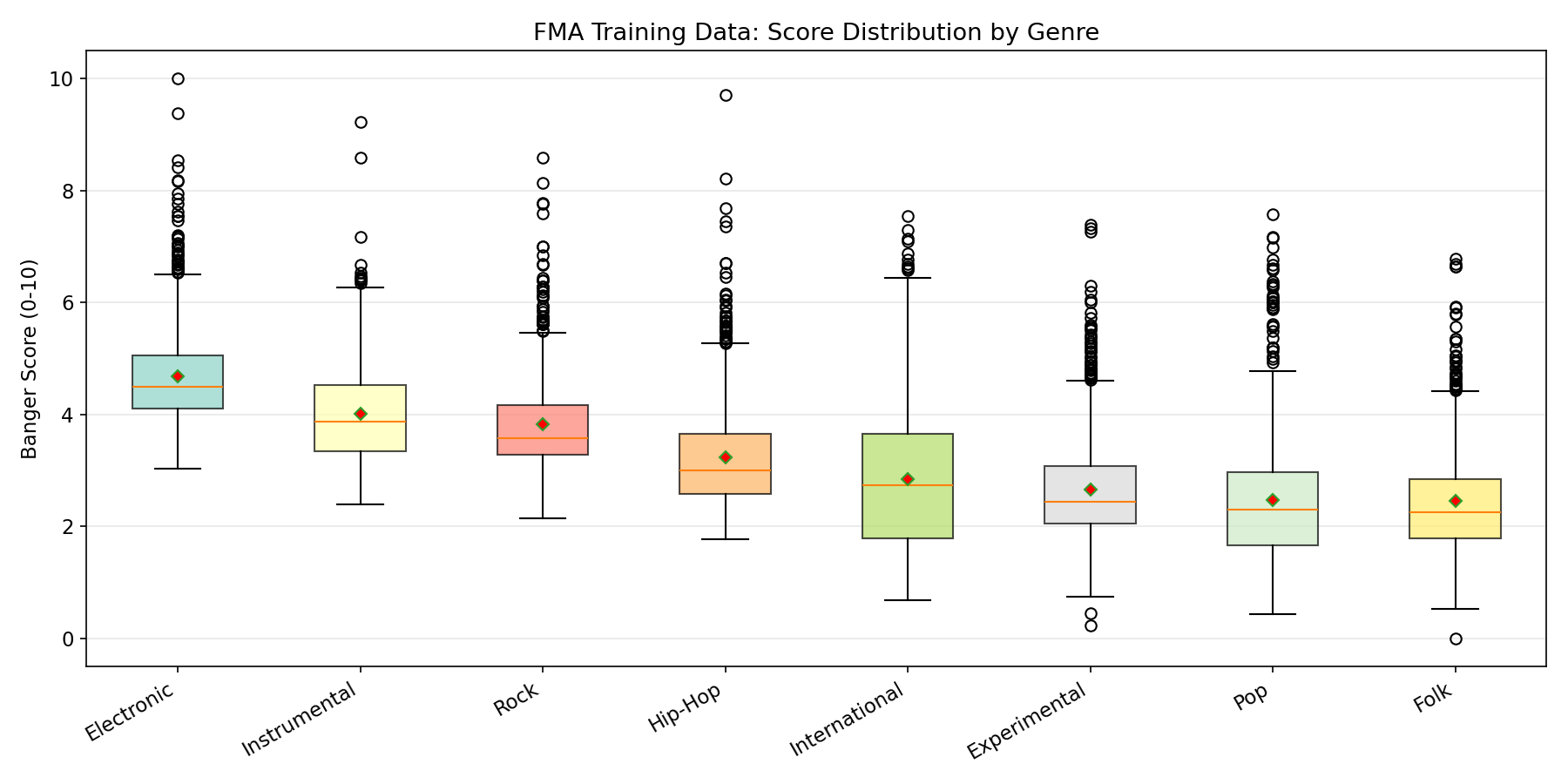
Trained on FMA-Small (Free Music Archive), a Creative Commons dataset of 8,000 tracks across 8 balanced genres (1,000 each): Hip-Hop, Pop, Folk, Experimental, Rock, International, Electronic, Instrumental.
Labels: Play counts from FMA, log-normalized to a 0-10 scale:
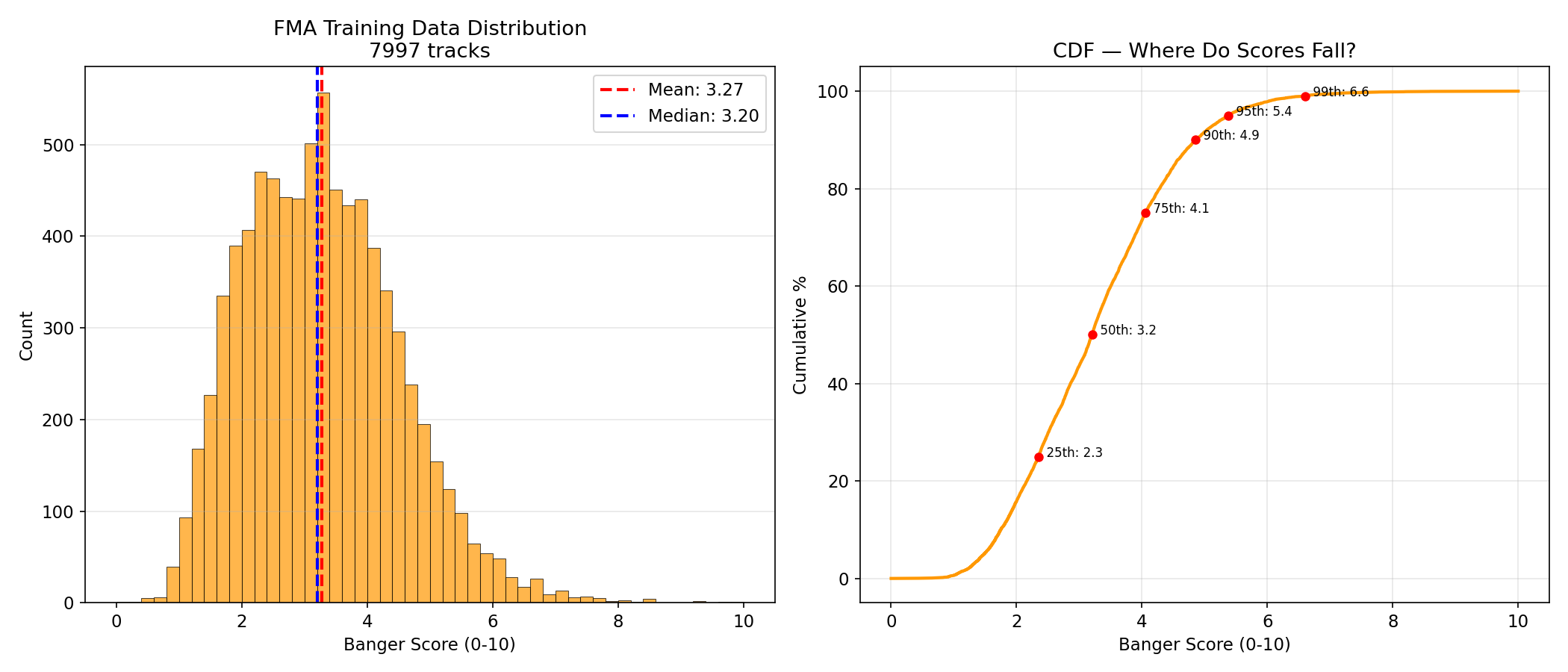
After log-normalization, the training score distribution is heavily concentrated in the 1-5 range, with very few examples above 7:
Training score distribution
Training genre distribution
Pre-computed embeddings are available as a separate dataset: treadon/fma-mert-embeddings. MERT embedding extraction took 101 minutes on M4 Pro MPS across 7,997 successfully processed tracks (3 corrupt MP3s failed, 99.96% success rate).
Early stopping: Patience 20, best model at epoch 9 (early stopped at epoch 30)
Training time: ~30 seconds on Apple M4 Pro (MPS) with cached embeddings
Device: Apple M4 Pro, Metal Performance Shaders (MPS)
Evaluation Results
Metric
Value
Target
Status
Test MAE
0.858
< 1.5
Exceeded by 43%
Test Spearman
0.468
> 0.4
Hit target
Val MAE
0.822
--
--
Model size
~2.6 MB
< 50 MB
--
MAE of 0.858 on a 0-10 scale means predictions are typically off by less than 1 point. For filtering purposes (pick the best 5 from 50), the model reliably distinguishes a 2/10 from a 6/10, even if it cannot tell a 7/10 from an 8/10.
Test Results: 230 AI-Generated Songs
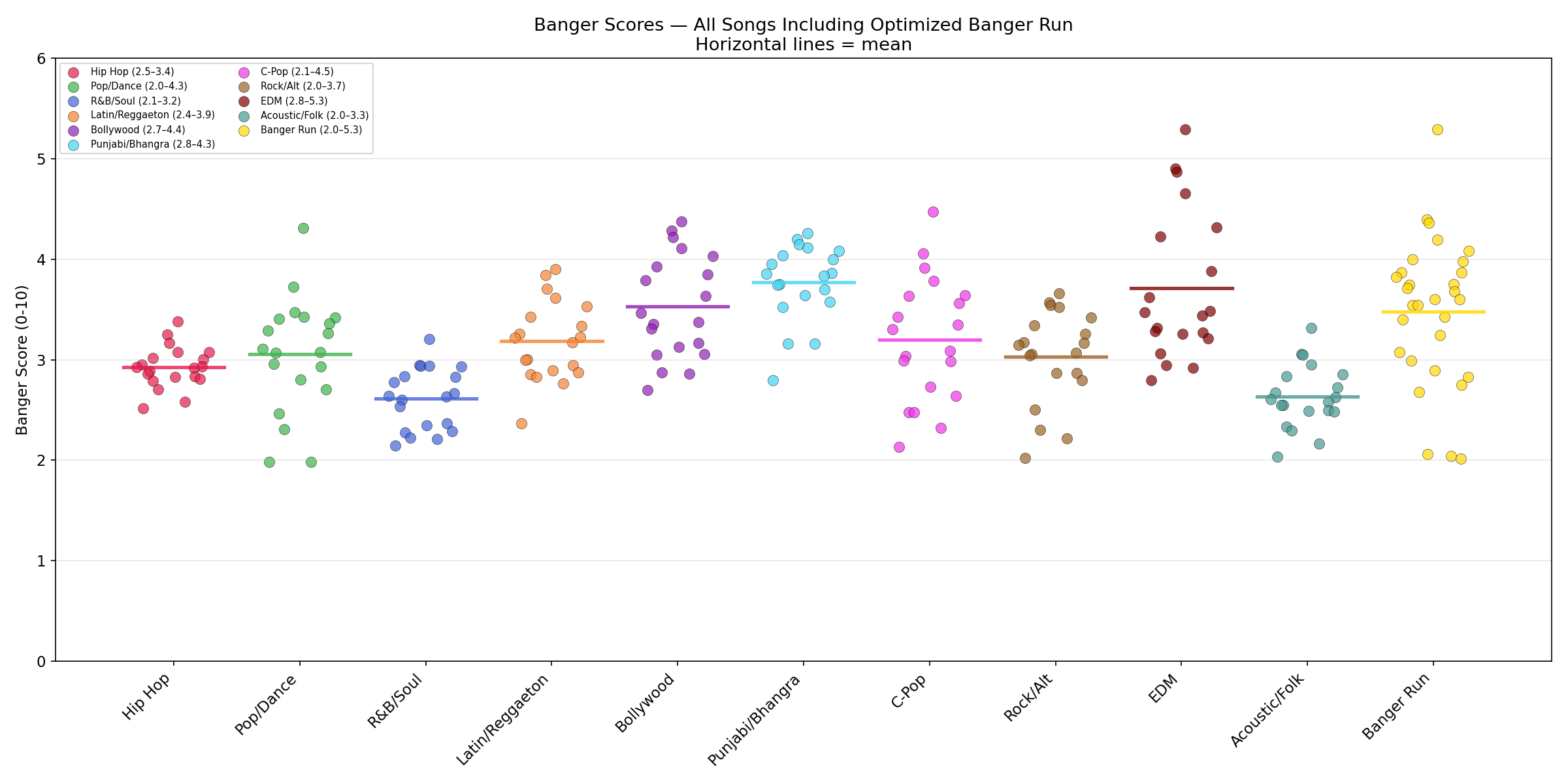
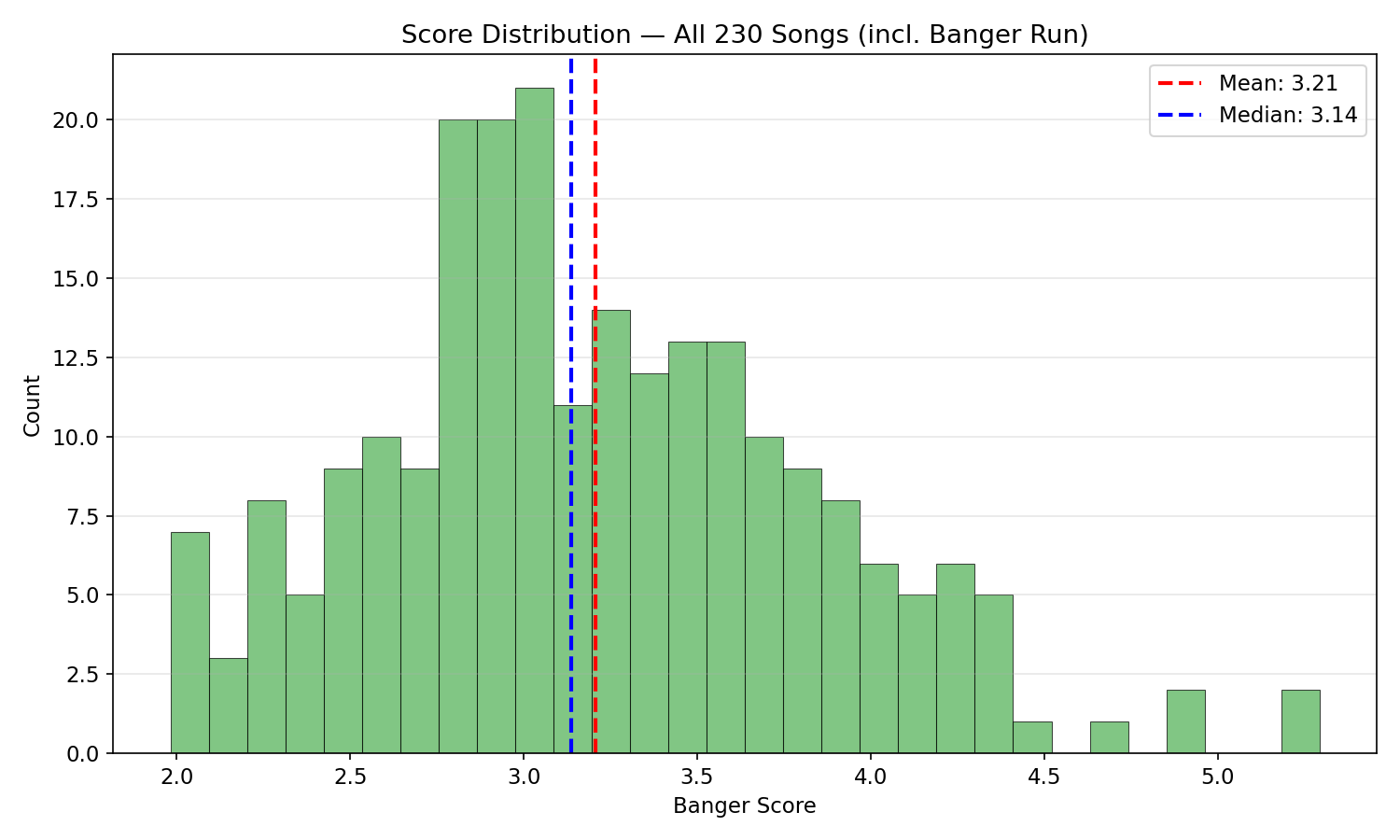
The scorer was tested on 230 songs generated with ACE-Step 1.5 across 10 genres (20 songs each) plus 1 banger-optimized run (30 songs). Languages included English, Spanish, Hindi, Punjabi, and Chinese.
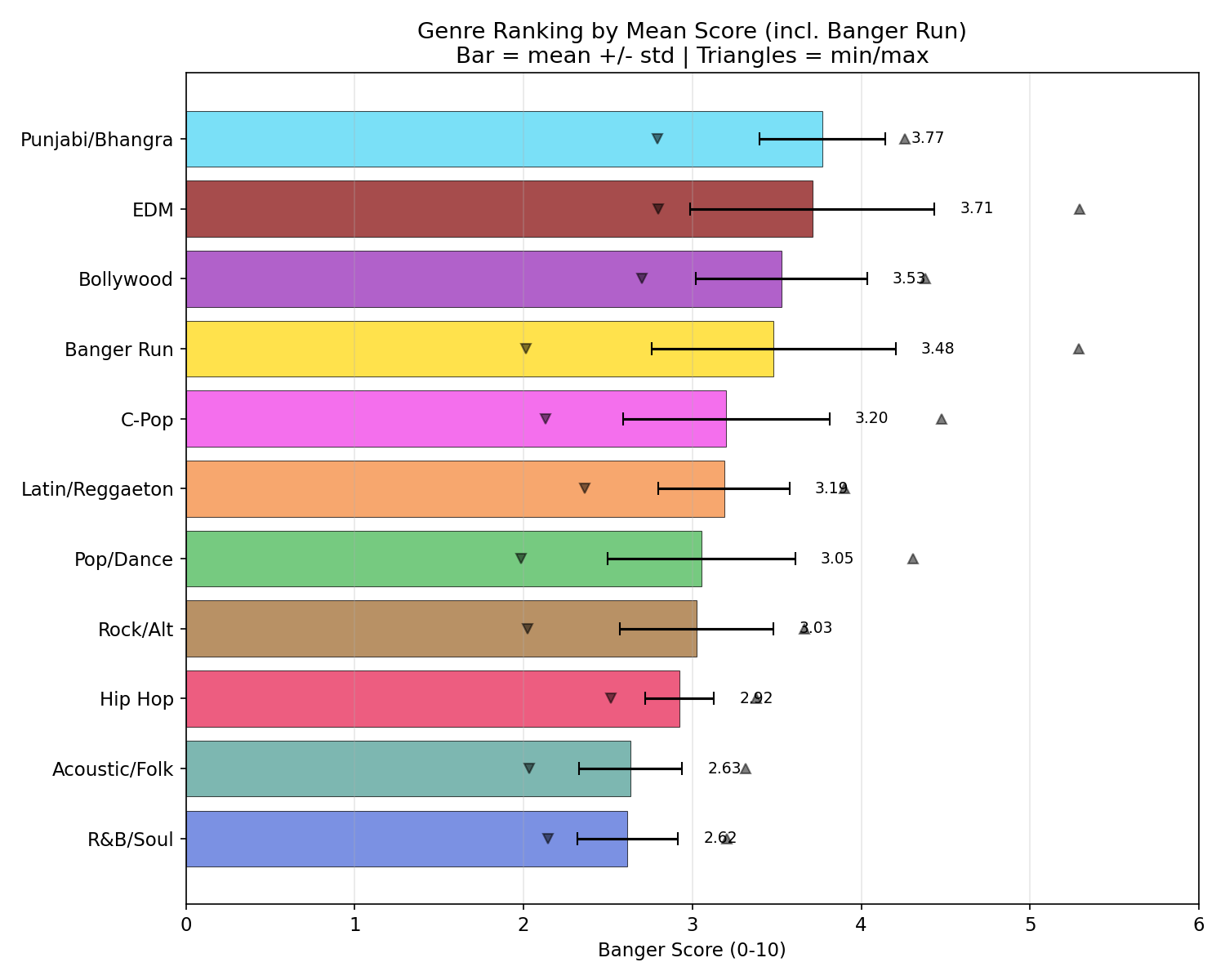
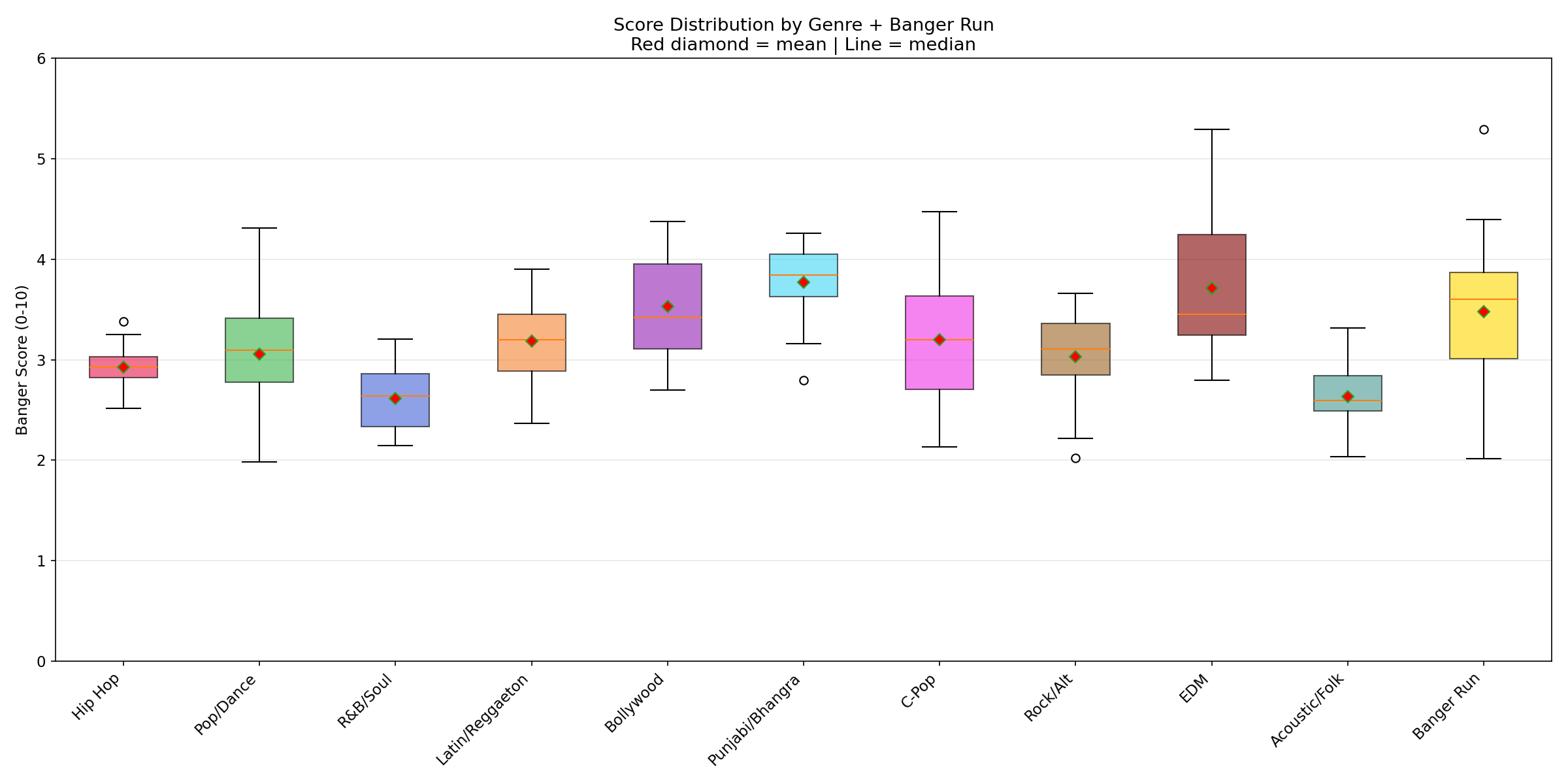
Genre ranking by mean score
Rank
Genre
Mean
Best
Range
1
Electronic/EDM
3.71
5.29
2.80-5.29
2
Punjabi/Bhangra
3.77
4.26
2.79-4.26
3
Bollywood
3.53
4.38
2.70-4.38
4
C-Pop
3.20
4.47
2.13-4.47
5
Latin/Reggaeton
3.19
3.90
2.36-3.90
6
Pop/Dance
3.05
4.31
1.98-4.31
7
Rock/Alternative
3.03
3.66
2.02-3.66
8
Hip Hop
2.92
3.38
2.52-3.38
9
Acoustic/Folk
2.63
3.31
2.03-3.31
10
R&B/Soul
2.62
3.21
2.14-3.21
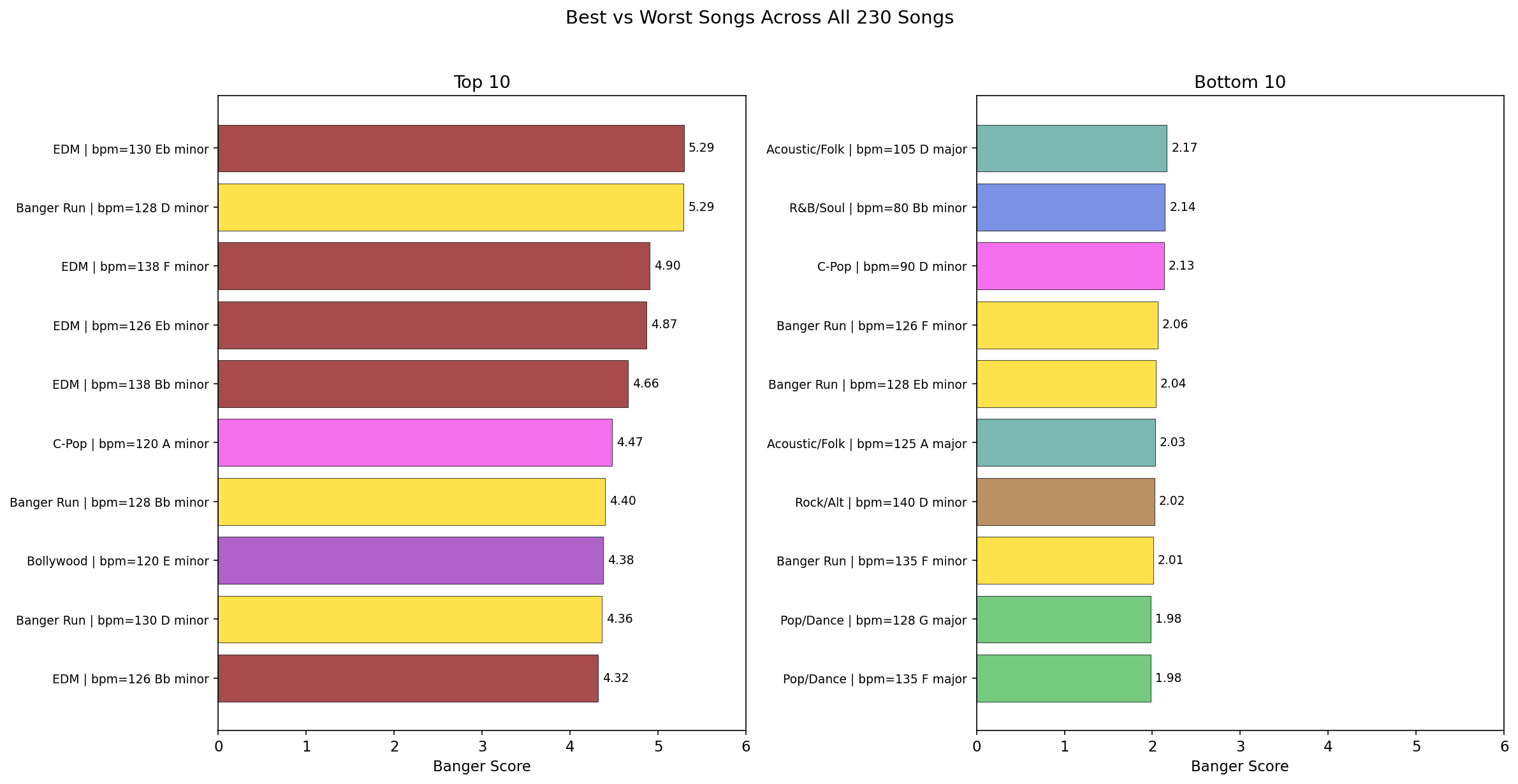
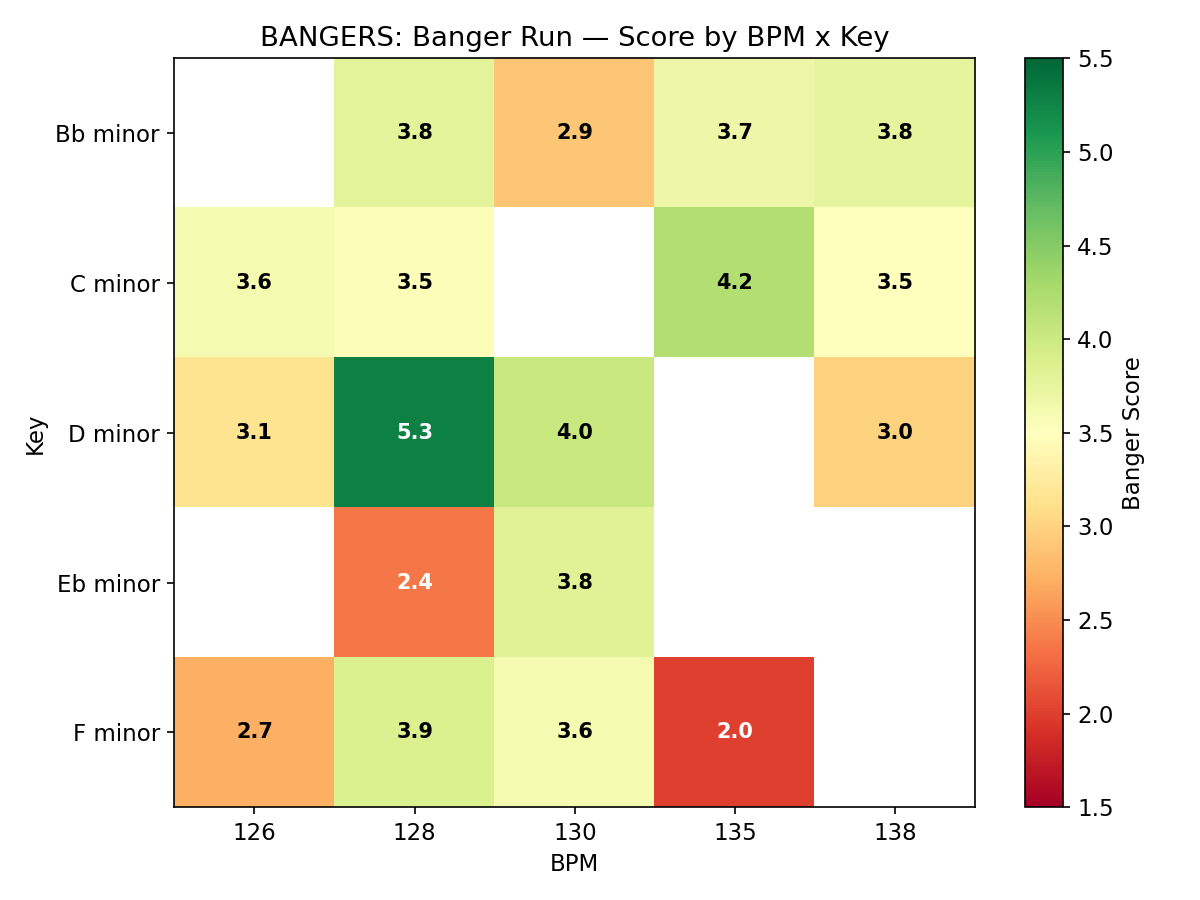
Overall best: Melodic techno, 130 BPM, Eb minor -- scored 5.29/10 (67th percentile of FMA).
Score distribution histogram
Box plot of scores by genre
Optimization Impact
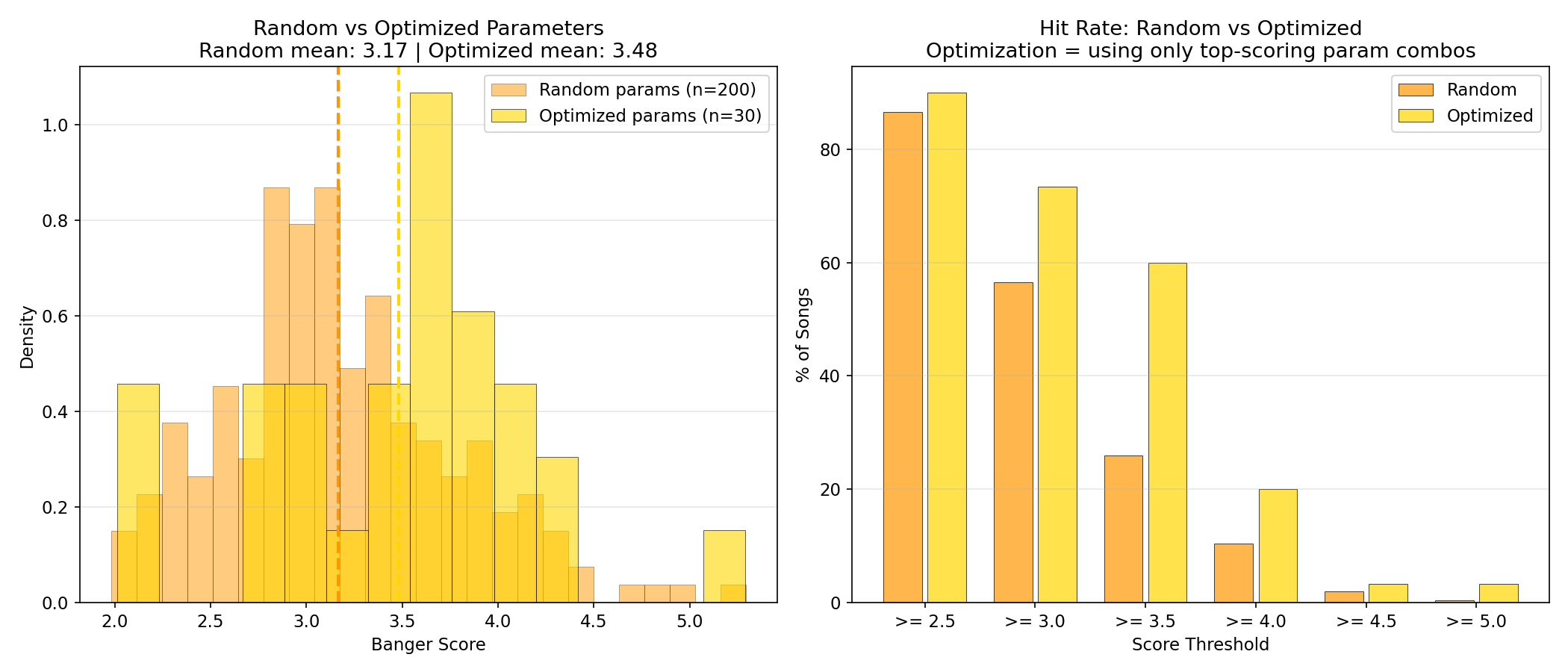
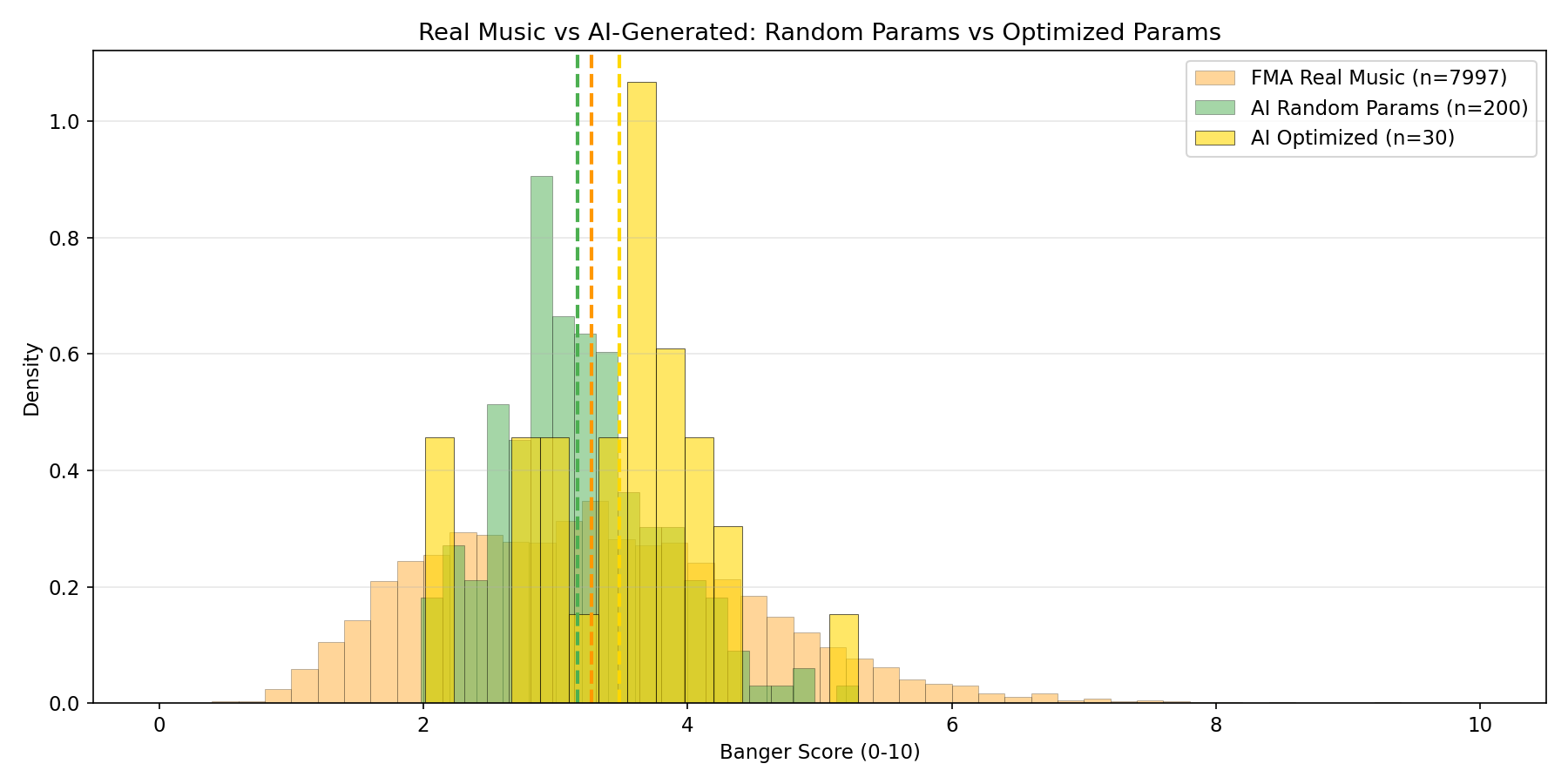
After analyzing the 200 random-parameter songs, a banger-optimized run of 30 songs was generated using only the highest-scoring parameter combinations (dark electronic/industrial styles, 126-138 BPM, minor keys only). Results:
Optimization impact comparison
Metric
Random (200 songs)
Optimized (30 songs)
Improvement
Mean score
3.17
3.48
+10%
Songs >= 3.5
20%
60%
3x
Songs >= 4.0
5%
20%
4x
Top score
5.29
5.29
Same ceiling
The optimization raised the floor and consistency dramatically (4x hit rate for scores >= 4.0) without raising the ceiling.
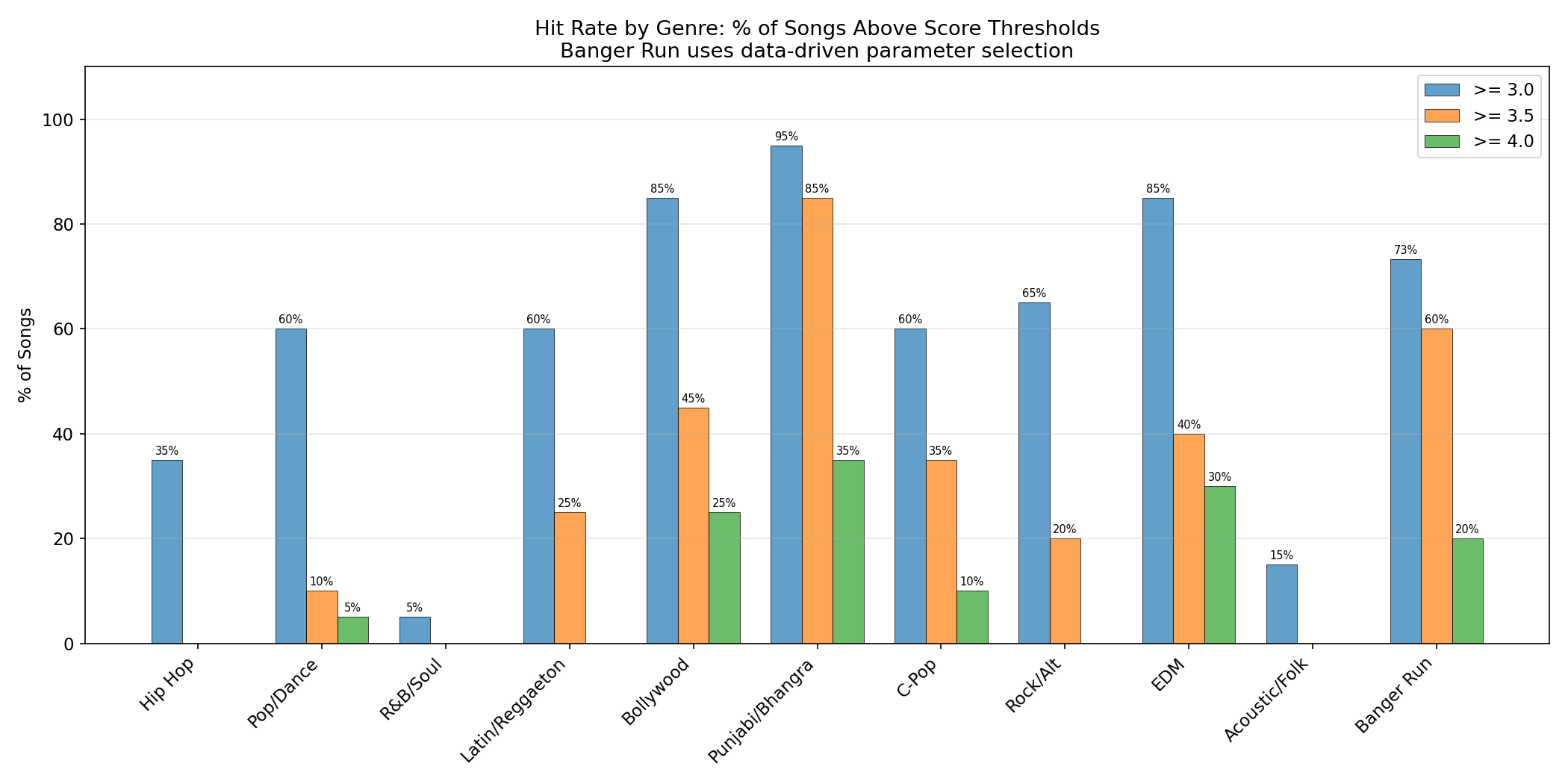
Hit rate comparison by genre
Musical Analysis
Top vs bottom songs comparison
Key findings:
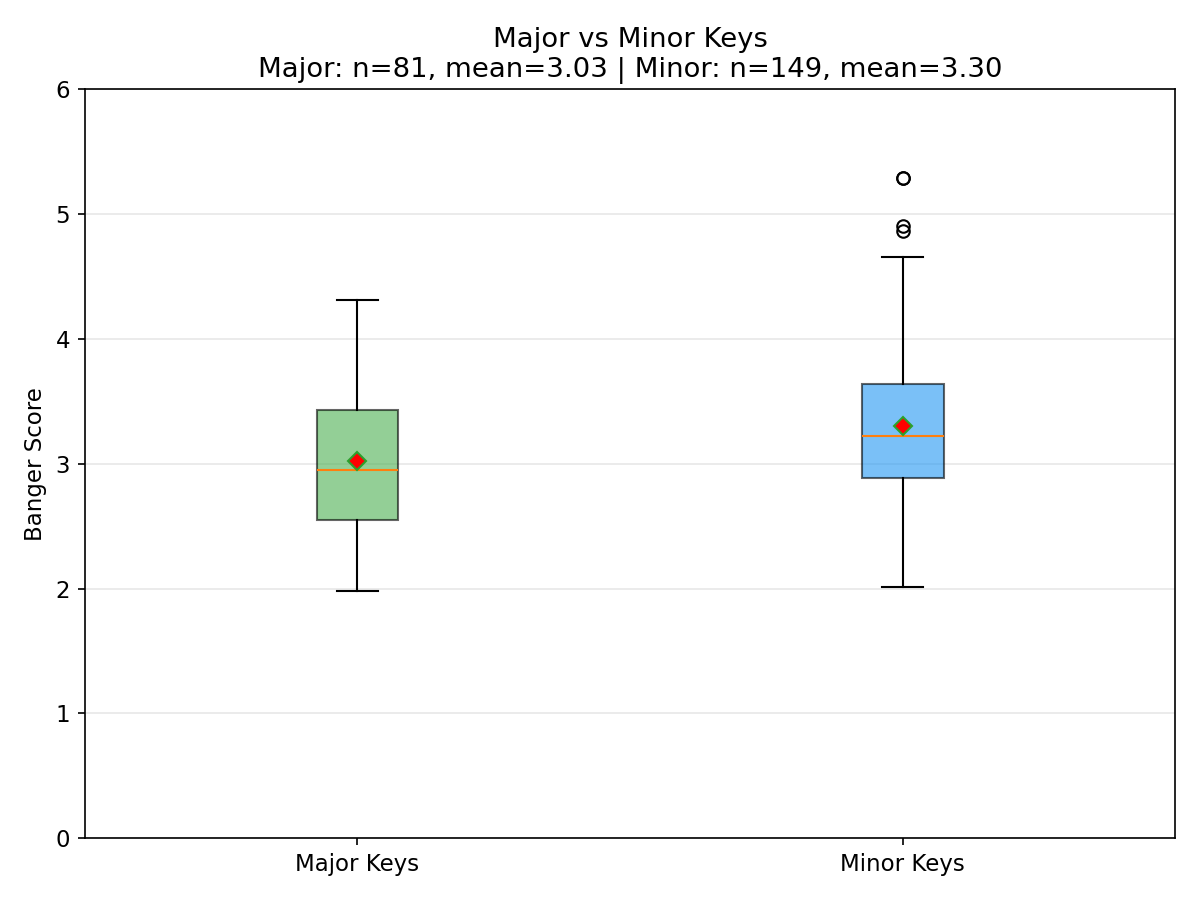
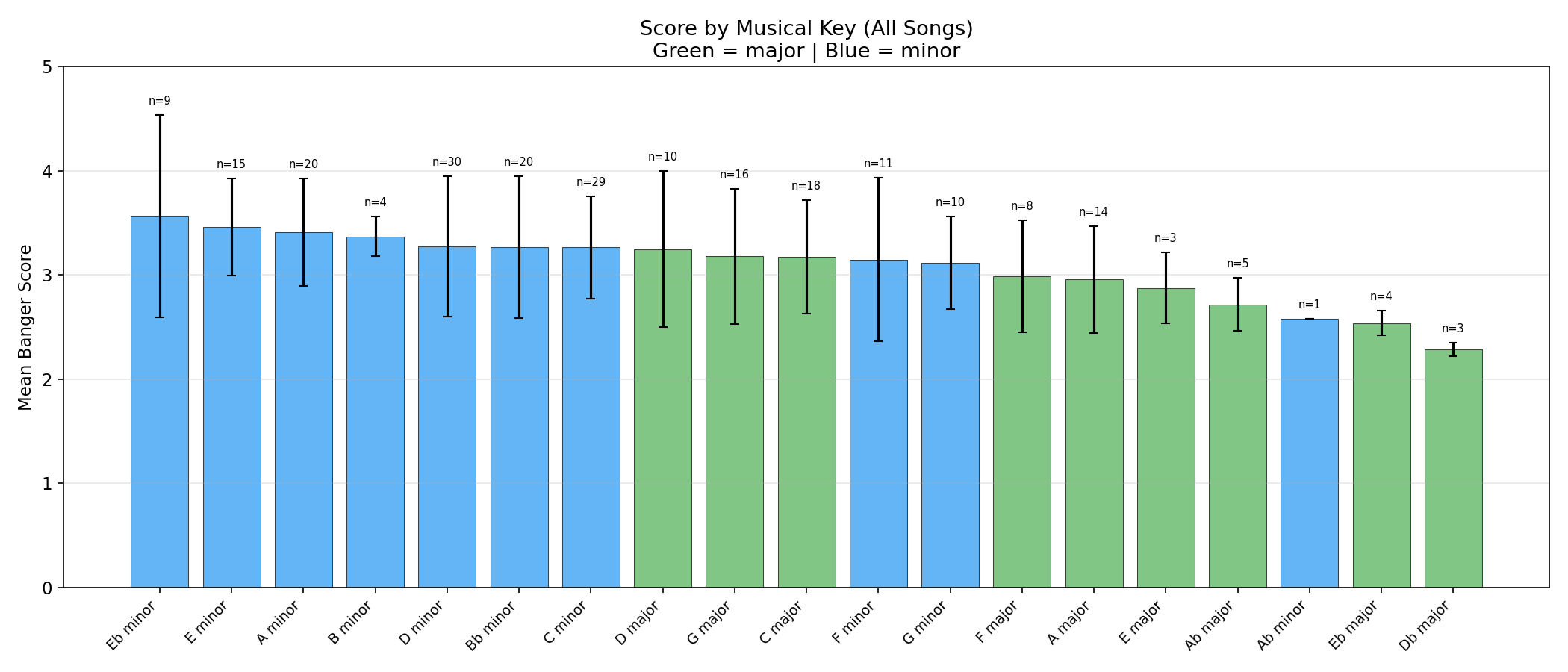
Minor keys outperformed major keys (3.26 vs 3.03 mean)
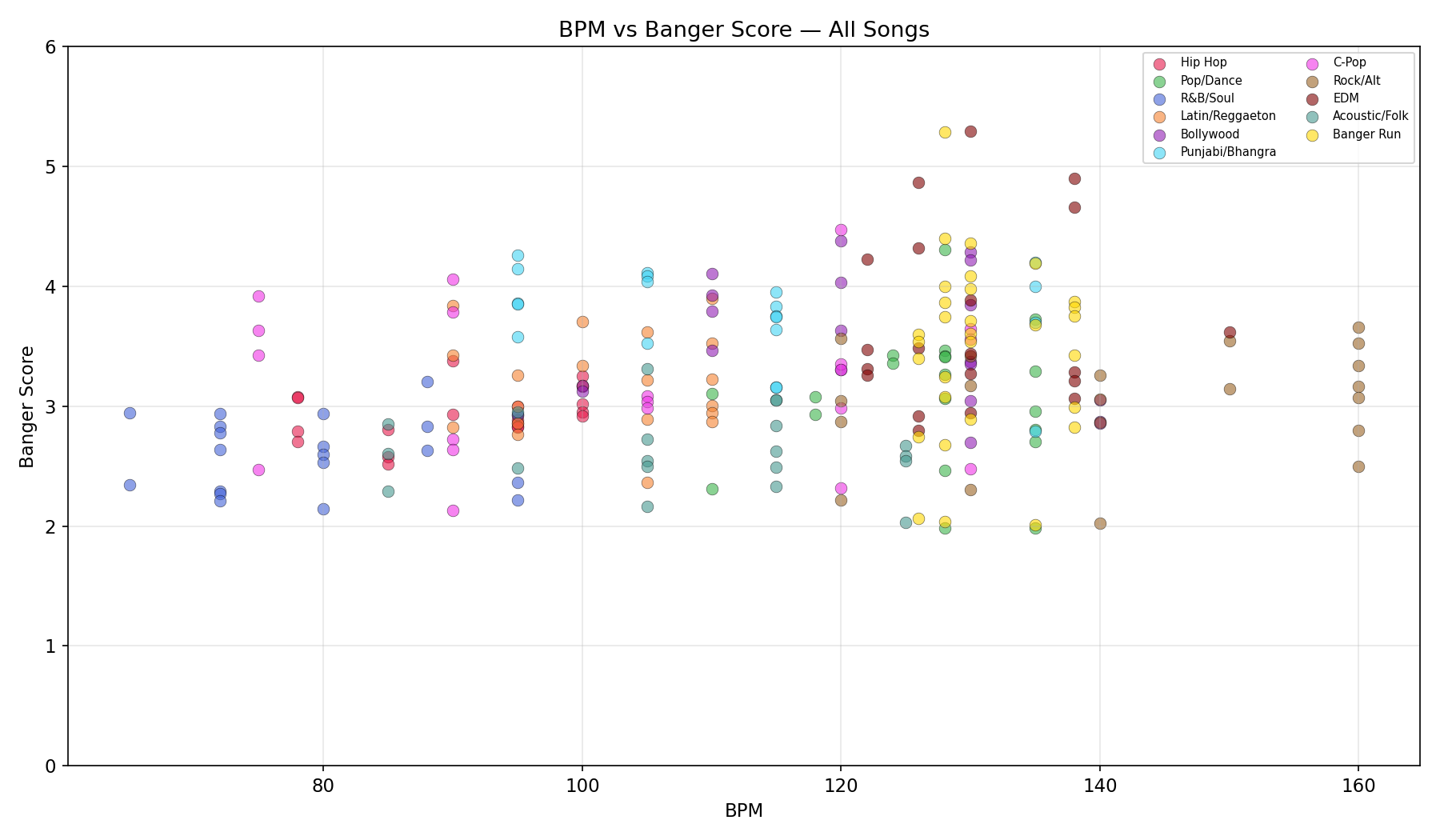
BPM sweet spots vary by genre: EDM peaks at 126-138, Punjabi at 95-105, Pop at 124-128
Slower BPMs (< 85) consistently underperformed across all genres
Do: Use the scorer to rank songs relative to each other within a batch. Generate N candidates, score them all, keep the top K.
Don't: Treat the score as an absolute quality judgment. A song scoring 3.5 is not objectively "bad" -- it just means the model thinks it is less likely to be popular based on patterns learned from FMA play counts.
The scorer is most useful as a cheap, fast filter to surface promising candidates from a large batch of AI-generated music, reducing the amount of human listening needed.
Limitations
Genre bias: The scorer strongly prefers high-energy, beat-driven music (EDM, Punjabi/Bhangra, Bollywood) over mellow genres (R&B, Acoustic/Folk). This reflects FMA's popularity distribution, not absolute musical quality.
FMA popularity != mainstream popularity. FMA is indie/unsigned artists on a free archive. The model learned "music that people actively seek out on a niche platform," not Billboard chart hits.
30-second clips. Songs are scored based on 30-second excerpts. Quality aspects involving full-track structure (build-ups, drops, bridges) are not fully captured.
Mean pooling loses temporal info. By averaging MERT's per-frame outputs, temporal dynamics are collapsed. A song with a brilliant 10-second hook and 20 seconds of noise averages to the same embedding as a consistently mediocre song.
Popularity is not quality. Some brilliant niche music has low play counts; some generic music has millions of plays. The model learns statistical tendencies, not absolute aesthetic truth.
Distribution shift. MERT was trained on real music. AI-generated music may contain subtle artifacts that shift the embedding distribution in ways the scorer was not trained to handle.
Training data skew. Only 45 tracks out of 8,000 score above 7 in the training data. The model learned the 2-5 range well but cannot confidently score anything higher.
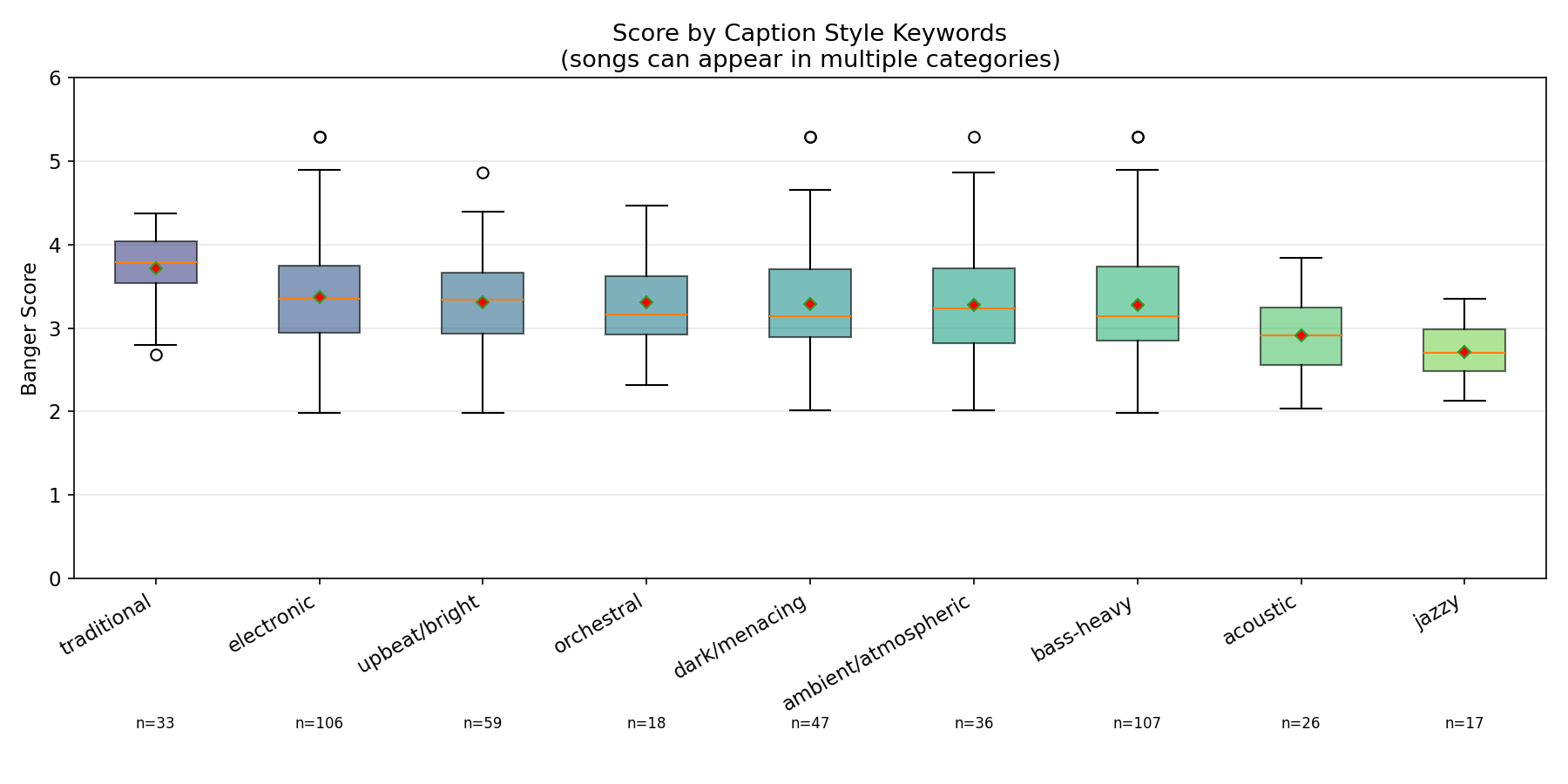
Caption style analysis
Citation
If you use this model, please cite the MERT paper and the FMA dataset:
bibtex
1@article{li2023mert,
2 title={MERT: Acoustic Music Understanding Model with Large-Scale Self-supervised Training},
3 author={Li, Yizhi and Yuan, Ruibin and Zhang, Ge and Ma, Yinghao and others},
4 journal={arXiv preprint arXiv:2306.00107},
5 year={2023}
6}
78@inproceedings{defferrard2017fma,
9 title={FMA: A Dataset For Music Analysis},
10 author={Defferrard, Micha{\"e}l and Benzi, Kirell and Vandergheynst, Pierre and Bresson, Xavier},
11 booktitle={ISMIR},
12 year={2017}
13}