Minerva is the first family of LLMs pretrained from scratch on Italian developed by Sapienza NLP
in the context of the Future Artificial Intelligence Research (FAIR) project, in collaboration with CINECA and with additional contributions from Babelscape and the CREATIVE PRIN Project.
Notably, the Minerva models are truly-open (data and model) Italian-English LLMs, with approximately half of the pretraining data
including Italian text.
This is the model card for Minerva-7B-instruct-v1.0, a 7 billion parameter model trained on almost 2.5 trillion tokens (1.14 trillion in Italian,
1.14 trillion in English and 200 billion in code).
Content that may not be appropriate for all settings, including sexual content
Make errors, including producing incorrect information or historical facts as if it were factual
Generate irrelevant or repetitive outputs
We are aware of the biases and potential problematic/toxic content that current pretrained large language models exhibit: more specifically, as probabilistic models of (Italian and English) languages, they reflect and amplify the biases of their training data.
For more information about this issue, please refer to our survey:
1import transformers
2import torch
34model_id ="sapienzanlp/Minerva-7B-instruct-v1.0"56# Initialize the pipeline.7pipeline = transformers.pipeline(8 model=model_id,9 model_kwargs={"torch_dtype": torch.bfloat16},10 device_map="auto",11)1213# Input text for the model.14input_conv =[{"role":"user","content":"Qual è la capitale dell'Italia?"}]1516# Compute the outputs.17output = pipeline(18 input_conv,19 max_new_tokens=128,20)2122output
[{'generated_text': [{'role': 'user', 'content': "Qual è la capitale dell'Italia?"}, {'role': 'assistant', 'content': "La capitale dell'Italia è Roma."}]}]
Model Architecture
Minerva-7B-base-v1.0 is a Transformer model based on the Mistral architecture.
Please look at the configuration file for a detailed breakdown of the hyperparameters we chose for this model.
The Minerva LLM family is composed of:
Model Name
Tokens
Layers
Hidden Size
Attention Heads
KV Heads
Sliding Window
Max Context Length
Minerva-350M-base-v1.0
70B (35B it + 35B en)
16
1152
16
4
2048
16384
Minerva-1B-base-v1.0
200B (100B it + 100B en)
16
2048
16
4
2048
16384
Minerva-3B-base-v1.0
660B (330B it + 330B en)
32
2560
32
8
2048
16384
Minerva-7B-base-v1.0
2.48T (1.14T it + 1.14T en + 200B code)
32
4096
32
8
None
4096
Model Training
Minerva-7B-base-v1.0 was trained using llm-foundry 0.8.0 from MosaicML. The hyperparameters used are the following:
Model Name
Optimizer
lr
betas
eps
weight decay
Scheduler
Warmup Steps
Batch Size (Tokens)
Total Steps
Minerva-350M-base-v1.0
Decoupled AdamW
2e-4
(0.9, 0.95)
1e-8
0.0
Cosine
2%
4M
16,690
Minerva-1B-base-v1.0
Decoupled AdamW
2e-4
(0.9, 0.95)
1e-8
0.0
Cosine
2%
4M
47,684
Minerva-3B-base-v1.0
Decoupled AdamW
2e-4
(0.9, 0.95)
1e-8
0.0
Cosine
2%
4M
157,357
Minerva-7B-base-v1.0
AdamW
3e-4
(0.9, 0.95)
1e-5
0.1
Cosine
2000
4M
591,558
SFT Training
The SFT model was trained using Llama-Factory. The data mix was the following:
This model card is for our DPO model. Direct Preference Optimization (DPO) is a method that refines models based on user feedback, similar to Reinforcement Learning from Human Feedback (RLHF), but without the complexity of reinforcement learning. Online DPO further improves this by allowing real-time adaptation during training, continuously refining the model with new feedback. For training this model, we used the Hugging Face TRL library and Online DPO, with the Skywork/Skywork-Reward-Llama-3.1-8B-v0.2 model as the judge to evaluate and guide optimization. For this stage we used just the prompts from HuggingFaceH4/ultrafeedback_binarized (English), efederici/evol-dpo-ita (Italian) and Babelscape/ALERT translated to Italian, with additional manually curated data for safety.
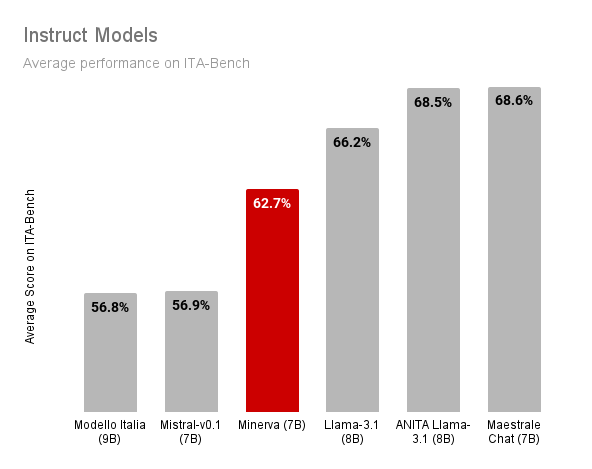
For Minerva's evaluation process, we utilized ITA-Bench, a new evaluation suite to test the capabilities of Italian-speaking models.
ITA-Bench is a collection of 18 benchmarks that assess the performance of language models on various tasks, including scientific knowledge,
commonsense reasoning, and mathematical problem-solving.
Results on instructed models
Results on instructed models
Tokenizer Fertility
The tokenizer fertility measures the average amount of tokens produced per tokenized word.
A tokenizer displaying high fertility values in a particular language typically indicates that it segments words in that language extensively.
The tokenizer fertility is strictly correlated with the inference speed of the model with respect to a specific language,
as higher values mean longer sequences of tokens to generate and thus lower inference speed.
Fertility computed over a sample of Cultura X (CX) data and Wikipedia (Wp):
Model
Voc. Size
Fertility IT (CX)
Fertility EN (CX)
Fertility IT (Wp)
Fertility EN (Wp)
Mistral-7B-v0.1
32000
1.87
1.32
2.05
1.57
gemma-7b
256000
1.42
1.18
1.56
1.34
Minerva-3B-base-v1.0
32768
1.39
1.32
1.66
1.59
Minerva-7B-base-v1.0
51200
1.32
1.26
1.56
1.51
The Sapienza NLP Team
🧭 Project Lead and Coordination
Roberto Navigli: project lead and coordination; model analysis, evaluation and selection, safety and guardrailing, conversations.
🤖 Model Development
Edoardo Barba: pre-training, post-training, data analysis, prompt engineering.
Simone Conia: pre-training, post-training, evaluation, model, and data analysis.
Pere-Lluís Huguet Cabot: data processing, filtering,g and deduplication, preference modeling.
Luca Moroni: data analysis, evaluation, post-training.
Riccardo Orlando: pre-training process and data processing.
👮 Safety and Guardrailing
Stefan Bejgu: safety and guardrailing.
Federico Martelli: synthetic prompt generation, model and safety analysis.
Ciro Porcaro: additional safety prompts.
Alessandro Scirè: safety and guardrailing.
Simone Stirpe: additional safety prompts.
Simone Tedeschi: English dataset for safety evaluation.
Special thanks for their support
Giuseppe Fiameni, Nvidia
Sergio Orlandini, CINECA
Acknowledgments
This work was funded by the PNRR MUR project PE0000013-FAIR and the CREATIVE PRIN project, which is funded by the MUR Progetti di
Rilevante Interesse Nazionale programme (PRIN 2020).
We acknowledge the CINECA award "IscB_medit" under the ISCRA initiative for the availability of high-performance computing resources and support.


.png)