


Views
No views yet
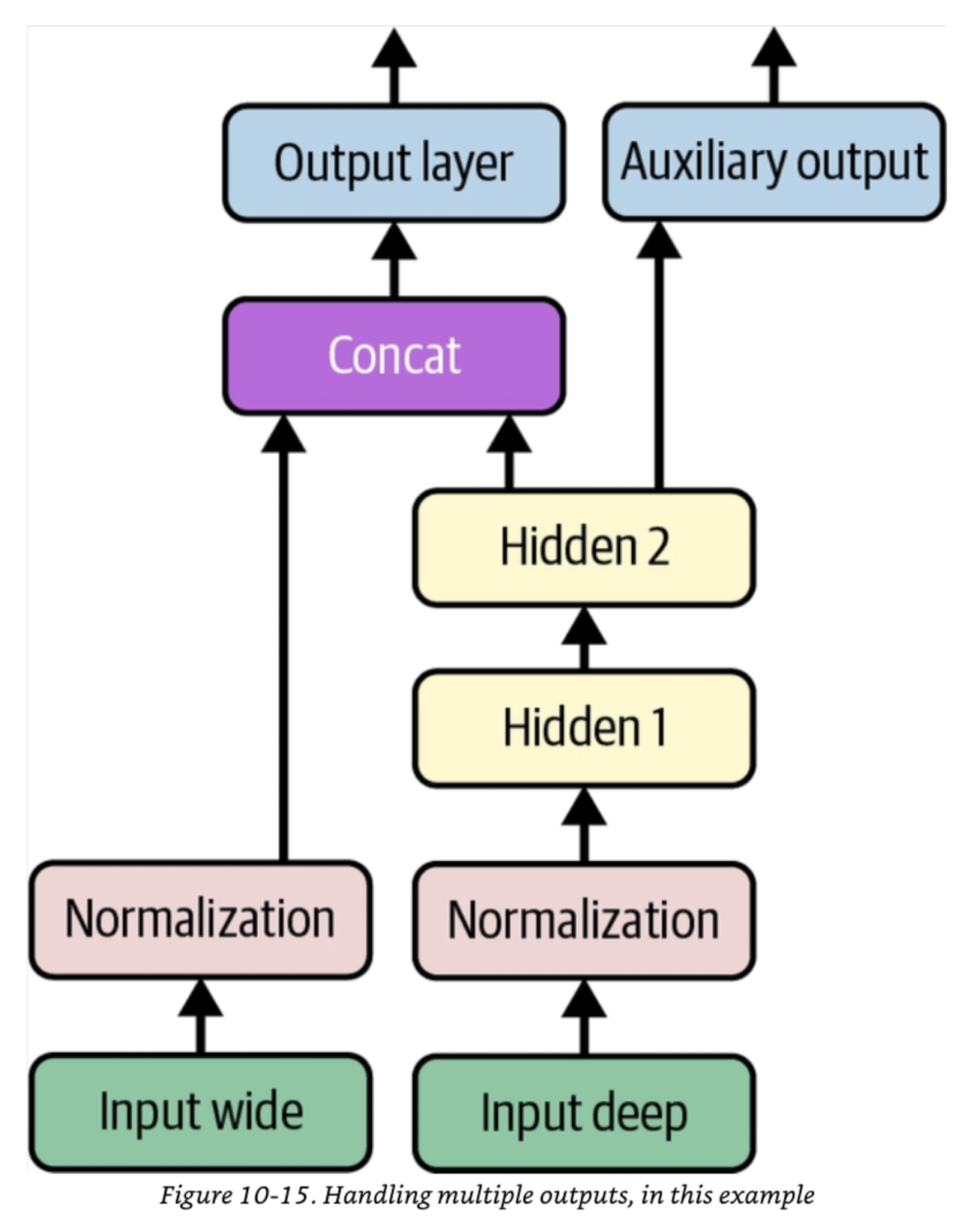
'MedInc', 'HouseAge', 'AveRooms', 'AveBedrms', 'Population', 'AveOccup', 'Latitude' and 'Longitude'. It predicts 'MedHouseVal'.'MedInc', 'HouseAge', 'AveRooms', 'AveBedrms' and 'Population') flow through the wide path.'AveRooms', 'AveBedrms', 'Population', 'AveOccup', 'Latitude' and 'Longitude') flow through the deep path.'AveRooms', 'AveBedrms' and 'Population' flow through both the wide path and the deep path.'MedHouseVal'). As mentioned in the book, this is a regularization technique, to try and ensure that the "underlying part of the network" (i.e., the deep path) learns something useful on its own, without relying on the rest of the network.from sklearn.datasets import fetch_california_housing
housing = fetch_california_housing(as_frame=True)
from sklearn.model_selection import train_test_split
X_train_full, X_test, y_train_full, y_test = train_test_split(housing['data'], housing['target'], test_size=0.25, random_state=42)
X_train, X_valid, y_train, y_valid = train_test_split(X_train_full, y_train_full, test_size=0.25, random_state=42)
X_means, X_stds = X_train.mean(axis=0), X_train.std(axis=0)
X_train = (X_train - X_means) / X_stds
X_valid = (X_valid - X_means) / X_stds
X_test = (X_test - X_means) / X_stds
import torch
device = torch.device("cpu")
from dataclasses import dataclass
from typing import Optional
@dataclass
class WideAndDeepNetOutput:
main_output: torch.Tensor
aux_output: torch.Tensor
main_loss: Optional[torch.Tensor] = None
aux_loss: Optional[torch.Tensor] = None
loss: Optional[torch.Tensor] = None
import torch.nn as nn
from huggingface_hub import PyTorchModelHubMixin
class WideAndDeepNet(nn.Module, PyTorchModelHubMixin):
def __init__(self):
super().__init__()
self.hidden1 = nn.Linear(6, 30)
self.hidden2 = nn.Linear(30, 30)
self.main_head = nn.Linear(35, 1)
self.aux_head = nn.Linear(30, 1)
self.main_loss_fn = nn.MSELoss(reduction='sum')
self.aux_loss_fn = nn.MSELoss(reduction='sum')
def forward(self, input_wide, input_deep, label=None):
act = torch.relu(self.hidden1(input_deep))
act = torch.relu(self.hidden2(act))
concat = torch.cat([input_wide, act], dim=1)
main_output = self.main_head(concat)
aux_output = self.aux_head(act)
if label is not None:
main_loss = self.main_loss_fn(main_output.squeeze(), label)
aux_loss = self.aux_loss_fn(aux_output.squeeze(), label)
loss = 0.9 * main_loss + 0.1 * aux_loss
return WideAndDeepNetOutput(main_output, aux_output, main_loss, aux_loss, loss)
else:
return WideAndDeepNetOutput(main_output, aux_output)
model = WideAndDeepNet.from_pretrained("sadhaklal/wide-and-deep-net-california-housing-v3")
model.to(device)
model.eval()
# Let's predict on 3 unseen examples from the test set:
print(f"Ground truth housing prices: {y_test.values[:3]}")
new = {
'input_wide': torch.tensor(X_test.values[:3, :5], dtype=torch.float32),
'input_deep': torch.tensor(X_test.values[:3, 2:], dtype=torch.float32)
}
new = {k: v.to(device) for k, v in new.items()}
with torch.no_grad():
output = model(**new)
print(f"Predicted housing prices: {output.main_output.squeeze()}")