A Taiwan-aligned research preview for local GGUF evaluation — and an early community showcase for a broader model-neutral Taiwan Alignment Pipeline.
This repository is an independent community research preview derived from Qwen/Qwen3.6-35B-A3B at pinned revision 995ad96eacd98c81ed38be0c5b274b04031597b0.
It focuses on selected Taiwan-specific instruction-following behaviors: Traditional Chinese, ROC/Taiwan governance, cross-strait framing, sensitive history, Taiwan public-sector terminology, and local evaluation workflows.
Project philosophy
This project does not attempt to create a politically “correct” model.
Instead, it explores how open-weight models can be localized to a specific legal, cultural, linguistic, and governance context through transparent and reproducible engineering.
Why this matters
Fluent Chinese is not the same as Taiwan-ready AI. A model can answer in Traditional Chinese while still failing on ROC institutions, Taiwan legal/regulatory terms, ROC year conversion, Taiwan history, public-document style, or cross-strait factual framing.
This model is therefore best understood as a showcase for a repeatable pipeline:
text
1Base model
2  -> Taiwan-localized benchmark
3  -> adaptation / fine-tuning / RAG / guardrails
4  -> regression and safety checks
5  -> local GGUF or deployment package
6  -> reproducible evaluation report
What is public today
This release is a research preview with provenance, quantization details, runtime notes, limitations, and reproducibility material.
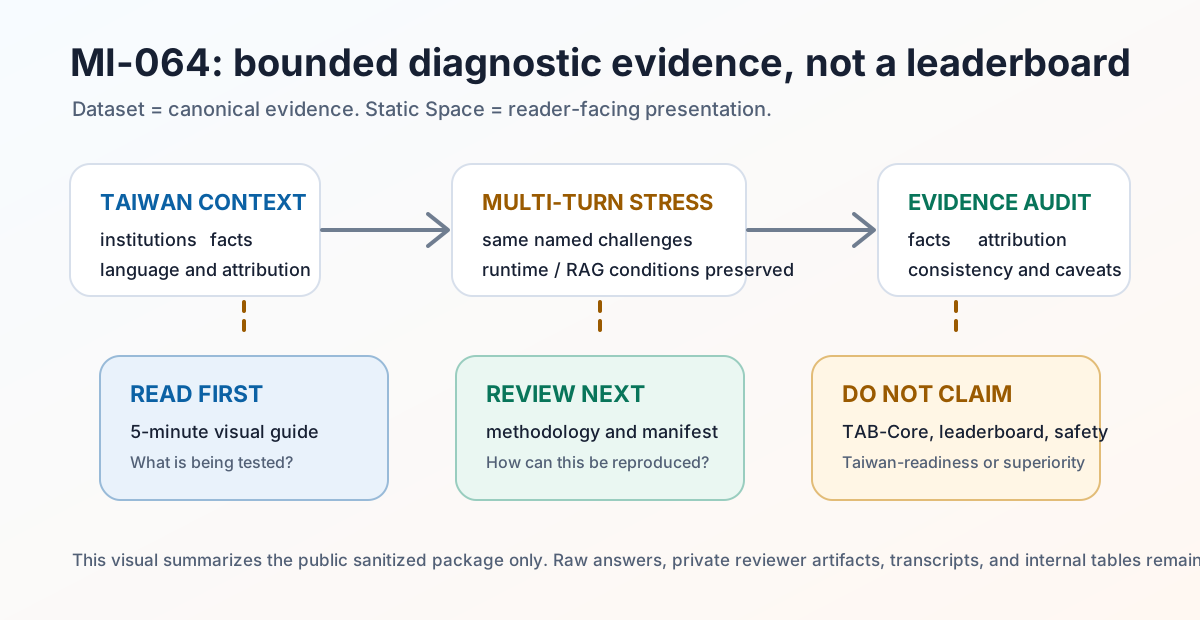
A bounded public diagnostic-methodology package for external review is available at rickytzai/mi-064-local-openbook-diagnostics-staging. It documents sanitized MI-064 methodology, comparability corrections, and bridge-review material for review purposes only. It is not TAB-Core, not a leaderboard, not a safety proof, not a model-superiority proof, and not a claim that this or any other model is Taiwan-ready.
A broader Taiwan Alignment Benchmark (TAB) is being prepared separately. Public leaderboard-style scores are intentionally not highlighted here yet, because the current benchmark seed is still too small to be used as a community ranking standard.
Reproducible before / after example
Before/After demo
This is a single verified example from the local MI-061 comparison artifact. It is useful as a communication demo, not as a standalone benchmark or safety proof.
Recorded device: AMD Radeon(TM) 8060S Graphics, ROCm/HIP runtime.
Caveat
One example does not prove general alignment, safety, robustness, or production readiness. It only illustrates the kind of framing difference TAB is designed to evaluate at larger scale.
FAQ: Why not just use RAG?
RAG is useful, and this project does not reject it.
However, RAG does not fully solve every localization problem. Some failures are not missing-document problems; they are instruction-following, framing, terminology, refusal-policy, or long-dialogue drift problems. A model may retrieve the right source and still answer with the wrong governance frame, wrong Taiwan terminology, or an over-broad political refusal.
The long-term pipeline should compare multiple approaches:
raw base model,
fine-tuned model,
RAG-assisted model,
guarded harness,
and hybrid systems.
These should not be mixed into one leaderboard without labels.
See docs/MODEL_LINEAGE.md and PROVENANCE.json for details.
Fine-tuning Method
The v4a adapter was trained with BF16 LoRA on task-specific materials targeting selected Taiwan governance, cross-strait framing, Tiananmen / 8964, 228 Incident, answer-policy, and general-retention behaviors. Training and evaluation remain limited in scope.
GGUF tensor count recorded in MI-061 evidence: 733
Evaluation Boundary
This model has internal task-specific evaluation evidence, but it should not be read as a public leaderboard, general-intelligence benchmark, safety proof, neutrality proof, or production-readiness claim.
A broader Taiwan Alignment Benchmark (TAB) is being prepared as a separate, model-neutral benchmark. Public TAB-Core scores should wait for larger reviewed coverage, cleaner source citations, contamination controls, fair runtime settings, and separate tracks for raw / fine-tuned / RAG / guarded-harness systems.
Known Limitations
Some sensitive historical and political outputs may still require independent verification.
Training and evaluation coverage remain limited.
Runtime settings can affect final content; insufficient output budget or enabled reasoning may produce empty final responses.
This release does not resolve supply-chain suitability questions for government, national-security, critical-infrastructure, or highly regulated use cases.
Recommended Runtime Settings
Temperature: 0.0 for evaluation-style use.
Reasoning effort: none when the runtime supports it.
Prompt suffix/prefix convention used in smoke tests: /no_think.
Tested local context length for smoke: 4096.
LM Studio Usage
See USE_IN_LMSTUDIO.md.
llama.cpp Usage
See USE_WITH_LLAMA_CPP.md.
OpenAI-Compatible API Example
See USE_WITH_OPENAI_COMPATIBLE_API.md, examples/openai_compatible_python.py, and examples/curl_chat_completions.sh.
Suggested Use
Use this model for local research, comparison, and reproducibility experiments. For enterprise or public-sector use, evaluate supply-chain constraints, data boundary, deployment controls, audit logs, and customer-specific compliance requirements before any deployment decision.
License and Attribution
This release preserves the upstream Apache-2.0 license. Apache-2.0 grants redistribution of derivative/object forms subject to its conditions, including providing the license, retaining notices, marking changes, and respecting trademark limitations. No trademark license is granted beyond reasonable descriptive use.
Citation
If referencing this research preview, cite the base model and this derivative package:
text
1Qwen/Qwen3.6-35B-A3B, revision 995ad96eacd98c81ed38be0c5b274b04031597b0.
2Qwen3.6-35B-A3B Taiwan Edition — TW-v4a GGUF, independent community derivative research preview.
Contact and Issue Reporting
Report issues through this Hugging Face repository discussion or issue interface. Please include runtime, prompt, settings, and whether /no_think or equivalent reasoning suppression was used.
LM Studio 0.4.19 Filename Cache Observation
During a Windows 11 / LM Studio 0.4.19 manual test, the unchanged GGUF initially displayed incomplete model-browser metadata under a reused filename. Renaming the same unchanged GGUF forced a fresh scan and restored architecture detection as qwen35moe. This appears to be a local cache/filename refresh observation, not evidence that the GGUF content was defective.