Qwen-7B is the 7B-parameter version of the large language model series, Qwen (abbr. Tongyi Qianwen), proposed by Aibaba Cloud. Qwen-7B is a Transformer-based large language model, which is pretrained on a large volume of data, including web texts, books, codes, etc. Additionally, based on the pretrained Qwen-7B, we release Qwen-7B-Chat, a large-model-based AI assistant, which is trained with alignment techniques. This repository is the one for Qwen-7B.
The features of Qwen-7B include:
Large-scale high-quality training corpora: It is pretrained on over 2.2 trillion tokens, including Chinese, English, multilingual texts, code, and mathematics, covering general and professional fields. The distribution of the pre-training corpus has been optimized through a large number of ablation experiments.
Competitive performance: It significantly surpasses existing open-source models of similar scale on multiple Chinese and English downstream evaluation tasks (including commonsense, reasoning, code, mathematics, etc.), and even surpasses some larger-scale models in several benchmarks. See below for specific evaluation results.
More comprehensive vocabulary coverage: Compared with other open-source models based on Chinese and English vocabularies, Qwen-7B uses a vocabulary of over 150K tokens. This vocabulary is more friendly to multiple languages, enabling users to directly further enhance the capability for certain languages without expanding the vocabulary.
For more details about the open-source model of Qwen-7B, please refer to the Github code repository.
要求(Requirements)
python 3.8及以上版本
pytorch 1.12及以上版本,推荐2.0及以上版本
建议使用CUDA 11.4及以上(GPU用户、flash-attention用户等需考虑此选项)
python 3.8 and above
pytorch 1.12 and above, 2.0 and above are recommended
CUDA 11.4 and above are recommended (this is for GPU users, flash-attention users, etc.)
依赖项 (Dependency)
运行Qwen-7B,请确保满足上述要求,再执行以下pip命令安装依赖库
To run Qwen-7B, please make sure you meet the above requirements, and then execute the following pip commands to install the dependent libraries.
In addition, it is recommended to install the flash-attention library for higher efficiency and lower memory usage.
git clone -b v1.0.8 https://github.com/Dao-AILab/flash-attention
cd flash-attention && pip install .
# 下方安装可选,安装可能比较缓慢。
# Below are optional. Installing them might be slow.
# pip install csrc/layer_norm
# pip install csrc/rotary
快速使用(Quickstart)
您可以通过以下代码轻松调用:
You can easily call the model with the following code:
from transformers import AutoModelForCausalLM, AutoTokenizer
from transformers.generation import GenerationConfig

# Note: The default behavior now has injection attack prevention off.
tokenizer = AutoTokenizer.from_pretrained("Qwen/Qwen-7B", trust_remote_code=True)

# use bf16
# model = AutoModelForCausalLM.from_pretrained("Qwen/Qwen-7B", device_map="auto", trust_remote_code=True, bf16=True).eval()
# use fp16
# model = AutoModelForCausalLM.from_pretrained("Qwen/Qwen-7B", device_map="auto", trust_remote_code=True, fp16=True).eval()
# use cpu only
# model = AutoModelForCausalLM.from_pretrained("Qwen/Qwen-7B", device_map="cpu", trust_remote_code=True).eval()
# use auto mode, automatically select precision based on the device.
model = AutoModelForCausalLM.from_pretrained("Qwen/Qwen-7B", device_map="auto", trust_remote_code=True).eval()

# Specify hyperparameters for generation
model.generation_config = GenerationConfig.from_pretrained("Qwen/Qwen-7B", trust_remote_code=True)

inputs = tokenizer('蒙古国的首都是乌兰巴托(Ulaanbaatar)\n冰岛的首都是雷克雅未克(Reykjavik)\n埃塞俄比亚的首都是', return_tensors='pt')
inputs = inputs.to(model.device)
pred = model.generate(**inputs)
print(tokenizer.decode(pred.cpu()[0], skip_special_tokens=True))
# 蒙古国的首都是乌兰巴托(Ulaanbaatar)\n冰岛的首都是雷克雅未克(Reykjavik)\n埃塞俄比亚的首都是亚的斯亚贝巴(Addis Ababa)...
Our tokenizer based on tiktoken is different from other tokenizers, e.g., sentencepiece tokenizer. You need to pay attention to special tokens, especially in finetuning. For more detailed information on the tokenizer and related use in fine-tuning, please refer to the documentation.
模型细节 (Model)
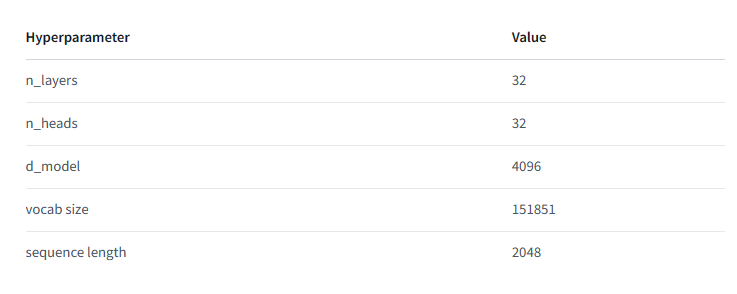
Qwen-7B模型规模基本情况如下所示:
The details of the model architecture of Qwen-7B are listed as follows:
For position encoding, FFN activation function, and normalization methods, we adopt the prevalent practices, i.e., RoPE relative position encoding, SwiGLU for activation function, and RMSNorm for normalization (optional installation of flash-attention for acceleration).
For tokenization, compared to the current mainstream open-source models based on Chinese and English vocabularies, Qwen-7B uses a vocabulary of over 150K tokens. It first considers efficient encoding of Chinese, English, and code data, and is also more friendly to multilingual languages, enabling users to directly enhance the capability of some languages without expanding the vocabulary. It segments numbers by single digit, and calls the tiktoken tokenizer library for efficient tokenization.
We randomly selected 1 million document corpus of each language to test and compare the encoding compression rates of different models (with XLM-R, which supports 100 languages, as the base value 1). The specific performance is shown in the figure above.
As can be seen, while ensuring the efficient decoding of Chinese, English, and code, Qwen-7B also achieves a high compression rate for many other languages (such as th, he, ar, ko, vi, ja, tr, id, pl, ru, nl, pt, it, de, es, fr etc.), equipping the model with strong scalability as well as high training and inference efficiency in these languages.
For pre-training data, on the one hand, Qwen-7B uses part of the open-source generic corpus. On the other hand, it uses a massive amount of accumulated web corpus and high-quality text content. The scale of corpus reaches over 2.2T tokens after deduplication and filtration, encompassing web text, encyclopedias, books, code, mathematics, and various domain.
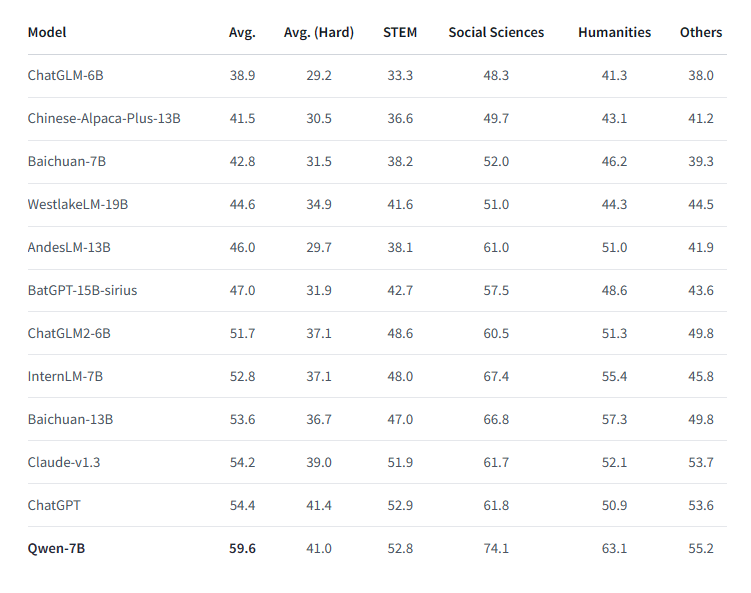
C-Eval is a common evaluation benchmark for testing the common sense capability of pre-trained models in Chinese. It covers 52 subjects in four major directions: humanities, social sciences, STEM, and other specialties. According to the standard practice, we use the development set samples as the source of few-shot, to evaluate the 5-shot validation set and test set accuracy of the Qwen-7B pre-trained model.
在C-Eval验证集上,Qwen-7B模型和其他模型的准确率对比如下:
The accuracy comparison of Qwen-7B and the other models on the C-Eval validation set is shown as follows:
在C-Eval测试集上,Qwen-7B预训练模型与其他模型的效果对比如下表所示:
The performance comparison of Qwen-7B and other models on the C-Eval test set is shown in the following table:
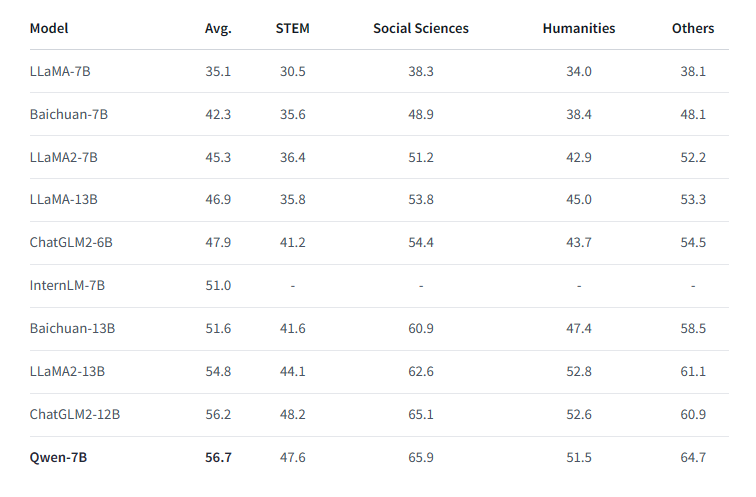
MMLU is currently one of the most recognized benchmarks for evaluating English comprehension abilities, covering 57 subtasks across different academic fields and difficulty levels. The MMLU 5-shot accuracy performance of Qwen-7B is shown in the following table:
In terms of English, Qwen-7B also surpasses other similar open-source pre-trained models, and is competitive when compared to larger versions of other models.
We introduce NTK-aware interpolation, LogN attention scaling, Window attention, etc. to extend the context length to over 8K tokens. We conduct language modeling experiments on the arXiv dataset with the PPL evaluation. Results are demonstrated below:
(To use NTK interpolation and LogN scaling, please set use_dynamic_ntk and use_long_attn to true in config.json.)
Our code and checkpoints are open to research purpose, and they are allowed for commercial purposes. Check LICENSE for more details about the license. If you have requirements for commercial use, please fill out the form to apply.
If you are interested to leave a message to either our research team or product team, feel free to send an email to qianwen_opensource@alibabacloud.com.