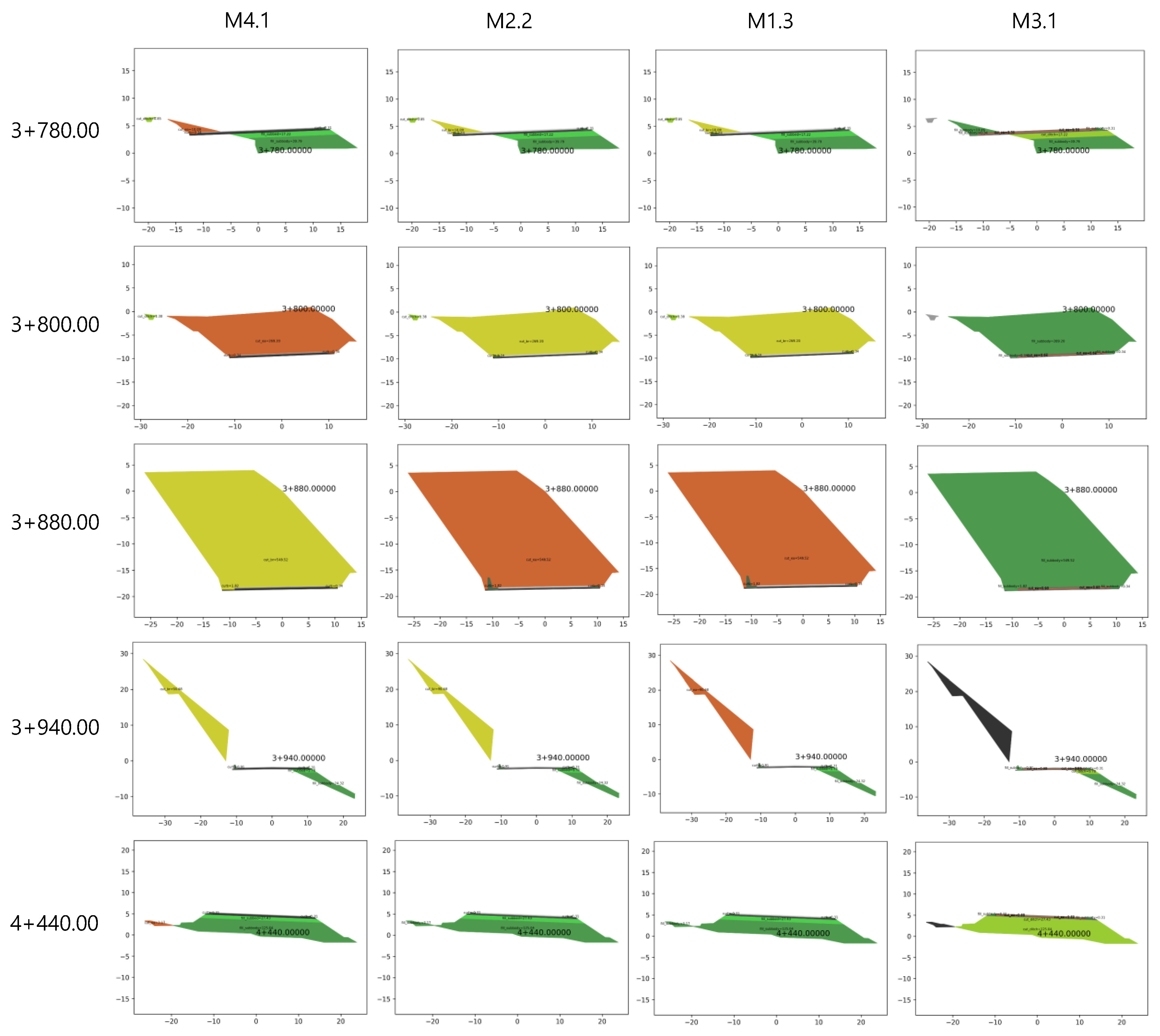
Earthwork Network Architecture (ENA) is designed to compare deep learning models for accurate estimation prediction of earthwork volumes from CAD-based cross-sectional drawings in construction engineering domain. The construction field, commonly known as AEC (Architecture, Engineering and Construction), has lagged behind other fields in the development of AI and LLM models for various reasons. In this open source, we demonstrate that LLM based on Transformers can be extended and applied to various applications in the engineering field through various comparisons among different methods. However, we also note that LLM may not be a cost-effective method for certain use cases. This huggingface repository contains four unique ENA deep learning models: MLP, LSTM, Transformers, and LLM-based architecture tailored to automate and improve earthwork volume estimation from CAD-based cross-sectional drawings.
-
Multi-Model Approach:
- MLP-Based Model: Lightweight and efficient for smaller datasets.
- LSTM-Based Model: Ideal for sequential dependencies in time-series data.
- Transformer-Based Model: Handles complex relationships and large datasets.
- LLM-Based Model (BERT): Excels in processing contextual and unstructured data.
-
Automated Data Processing:
- Converts CAD cross-sectional drawings into structured datasets.
- Employs a Half-Edge Topology Structure to tokenize and preprocess geometrical features.
-
Enhanced Performance:
- Provides superior accuracy in Quantity Takeoff Classification (QTC) for earthwork with reduced loss metrics.
- Demonstrates robust generalization for unseen datasets, validated through a real-world road construction project.
This project is licensed under the MIT License.
We would like to acknowledge the contribution of the road crossing drawings used for model training, provided by engineers Dong Geun Lee and Yoon Sang Lee at Gunhwa Engineering (Seoul, Republic of Korea).