If you have any questions, please feel free to open an issue or contact me with emails: xiaolinhui16@mails.ucas.ac.cn.
Any kind discussions are welcomed!
Please leave a STAR ⭐ if you like this project!
News
:fire: Update on 2025/07/30:All of the code and models have been released!
:exclamation: During the code tidying process, some bugs may arise due to changes in variable names. If any issues occur, please raise them in the issue page, and I will try to resolve them timely.
:fire: Update on 2024/12/28: We conducted a Survey of Visual Grounding over the past decade, entitled "Towards Visual Grounding: A Survey" (Paper, Project), Comments are welcome !!!
:fire: Update on 2024/10/10: Our grounding work OneRef (Paper, Code, Model) has been accepted by the top conference NeurIPS 2024 !
Update on 2024/07/16:Our grounding work HiVG (Publication, Paper, Code) has been accepted by the top conference ACM MM 2024 !
Update on 2023/9/25:Our grounding work CLIP-VG (paper, Code) has been accepted by the top journal IEEE Transaction on Multimedia (2023)!
Citation
If you find our work helpful for your research, please consider citing the following BibTeX entry.
bibtex
1@inproceedings{xiao2024oneref,
2  title={OneRef: Unified One-tower Expression Grounding and Segmentation with Mask Referring Modeling},
3  author={Xiao, Linhui and Yang, Xiaoshan and Peng, Fang and Wang, Yaowei and Xu, Changsheng},
4  booktitle={Proceedings of the 38th International Conference on Neural Information Processing Systems},
5  year={2024}
6}
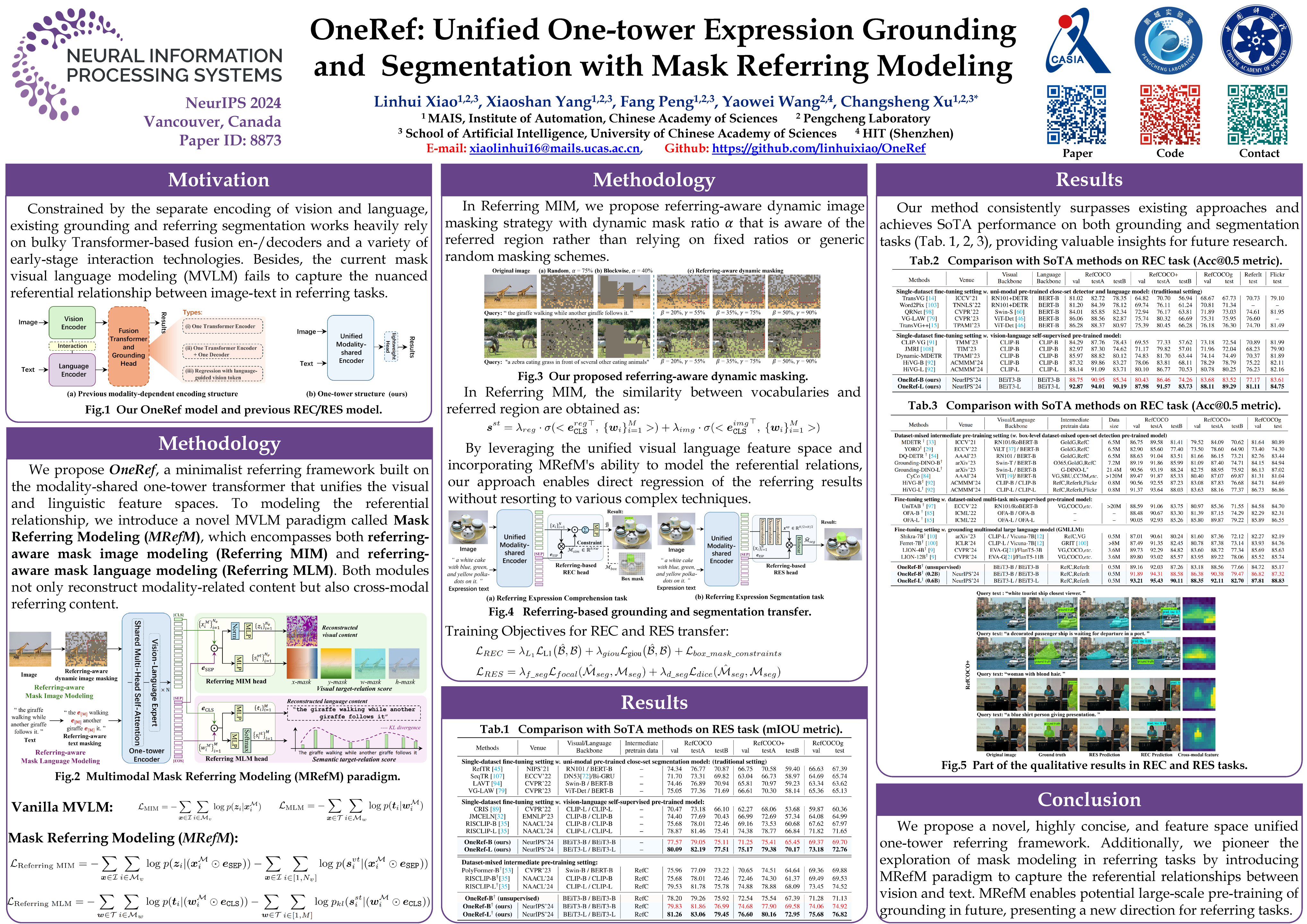
(i) We pioneer the application of mask modeling to referring tasks by introducing a novel paradigm called mask referring modeling. This paradigm
effectively models the referential relation between visual and language.
(ii) Diverging from previous works, we propose a remarkably concise one-tower framework for grounding and referring
segmentation in a unified modality-shared feature space. Our model eliminates the commonly used modality
interaction modules, modality fusion en-/decoders, and special grounding tokens.
(iii) We extensively validate the effectiveness of OneRef in three referring tasks on five datasets. Our method consistently
surpasses existing approaches and achieves SoTA performance across several settings, providing a
valuable new insights for future grounding and referring segmentation research.
Introduction
Constrained by the separate encoding of vision and language, existing grounding
and referring segmentation works heavily rely on bulky Transformer-based fusion
en-/decoders and a variety of early-stage interaction technologies. Simultaneously,
the current mask visual language modeling (MVLM) fails to capture the nuanced
referential relationship between image-text in referring tasks. In this paper, we
propose OneRef, a minimalist referring framework built on the modality-shared
one-tower transformer that unifies the visual and linguistic feature spaces. To
modeling the referential relationship, we introduce a novel MVLM paradigm called
Mask Referring Modeling (MRefM), which encompasses both referring-aware
mask image modeling and referring-aware mask language modeling. Both modules not
only reconstruct modality-related content but also cross-modal referring
content. Within MRefM, we propose a referring-aware dynamic image masking
strategy that is aware of the referred region rather than relying on fixed ratios
or generic random masking schemes. By leveraging the unified visual language
feature space and incorporating MRefM’s ability to model the referential relations,
our approach enables direct regression of the referring results without resorting
to various complex techniques. Our method consistently surpasses existing approaches
and achieves SoTA performance on both grounding and segmentation
tasks, providing valuable insights for future research.
Our environment is aligned with Beit-3. Besides, our model is easy to deploy in a variety of environments and has been successfully tested on multiple pytorch versions.
Image Data Preparation
1.You can download the images from the original source and place them in your disk folder, such as $/path_to_image_data:
MS COCO 2014 (for RefCOCO, RefCOCO+, RefCOCOg dataset, almost 13.0GB)
We provide a script to download the mscoco2014 dataset, you just need to run the script in terminal with the following command:
bash download_mscoco2014.sh
Or you can also follow the data preparation of TransVG, which can be found in GETTING_STARTED.md.
Only the image data in these datasets is used, and these image data is easily find in similar repositories of visual grounding work, such as TransVG etc.
Finally, the $/path_to_image_data folder will have the following structure:
$/path_to_image_data/image_data/Flickr30k/flickr30k-images/: Image data for the Flickr30K dataset, please download from this link. Fill the form and download the images.
$/path_to_image_data/image_data/other/images/: Image data for RefCOCO/RefCOCO+/RefCOCOg, i.e., mscoco2014.
$/path_to_image_data/image_data/referit/images/: Image data for ReferItGame.
Text-Box Anotations
The labels in the fully supervised scenario is consistent with previous works such as CLIP-VG.
:star: As we need to conduct pre-training with mixed datasets, we have shuffled the order of the datasets and unified
some of the dataset formats. You need to download our text annotation files from the HuggingFace homepage.
* The mixup_with_refc denotes the mixup of the training data from RefCOCO/+/g-umd (without use gref), which used in RES task. The mixup_with_refc_referit denotes the
mixup of the training data from RefCOCO/+/g (without use gref) and ReferIt Game, which used in REC task. The val and test split of both Mixup1
and Mixup2 are used the val and testA file from RefCOCOg. The training data in RefCOCOg-g (i.e., gref) exist data leakage.
Download the above annotations to a disk directory such as $/path_to_split; then will have the following similar directory structure:
The checkpoints include the Base model and Large model
under the single-dataset fine-tuning setting and dataset-mixed
grounding pretraining setting with BothREC and RES tasks.
It should be noted that OneRef involves 29 models with a total size of 125GB, and we have made all of these 29 models
open source. We ensure that these models can reproduce the results in the paper. If these models fail to reproduce
the results or encounter errors, please contact us promptly via email or by raising an issue.
We will check and upload the correct models. This might be due to model upload errors or model corruption
during disk storage. After all, we trained nearly a hundred models during the research course of this work.
After downloading all of these checkpoints, you can save them in the following directory, allowing you to train and test
the five datasets at once and just using a single script.
angular2html
1|-- /finetuning_checkpoints (base or large model, rec or res task)
2 ├── flickr
3 │ └── best_checkpoint.pth
4 ├── gref_umd
5 │ └── best_checkpoint.pth
6 ├── referit
7 │ └── best_checkpoint.pth
8 ├── unc
9 │ └── best_checkpoint.pth
10 └── unc+
11 └── best_checkpoint.pth
1213|-- /mixup_grounding_pretraining (base or large model, rec or res task)
14 └── mixup
15 └── best_checkpoint.pth
MRefM pretrained backbone checkpoints download
We propose our multimodal Mask Referring Modeling (MRefM) paradigm to enhance the model's referring comprehension ability.
Since MRefM aims to improve its general referring comprehension ability through pre-training, it mainly demonstrates its
performance gain under the mixed pre-training setting. In the experiment, the MRefM pre-training for the REC task is
mainly carried out through a mixture of the RefCOCO/+/g (short as RefC) and ReferIt datasets. To ensure a fair comparison,
the MRefM pre-training for the RES task is mainly carried out through a mixture of the RefC datasets.
For MRefM pre-training, the base model took 15 hours on 32 NVIDIA A100 GPUs, while the large model took 50 hours on
the same number of GPUs. We provide the MRefM pre-trained checkpoints at the following: All model are placed in HuggingFace Page
In order to facilitate the reproducibility of the MRefM pre-training results and to achieve transferability in non-MRefM settings,
we also provide the original BEiT-3 model as follows. You can download it from the table below or from
the BEiT-3 official repository.
You only need to modify the corresponding paths (change $/path_to_split, $/path_to_image_data, $/path_to_output to your own file directory),
and then execute the corresponding scripts with the bash command to test and train the relevant models.
Training on RefCOCO with single dataset finetuning setting.
We strongly recommend to use the bash commands to training or testing with different datasets and splits,
which will significant reduce the training workforce. such as:
It should be noted that, due to the limited number of data samples in the single-dataset setting, MRefM did not yield significant improvements in performance. To streamline the training process and facilitate the reproducibility of our work, we provide a training process without MRefM pre-training specifically for the single-dataset scenario.
MRefM Pre-training
1. One-node Pre-training
Single-node means that only one multi-card server is needed. You just need to run the following command. This training is not much different from the fine-tuning training.
Multi-node training means that multiple multi-card servers are required. You need to use the scripts in the train_and_eval_script/submit_for_multi_node_pretraining directory to start the process on multiple servers. For detailed operations, you can refer to the relevant tutorials.
Results
1. REC task
REC Single-dataset Fine-tuning SoTA Result Table
COCO
REC Dataset-mixed Pretraining SoTA Result Table
COCO
2. RES task
RES Single-dataset Fine-tuning and Dataset-mixed Pretraining SoTA Result Table (mIoU)
COCO
RES Single-dataset Fine-tuning and Dataset-mixed Pretraining SoTA Result Table (oIoU)
COCO
3. Our model also has significant energy efficiency advantages.
Comparison of the computational cost in REC task.
COCO
Methods
An Illustration of our multimodal Mask Referring Modeling (MRefM) paradigm, which
includes Referring-aware mask image modeling and Referring-aware mask language modeling.
An Illustration of the referring-based grounding and segmentation transfer.
Illustrations of random masking (MAE) [27], block-wise masking (BEiT) [4], and our
referring-aware dynamic masking. α denotes the entire masking ratio, while β and γ denote the
masking ratio beyond and within the referred region.
Visualization
Qualitative results on the RefCOCO-val dataset.
Qualitative results on the RefCOCO+-val dataset.
Qualitative results on the RefCOCOg-val dataset.
Each example shows two different query texts. From left to right: the original input image, the ground truth with
box and segmentation mask (in green), the RES prediction of OneRef (in cyan), the REC prediction
of OneRef (in cyan), and the cross-modal feature.