Public real-weight text-to-image derivative exported to ONNX by Mobius from nota-ai/bk-sdm-small revision 572238db7ed3a10858900803f3fc8cca53e893e0. Canonical inference_metadata.yaml is hashless workflow IR. The executed runtime scheduler is typed DDIM (epsilon prediction); the source PNDM scheduler assets remain unchanged and are not relabeled.
License, attribution, and modifications
The source model is licensed under CreativeML OpenRAIL-M. Public redistribution is permitted by Section III.4 provided recipients receive the license, the Attachment A use restrictions remain enforceable, modifications are prominently identified, and applicable attribution notices are retained. This repository includes the complete license in LICENSE; all users and downstream redistributors must comply with its use restrictions. See NOTICE.md for attribution and modification details.
Download
hf download justinchuby/onnx-genai-stable-diffusion-bk-sdm-small --repo-type model --local-dir stable-diffusion-bk-sdm-small
Evidence: generated.png (Mobius runner) and api_evidence/a1111_generated.png (generic ONNX GenAI A1111 API). Full versions, timings, and peak memory are in execution_evidence.json; API timing is in generic_runtime_evidence.json.
license: creativeml-openrail-m
tags:
stable-diffusion
stable-diffusion-diffusers
text-to-image
datasets:
ChristophSchuhmann/improved_aesthetics_6.5plus
library_name: diffusers
pipeline_tag: text-to-image
extra_gated_prompt: >-
This model is open access and available to all, with a CreativeML OpenRAIL-M
license further specifying rights and usage.
The CreativeML OpenRAIL License specifies:
You can't use the model to deliberately produce nor share illegal or
harmful outputs or content
The authors claim no rights on the outputs you generate, you are free to
use them and are accountable for their use which must not go against the
provisions set in the license
You may re-distribute the weights and use the model commercially and/or as
a service. If you do, please be aware you have to include the same use
restrictions as the ones in the license and share a copy of the CreativeML
OpenRAIL-M to all your users (please read the license entirely and carefully)
extra_gated_heading: Please read the LICENSE to access this model
BK-SDM Model Card
Block-removed Knowledge-distilled Stable Diffusion Model (BK-SDM) is an architecturally compressed SDM for efficient general-purpose text-to-image synthesis. This model is bulit with (i) removing several residual and attention blocks from the U-Net of Stable Diffusion v1.4 and (ii) distillation pretraining on only 0.22M LAION pairs (fewer than 0.1% of the full training set). Despite being trained with very limited resources, our compact model can imitate the original SDM by benefiting from transferred knowledge.
An inference code with the default PNDM scheduler and 50 denoising steps is as follows.
python
1import torch
2from diffusers import StableDiffusionPipeline
34pipe = StableDiffusionPipeline.from_pretrained("nota-ai/bk-sdm-small", torch_dtype=torch.float16)5pipe = pipe.to("cuda")67prompt ="a tropical bird sitting on a branch of a tree"8image = pipe(prompt).images[0]910image.save("example.png")
The following code is also runnable, because we compressed the U-Net of Stable Diffusion v1.4 while keeping the other parts (i.e., Text Encoder and Image Decoder) unchanged:
python
1import torch
2from diffusers import StableDiffusionPipeline, UNet2DConditionModel
34pipe = StableDiffusionPipeline.from_pretrained("CompVis/stable-diffusion-v1-4", torch_dtype=torch.float16)5pipe.unet = UNet2DConditionModel.from_pretrained("nota-ai/bk-sdm-small", subfolder="unet", torch_dtype=torch.float16)6pipe = pipe.to("cuda")78prompt ="a tropical bird sitting on a branch of a tree"9image = pipe(prompt).images[0]1011image.save("example.png")
Compression Method
U-Net Architecture
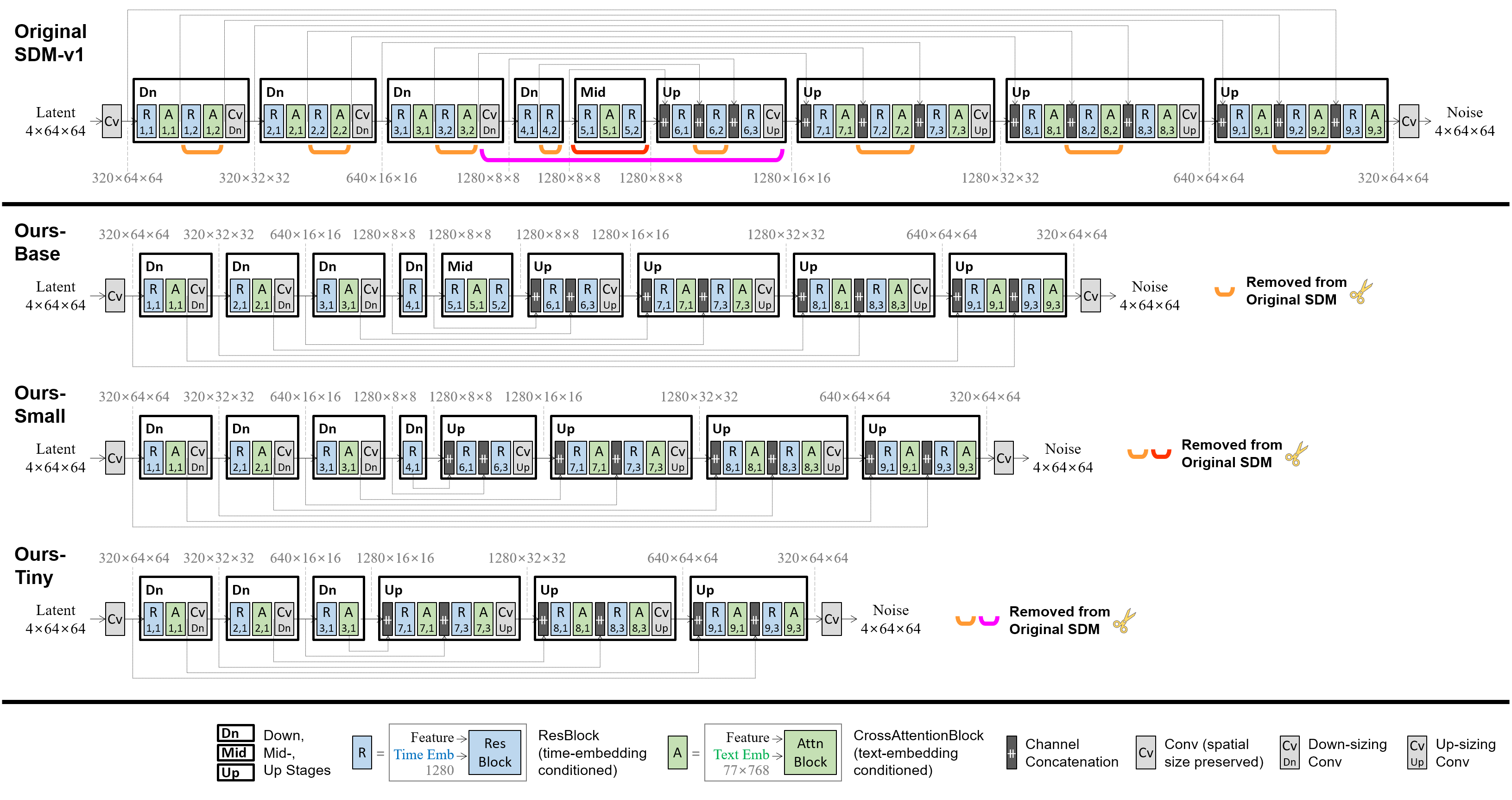
Certain residual and attention blocks were eliminated from the U-Net of SDM-v1.4:
1.04B-param SDM-v1.4 (0.86B-param U-Net): the original source model.
0.76B-param BK-SDM-Base (0.58B-param U-Net): obtained with ① fewer blocks in outer stages.
0.66B-param BK-SDM-Small (0.49B-param U-Net): obtained with ① and ② mid-stage removal.
0.50B-param BK-SDM-Tiny (0.33B-param U-Net): obtained with ①, ②, and ③ further inner-stage removal.
U-Net architectures
Distillation Pretraining
The compact U-Net was trained to mimic the behavior of the original U-Net. We leveraged feature-level and output-level distillation, along with the denoising task loss.
Learning Rate: a constant learning rate of 5e-5 for 50K-iteration pretraining
Experimental Results
The following table shows the zero-shot results on 30K samples from the MS-COCO validation split. After generating 512×512 images with the PNDM scheduler and 25 denoising steps, we downsampled them to 256×256 for evaluating generation scores. Our models were drawn at the 50K-th training iteration.
The model is intended for research purposes only. Possible research areas and tasks include
Safe deployment of models which have the potential to generate harmful content.
Probing and understanding the limitations and biases of generative models.
Generation of artworks and use in design and other artistic processes.
Applications in educational or creative tools.
Research on generative models.
Excluded uses are described below.
Misuse, Malicious Use, and Out-of-Scope Use
The model should not be used to intentionally create or disseminate images that create hostile or alienating environments for people. This includes generating images that people would foreseeably find disturbing, distressing, or offensive; or content that propagates historical or current stereotypes.
Out-of-Scope Use
The model was not trained to be factual or true representations of people or events, and therefore using the model to generate such content is out-of-scope for the abilities of this model.
Misuse and Malicious Use
Using the model to generate content that is cruel to individuals is a misuse of this model. This includes, but is not limited to:
Generating demeaning, dehumanizing, or otherwise harmful representations of people or their environments, cultures, religions, etc.
Intentionally promoting or propagating discriminatory content or harmful stereotypes.
Impersonating individuals without their consent.
Sexual content without consent of the people who might see it.
Mis- and disinformation
Representations of egregious violence and gore
Sharing of copyrighted or licensed material in violation of its terms of use.
Sharing content that is an alteration of copyrighted or licensed material in violation of its terms of use.
Limitations and Bias
Limitations
The model does not achieve perfect photorealism
The model cannot render legible text
The model does not perform well on more difficult tasks which involve compositionality, such as rendering an image corresponding to “A red cube on top of a blue sphere”
Faces and people in general may not be generated properly.
The model was trained mainly with English captions and will not work as well in other languages.
The autoencoding part of the model is lossy
The model was trained on a large-scale dataset LAION-5B which contains adult material and is not fit for product use without additional safety mechanisms and considerations.
No additional measures were used to deduplicate the dataset. As a result, we observe some degree of memorization for images that are duplicated in the training data. The training data can be searched at https://rom1504.github.io/clip-retrieval/ to possibly assist in the detection of memorized images.
Bias
While the capabilities of image generation models are impressive, they can also reinforce or exacerbate social biases. Stable Diffusion v1 was trained on subsets of LAION-2B(en), which consists of images that are primarily limited to English descriptions. Texts and images from communities and cultures that use other languages are likely to be insufficiently accounted for. This affects the overall output of the model, as white and western cultures are often set as the default. Further, the ability of the model to generate content with non-English prompts is significantly worse than with English-language prompts.
Safety Module
The intended use of this model is with the Safety Checker in Diffusers. This checker works by checking model outputs against known hard-coded NSFW concepts. The concepts are intentionally hidden to reduce the likelihood of reverse-engineering this filter. Specifically, the checker compares the class probability of harmful concepts in the embedding space of the CLIPTextModelafter generation of the images. The concepts are passed into the model with the generated image and compared to a hand-engineered weight for each NSFW concept.
We deeply appreciate the pioneering research on Latent/Stable Diffusion conducted by CompVis, Runway, and Stability AI.
Special thanks to the contributors to LAION, Diffusers, and Gradio for their valuable support.
Citation
bibtex
1@article{kim2023architectural,
2  title={BK-SDM: A Lightweight, Fast, and Cheap Version of Stable Diffusion},
3  author={Kim, Bo-Kyeong and Song, Hyoung-Kyu and Castells, Thibault and Choi, Shinkook},
4  journal={arXiv preprint arXiv:2305.15798},
5  year={2023},
6  url={https://arxiv.org/abs/2305.15798}
7}
bibtex
1@article{kim2023bksdm,
2  title={BK-SDM: Architecturally Compressed Stable Diffusion for Efficient Text-to-Image Generation},
3  author={Kim, Bo-Kyeong and Song, Hyoung-Kyu and Castells, Thibault and Choi, Shinkook},
4  journal={ICML Workshop on Efficient Systems for Foundation Models (ES-FoMo)},
5  year={2023},
6  url={https://openreview.net/forum?id=bOVydU0XKC}
7}
Review inference_metadata.annotated.yaml for inline explanations of this package's workflow, tensor/state/cache contracts, and fail-closed omissions. inference_metadata.yaml remains the canonical machine-authored contract; automated validation confirms both files parse to the same metadata object.