SDOFMv2: A Multi-Instrument Foundation Model for the Solar Dynamics Observatory
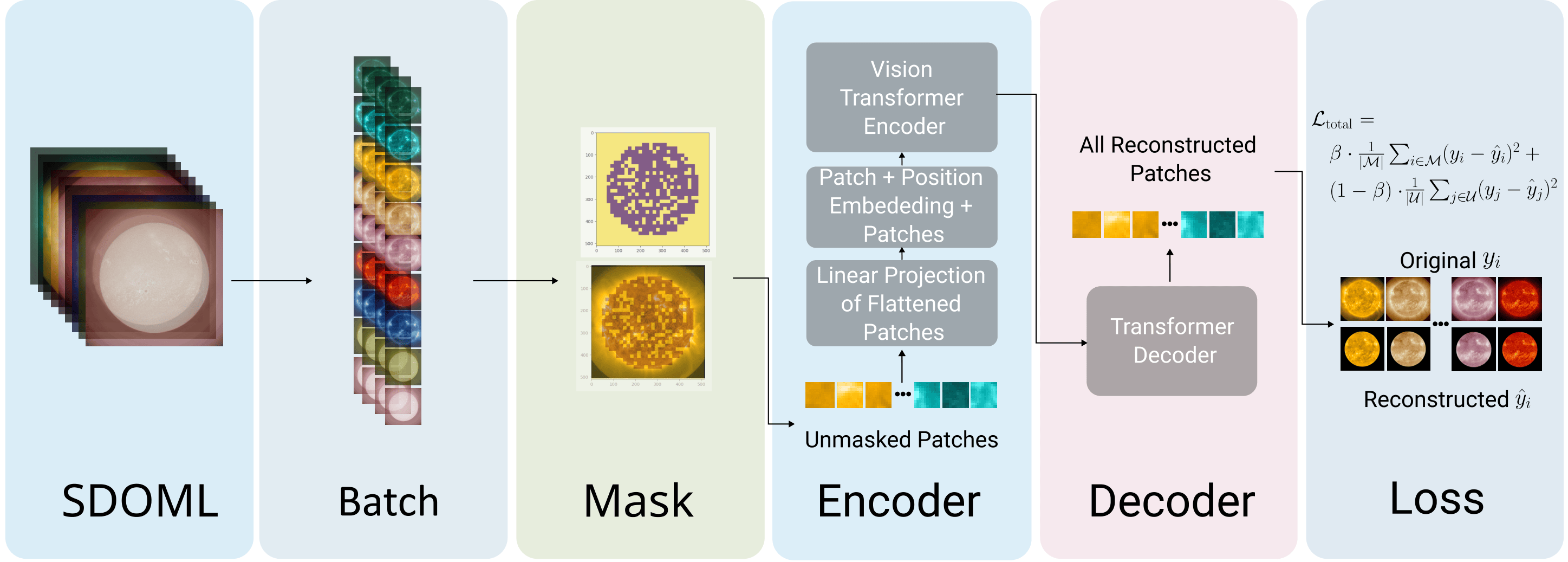
SDOFMv2 is an advanced multi-instrument foundation model for analyzing Solar Dynamics Observatory (SDO) data, designed to drive large-scale, data-driven heliophysics research. This model is a Masked Autoencoder (MAE) pretrained on the SDOMLv2 dataset.
This model card is for the pretrained MAE checkpoint, ready for finetuning on downstream tasks.
Model architecture
A Masked Autoencoder (MAE) built on a Vision Transformer (ViT) backbone is used for pretraining. The encoder processes a subset of image patches, and the decoder reconstructs the full image.
Model Details
Model type: Masked Autoencoder (MAE) with a Vision Transformer (ViT) backbone.
Pretrained on: SDOMLv2 dataset, containing multi-instrument data from the Solar Dynamics Observatory (AIA and HMI instruments).
Primary intended use: Feature extraction and finetuning for downstream heliophysics tasks such as solar flare prediction, coronal mass ejection detection, and physical parameter estimation.
The encoder outputs patch-level embeddings that can be used as features for downstream tasks:
python
1import torch
23# Input shape: (batch_size, num_channels, height, width)4# num_channels = 9 (AIA) or 12 (AIA + HMI)5x = torch.randn(1,9,512,512)67with torch.no_grad():8 features = model.forward_encoder(x, mask_ratio=0.5)910# Output shape: (1, N, D) — N patch tokens, D embedding dimension11print(features.shape)
Finetuning
To finetune SDOFMv2 on a downstream task, attach a task head to the extracted features:
python
1import torch.nn as nn
23classSDOFMv2Classifier(nn.Module):4def__init__(self, backbone, num_classes=2):5super().__init__()6 self.backbone = backbone
7 self.head = nn.Linear(backbone.embed_dim, num_classes)89defforward(self, x):10 features = self.backbone.forward_encoder(x, mask_ratio=0.0)# (B, N, D)11 pooled = features.mean(dim=1)# global average pool → (B, D)12return self.head(pooled)1314classifier = SDOFMv2Classifier(model, num_classes=2)# e.g., flare / no-flare
The model was pretrained on the SDOMLv2 dataset, which contains:
Component
Instrument
Data Type
Approx. Size
Description
aia
AIA
EUV Images
~7.2 TB
9 extreme ultraviolet channels capturing the solar atmosphere
hmi
HMI
Magnetograms
~713 GB
3-component vector magnetic field for the solar photosphere
Due to its size, the data was streamed from NASA's HDRL S3 bucket during training. For more information on accessing the dataset, see the data preparation guide.
Evaluation Results
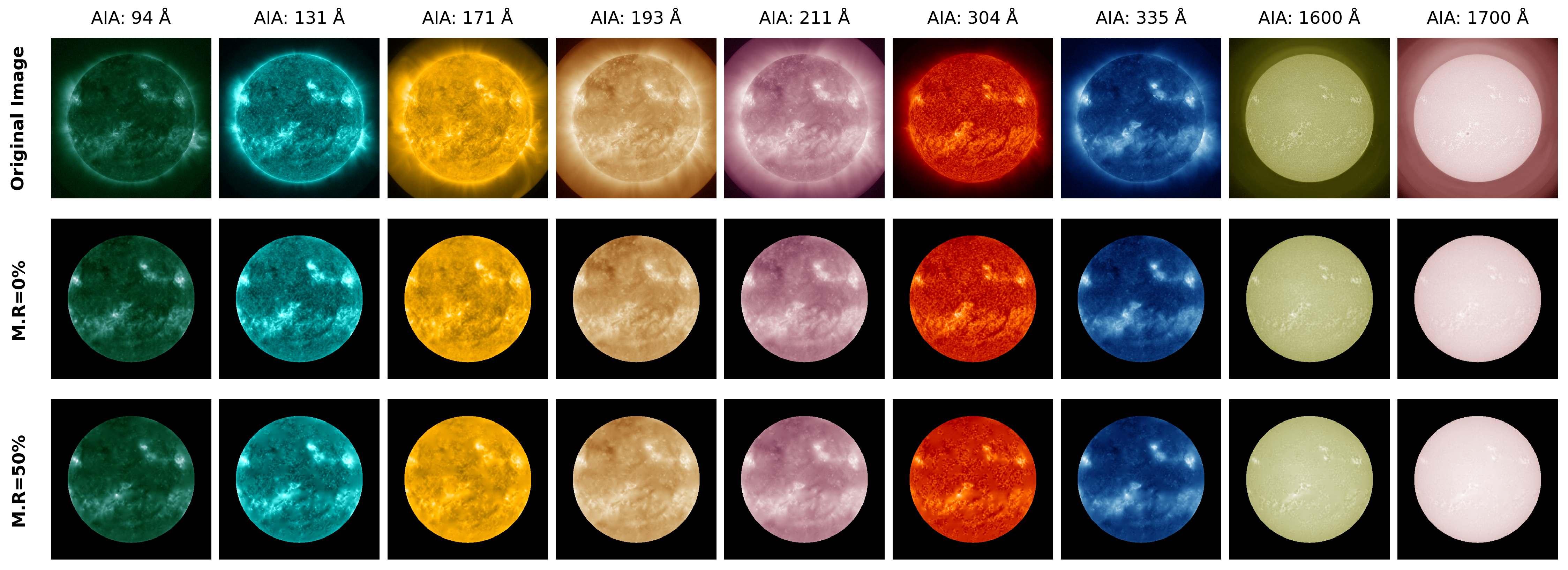
The model demonstrates high-quality reconstruction of SDO images, indicating a robust understanding of solar features.
Sample Visualization
Row 1: Ground-truth images. Row 2: Reconstructions at 0% masking ratio. Row 3: Reconstructions at 50% masking ratio.
Citation
If you find SDOFMv2 useful in your research, please cite the original work:
bibtex
1@misc{sdofmv2,
2  author    = {Hong, Jinsu and Martin, Daniela and Gallego, Joseph},
3  title     = {SDOFMv2: A Multi-Instrument Foundation Model for the Solar Dynamics Observatory with Transferable Downstream Applications},
4  year      = {2026},
5  publisher = {GitHub},
6  journal   = {GitHub repository},
7  howpublished = {\url{https://github.com/Joaggi/sdofmv2}},
8  note      = {Jinsu Hong, Daniela Martin, and Joseph Gallego contributed equally to this work}
9}
Acknowledgments
This work builds on the SDOFM framework. We thank the creators of SDOMLv2 for the curated training data and the NASA Solar Dynamics Observatory mission for their open data policy.