BLOOM is an autoregressive Large Language Model (LLM), trained to continue text from a prompt on vast amounts of text data using industrial-scale computational resources. As such, it is able to output coherent text in 46 languages and 13 programming languages that is hardly distinguishable from text written by humans. BLOOM can also be instructed to perform text tasks it hasn't been explicitly trained for, by casting them as text generation tasks.
Basics
This section provides information about the model type, version, license, funders, release date, developers, and contact information.It is useful for anyone who wants to reference the model.
Organizations of contributors. (Further breakdown of organizations forthcoming.)
Technical Specifications
This section includes details about the model objective and architecture, and the compute infrastructure.It is useful for people interested in model development.
This section provides information about the training data, the speed and size of training elements, and the environmental impact of training.It is useful for people who want to learn more about the model inputs and training footprint.
Click to expand
Training Data
This section provides a high-level overview of the training data. It is relevant for anyone who wants to know the basics of what the model is learning.
Details for each dataset are provided in individual Data Cards, and the sizes of each of their contributions to the aggregated training data are presented in an Interactive Corpus Map.
Training data includes:
46 natural languages
13 programming languages
In 1.6TB of pre-processed text, converted into 350B unique tokens (see the tokenizer section for more.)
Languages
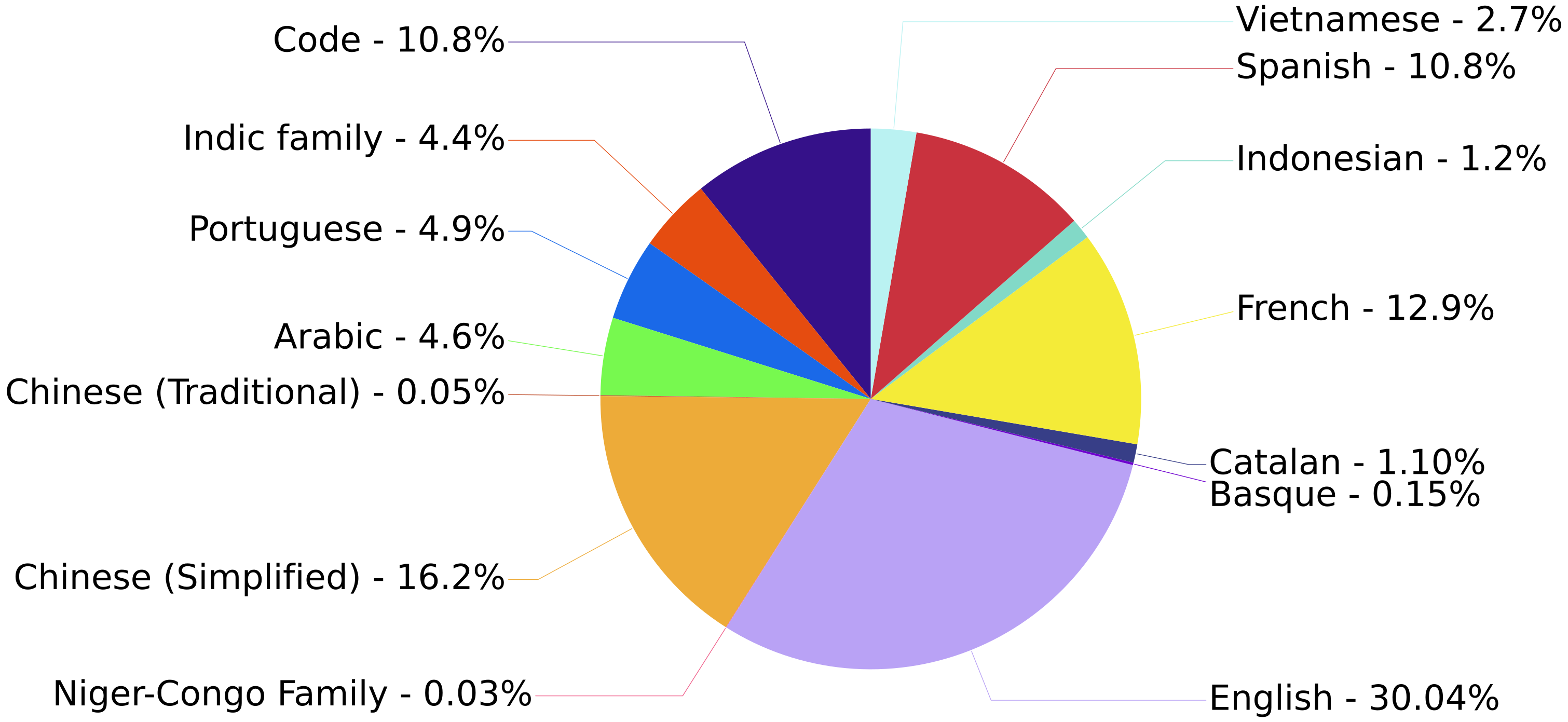
The pie chart shows the distribution of languages in training data.
pie chart showing the distribution of languages in training data
The following tables shows the further distribution of Niger-Congo & Indic languages and programming languages in the training data.
Distribution of Niger Congo and Indic languages.
Niger Congo
Percentage
Indic
Percentage
Chi Tumbuka
0.00002
Assamese
0.01
Kikuyu
0.00004
Odia
0.04
Bambara
0.00004
Gujarati
0.04
Akan
0.00007
Marathi
0.05
Xitsonga
0.00007
Punjabi
0.05
Sesotho
0.00007
Kannada
0.06
Chi Chewa
0.0001
Nepali
0.07
Setswana
0.0002
Telugu
0.09
Lingala
0.0002
Malayalam
0.10
Northern Sotho
0.0002
Urdu
0.10
Fon
0.0002
Tamil
0.20
Kirundi
0.0003
Bengali
0.50
Wolof
0.0004
Hindi
0.70
Luganda
0.0004
Chi Shona
0.001
Isi Zulu
0.001
Igbo
0.001
Xhosa
0.001
Kinyarwanda
0.003
Yoruba
0.006
Swahili
0.02
Distribution of programming languages.
Extension
Language
Number of files
java
Java
5,407,724
php
PHP
4,942,186
cpp
C++
2,503,930
py
Python
2,435,072
js
JavaScript
1,905,518
cs
C#
1,577,347
rb
Ruby
6,78,413
cc
C++
443,054
hpp
C++
391,048
lua
Lua
352,317
go
GO
227,763
ts
TypeScript
195,254
C
C
134,537
scala
Scala
92,052
hh
C++
67,161
H
C++
55,899
tsx
TypeScript
33,107
rs
Rust
29,693
phpt
PHP
9,702
c++
C++
1,342
h++
C++
791
php3
PHP
540
phps
PHP
270
php5
PHP
166
php4
PHP
29
Preprocessing
Tokenization: The BLOOM tokenizer (link), a learned subword tokenizer trained using:
A byte-level Byte Pair Encoding (BPE) algorithm
A simple pre-tokenization rule, no normalization
A vocabulary size of 250,680
It was trained on a subset of a preliminary version of the corpus using alpha-weighting per language.
Training throughput: About 150 TFLOP per GPU per second
Number of epochs: 1
Estimated cost of training: Equivalent of $2-5M in cloud computing (including preliminary experiments)
Server training location: Île-de-France, France
Environmental Impact
The training supercomputer, Jean Zay (website), uses mostly nuclear energy. The heat generated by it is reused for heating campus housing.
Estimated carbon emissions:(Forthcoming.)
Estimated electricity usage:(Forthcoming.)
Uses
This section addresses questions around how the model is intended to be used, discusses the foreseeable users of the model (including those affected by the model), and describes uses that are considered out of scope or misuse of the model.It is useful for anyone considering using the model or who is affected by the model.
Click to expand
How to use
This model can be easily used and deployed using HuggingFace's ecosystem. This needs transformers and accelerate installed. The model can be downloaded as follows:
Intended Use
This model is being created in order to enable public research on large language models (LLMs). LLMs are intended to be used for language generation or as a pretrained base model that can be further fine-tuned for specific tasks. Use cases below are not exhaustive.
Direct Use
Text generation
Exploring characteristics of language generated by a language model
Examples: Cloze tests, counterfactuals, generations with reframings
Downstream Use
Tasks that leverage language models include: Information Extraction, Question Answering, Summarization
Misuse and Out-of-scope Use
This section addresses what users ought not do with the model.
See the BLOOM License, Attachment A, for detailed usage restrictions. The below list is non-exhaustive, but lists some easily foreseeable problematic use cases.
Out-of-scope Uses
Using the model in high-stakes settings is out of scope for this model. The model is not designed for critical decisions nor uses with any material consequences on an individual's livelihood or wellbeing. The model outputs content that appears factual but may not be correct.
Out-of-scope Uses Include:
Usage in biomedical domains, political and legal domains, or finance domains
Usage for evaluating or scoring individuals, such as for employment, education, or credit
Applying the model for critical automatic decisions, generating factual content, creating reliable summaries, or generating predictions that must be correct
Misuse
Intentionally using the model for harm, violating human rights, or other kinds of malicious activities, is a misuse of this model. This includes:
WARNING: This section used to contain much more results, however they were not correct and we released without the approval of the evaluation working group. We are currently in the process of fixing the evaluations.
This section provides information on warnings and potential mitigations.
Click to expand
Indirect users should be made aware when the content they're working with is created by the LLM.
Users should be aware of Risks and Limitations, and include an appropriate age disclaimer or blocking interface as necessary.
Models trained or finetuned downstream of BLOOM LM should include an updated Model Card.
Users of the model should provide mechanisms for those affected to provide feedback, such as an email address for comments.
Glossary and Calculations
This section defines common terms and how metrics are calculated.
Click to expand
Loss: A calculation of the difference between what the model has learned and what the data shows ("groundtruth"). The lower the loss, the better. The training process aims to minimize the loss.
Perplexity: This is based on what the model estimates the probability of new data is. The lower the perplexity, the better. If the model is 100% correct at predicting the next token it will see, then the perplexity is 1. Mathematically this is calculated using entropy.
Deception: Doing something to intentionally mislead individuals to believe something that is false, such as by creating deadbots or chatbots on social media posing as real people, or generating text documents without making consumers aware that the text is machine generated.
More Information
This section provides links to writing on dataset creation, technical specifications, lessons learned, and initial results.
Click to expand
Intermediate checkpoints
For academic (or any) usage, we published the intermediate checkpoints, corresponding to the model state at each 5000 steps. Please follow this link to get these checkpoints.
The checkpoints in this repo correspond to the HuggingFace Transformers format. If you want to use our fork of Megatron-DeepSpeed that the model was trained with, you'd want to use this repo instead.