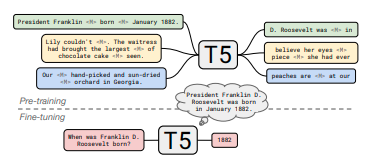
The model was pre-trained using T5's denoising objective on
C4, subsequently additionally pre-trained using
REALM's salient span masking objective on
Wikipedia, and finally fine-tuned on
Trivia QA (TQA).
Note: The model was fine-tuned on 100% of the train splits of
Trivia QA (TQA) for 10 steps.
Other community Checkpoints:
here1from transformers import AutoModelForSeq2SeqLM, AutoTokenizer
2
3t5_qa_model = AutoModelForSeq2SeqLM.from_pretrained("google/t5-11b-ssm-tqa")
4t5_tok = AutoTokenizer.from_pretrained("google/t5-11b-ssm-tqa")
5
6input_ids = t5_tok("When was Franklin D. Roosevelt born?", return_tensors="pt").input_ids
7gen_output = t5_qa_model.generate(input_ids)[0]
8
9print(t5_tok.decode(gen_output, skip_special_tokens=True))
It has recently been observed that neural language models trained on unstructured text can implicitly store and retrieve knowledge using natural language queries. In this short paper, we measure the practical utility of this approach by fine-tuning pre-trained models to answer questions without access to any external context or knowledge. We show that this approach scales with model size and performs competitively with open-domain systems that explicitly retrieve answers from an external knowledge source when answering questions. To facilitate reproducibility and future work, we release our code and trained models at
https://goo.gle/t5-cbqa.