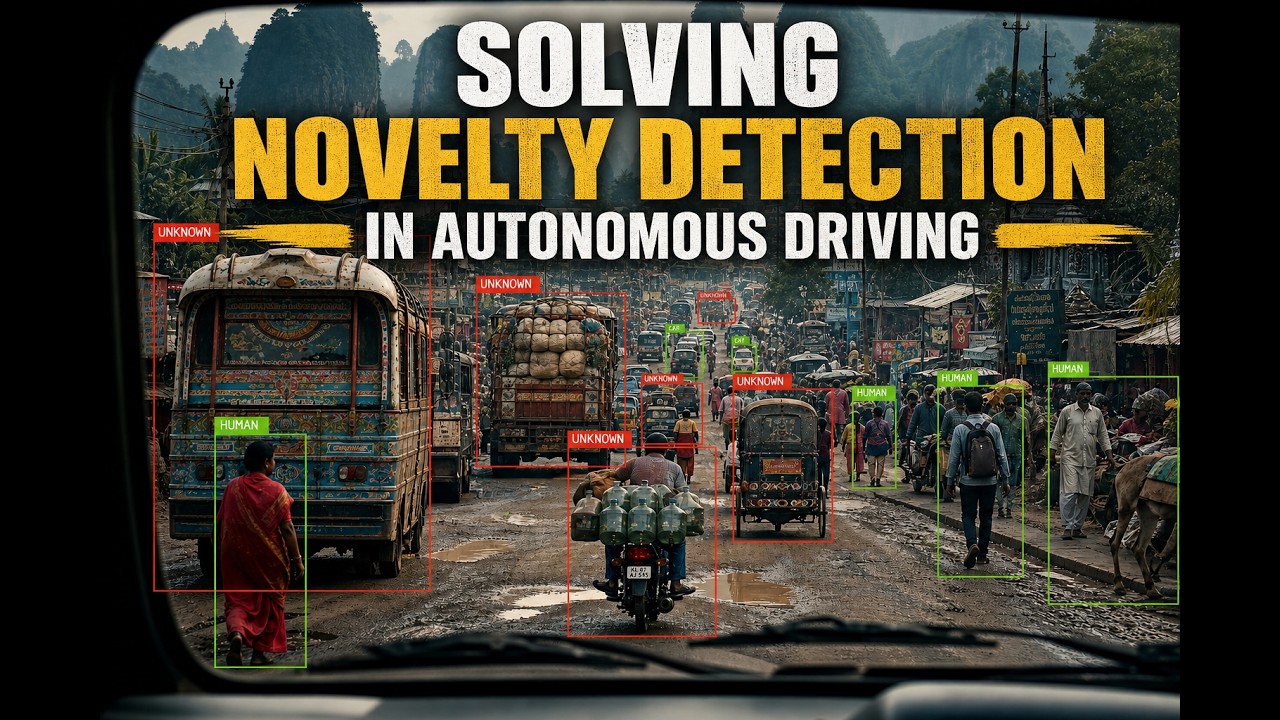
A training-free layer that turns a flat object detector into a hierarchical, open-set one. Every detection is resolved by taxonomic abstraction: the most specific level the evidence safely supports, or an explicit UNKNOWN OBSTACLE, never a confident wrong leaf.
The live tool. A deer, a class no closed detector is asked to output on the road, is not dropped and not mislabeled: it resolves to Living Being, with the full taxonomy descent path and an independent segmentation cross-check shown alongside.
A closed-set detector must assign every object one of a fixed set of labels. On an object outside that set (a horse-drawn carriage, road debris, livestock on a rural road) it can only do one of two unsafe things: force a confident but wrong specific label, or drop the object entirely. Real incidents trace back to exactly this failure.
How it works
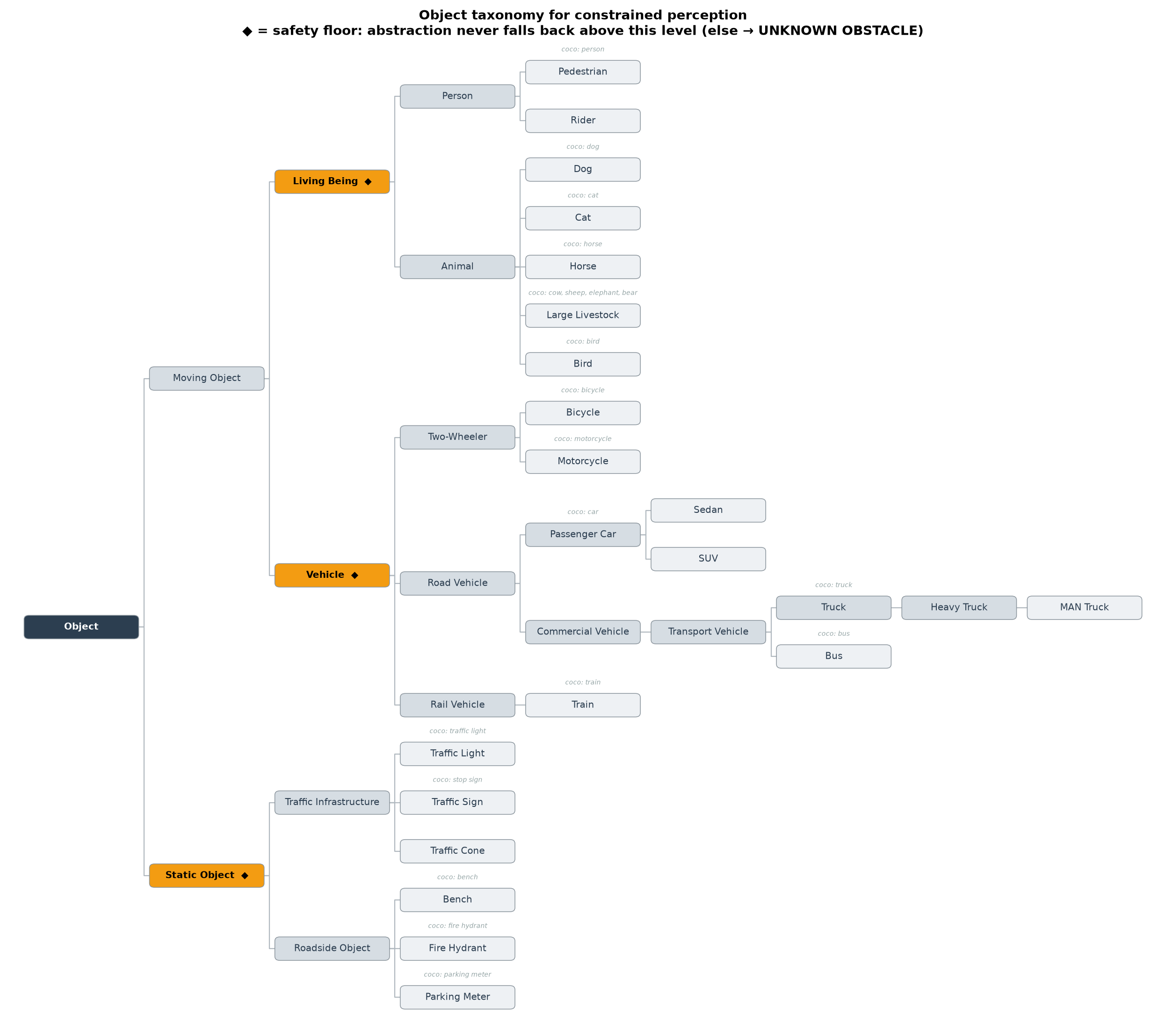
HOWC puts a taxonomy over the detector and, per object, aggregates leaf probability mass up the tree. It commits only as deep as one branch holds enough mass; otherwise it stops at a coarser node. A per-branch safety floor (Vehicle, Living Being, Static Object) means it never collapses into a useless bare Object: below the floor, it emits an explicit UNKNOWN OBSTACLE with a fully inspectable decision path.
The object taxonomy, with safety floors marked
How it decides (worked examples)
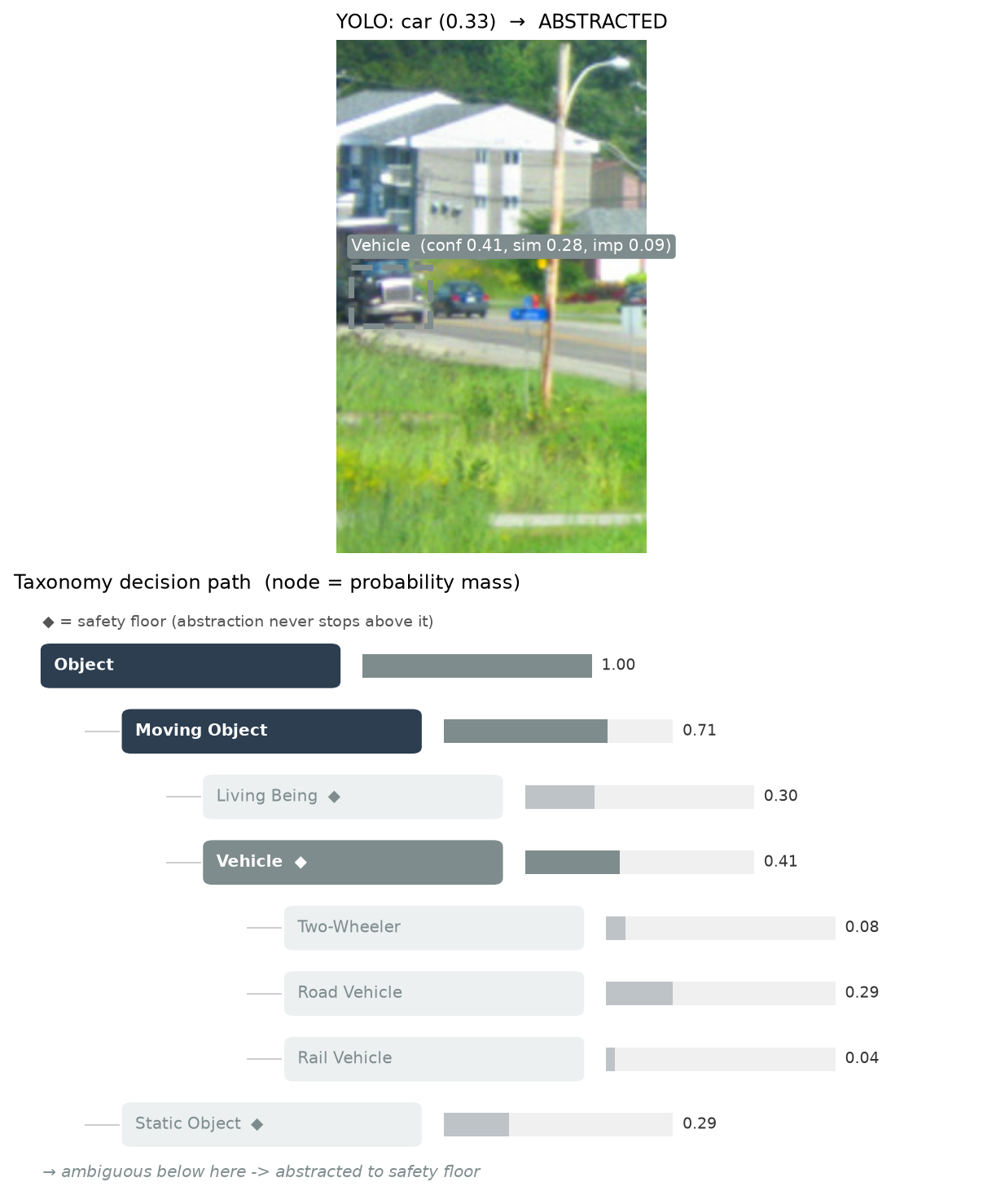
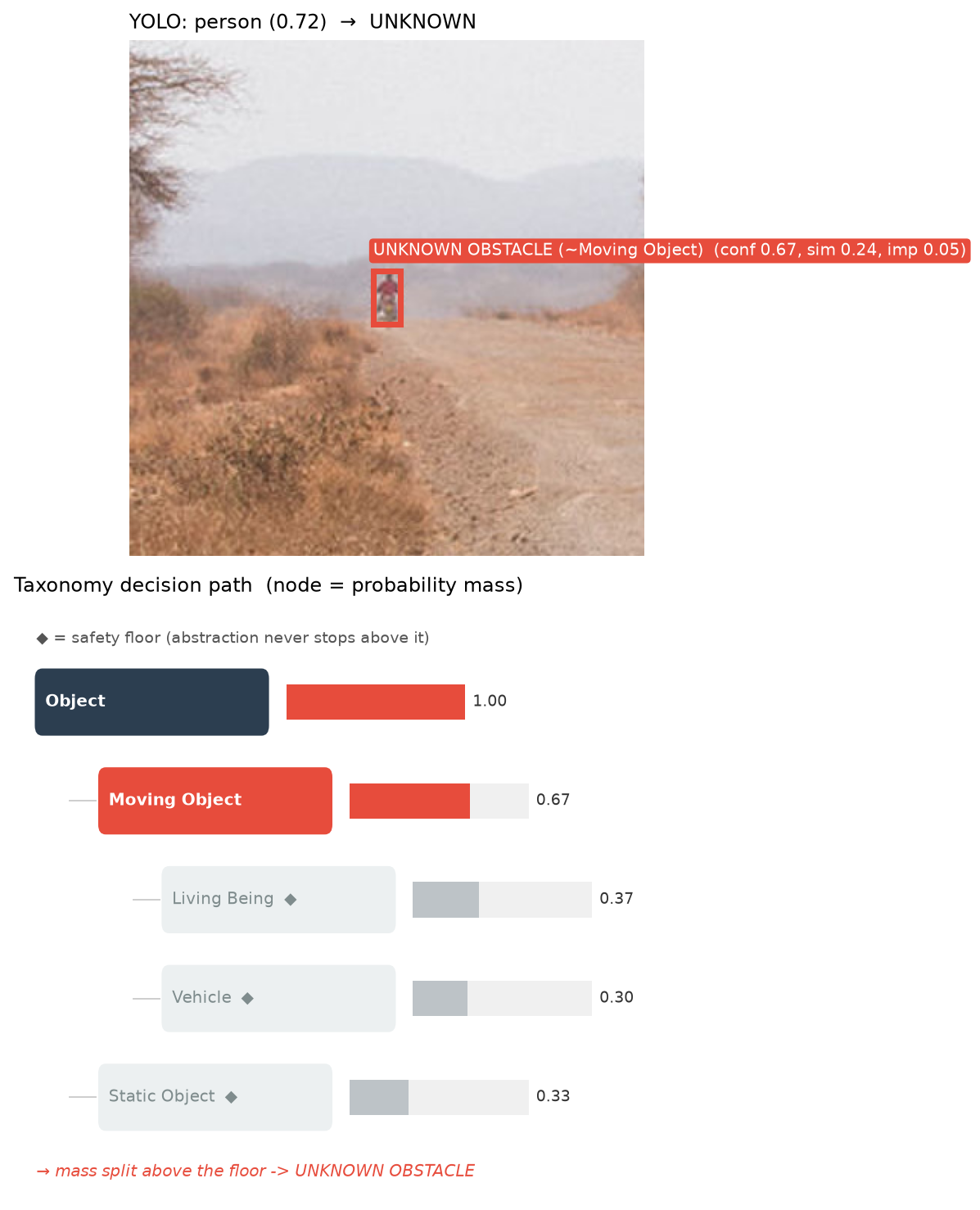
Each detection produces a decision path: probability mass per node, the safety floor, and the resulting action.
ABSTRACTED: a truck YOLO calls 'car' is abstracted up to the safe Vehicle floor
ABSTRACTED. YOLO calls a distant truck "car" (0.33). The mass is ambiguous below the Vehicle floor, so HOWC does not guess a leaf: it reports Vehicle, still useful, never wrong.
UNKNOWN: mass splits above the safety floor, so the object is flagged UNKNOWN OBSTACLE
UNKNOWN. A rural-road anomaly YOLO calls "person" (0.72). The mass splits above the floor across Living Being / Vehicle / Static, so HOWC refuses a category and flags UNKNOWN OBSTACLE.
Beyond 2D: a depth cue for flat detections
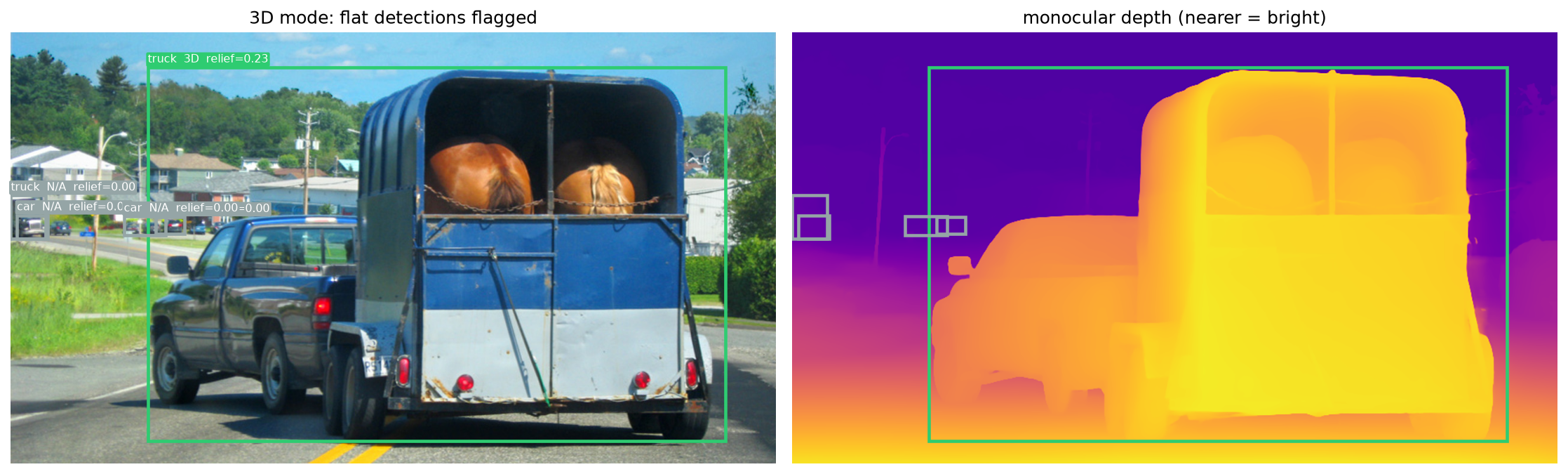
A 2D box cannot tell a real vehicle from a flat picture of one (a billboard, a truck livery). The open-world study adds a monocular-depth relief cue: detections that are geometrically flat get flagged, and the depth field feeds the open-world proposal front-end.
Left: 3D mode flags flat detections on a horse trailer scene. Right: monocular depth (nearer = bright)
Left: 3D mode flags flat detections. Right: the monocular depth field (nearer = bright). This is a feasibility signal, not a solved module, and the paper is explicit that no single 2D cue suffices.
Results (honest)
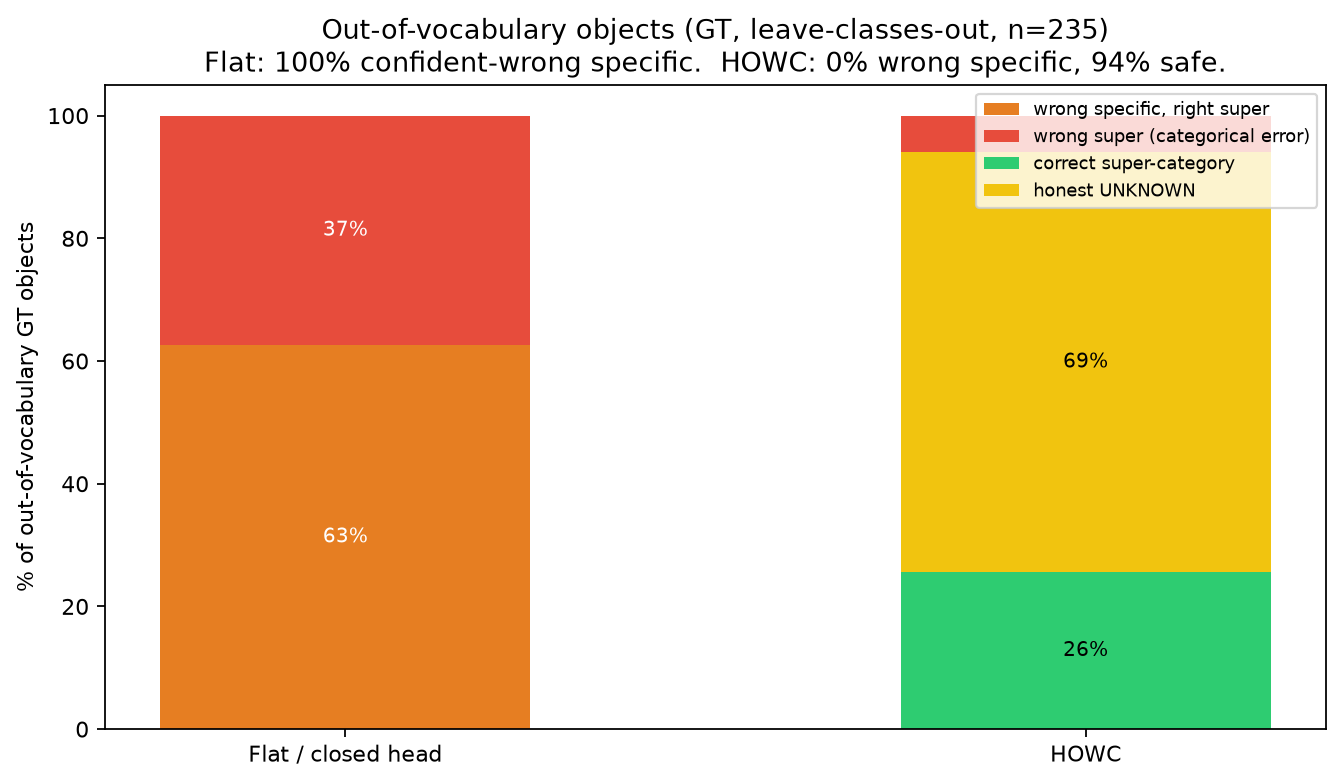
Out-of-vocabulary objects (v3 ground-truth leave-classes-out on COCO, n=235). Hold seven classes out of the taxonomy, then classify their real annotated crops:
Flat head is 100% confidently wrong; HOWC is 0% confidently wrong and 94% safe
On out-of-vocabulary objects
Flat / closed head
HOWC
Confident wrong specific label
100%
0%
... of which in the wrong super-category
37%
0%
Safely handled (right super-cat, or honest UNKNOWN)
0%
94%
Correct super-category recovered
—
26%
Conservatively flagged UNKNOWN
—
69%
On known, in-taxonomy objects: 0% off-branch (categorical) errors with ~24% calibrated abstention, versus a flat arg-max head's ~53% off-branch errors.
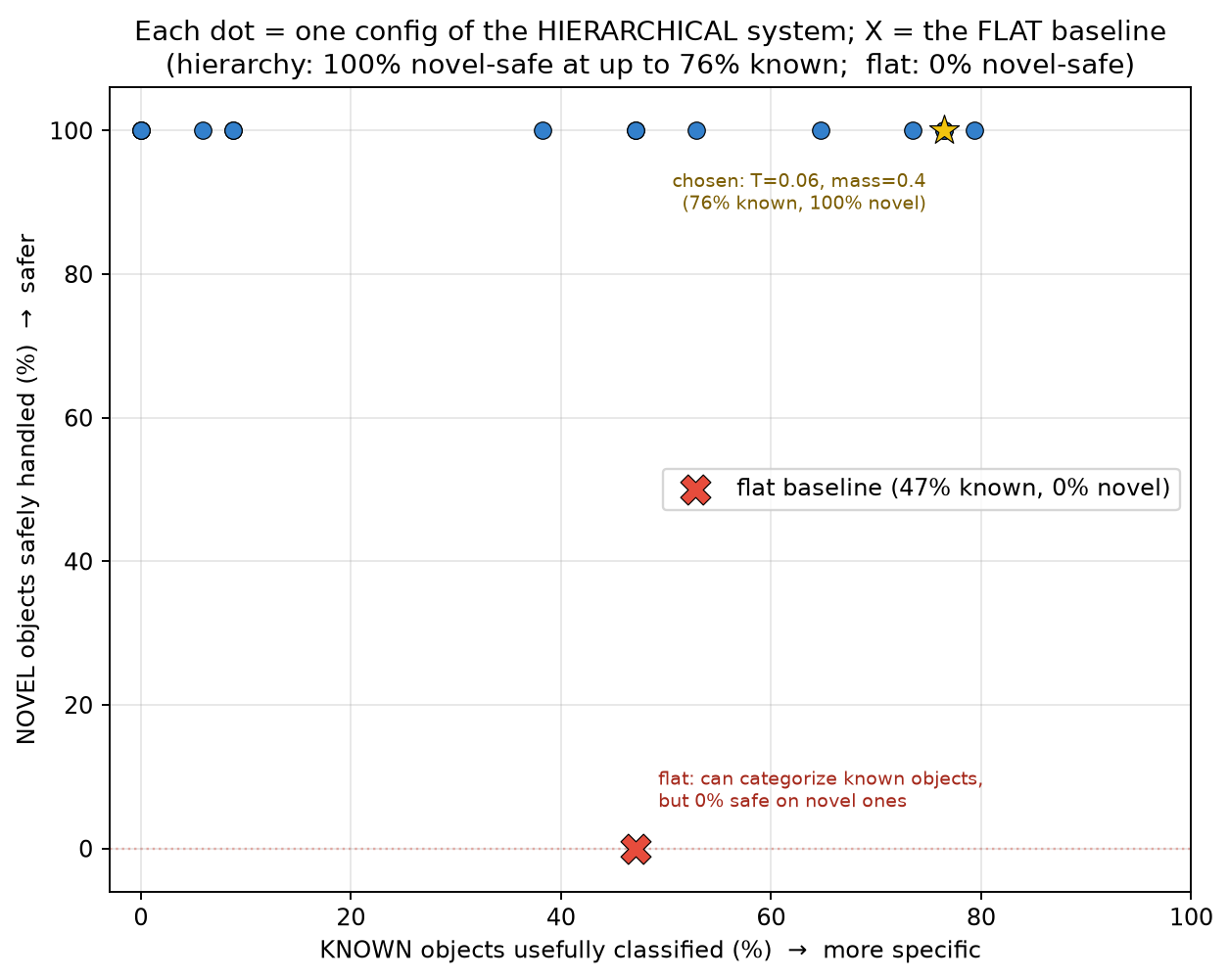
The safety/specificity trade-off is a dial, not a fixed point. Every hierarchical configuration stays 100% safe on novel objects while still usefully classifying up to 76% of known ones; the flat baseline sits alone at 0% novel-safe.
Safety vs specificity: every hierarchical config is 100% novel-safe; the flat baseline is 0% novel-safe
What this is, and is not. This is a safety result, not a specificity one. On closed-set COCO mAP a trained YOLO is more accurate, and we say so. The contribution is the abstraction layer over open-vocabulary (CLIP) features: it never makes a confident categorical mistake on an unknown object, at the honest cost of 69% abstention. The point is the tail, not the leaderboard.
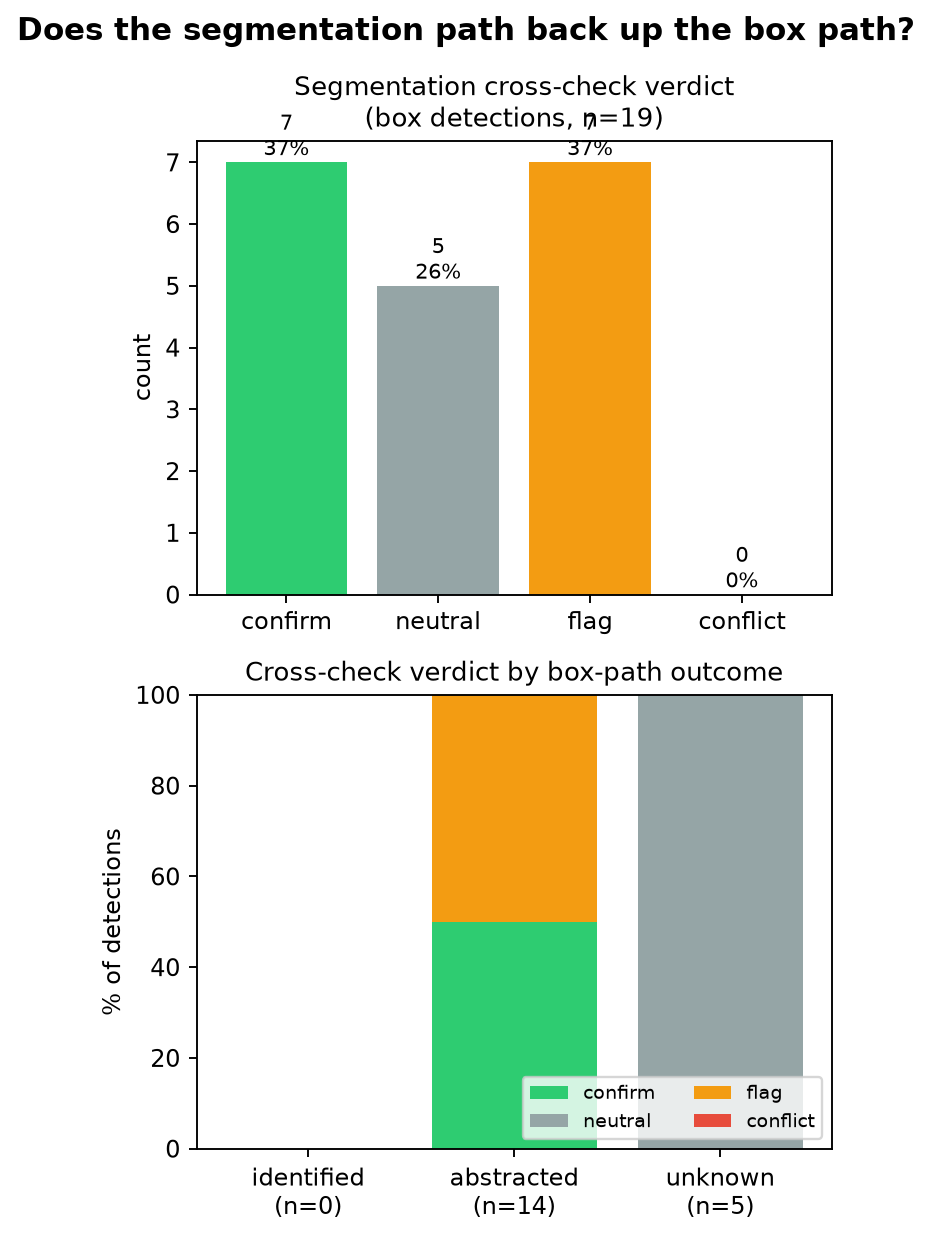
An independent second path
The box classification is cross-checked against a class-agnostic segmentation path: does the pixel evidence back up the box verdict? Across sampled detections it confirms or stays neutral 63% of the time and flags 37% for review, with 0% hard conflicts, and it agrees most where it should (on abstracted and unknown objects).
Self-contained: code + taxonomy + a Gradio app. Training-free (pretrained YOLO + CLIP zero-shot); first run downloads weights (~360 MB).
bash
1pip install -r requirements.txt
2python app.py # Gradio UI: upload an image, see the taxonomy decision path3python app.py --share # same, but also prints a temporary public URL (~72h)
Papers
Open-world (v3):Open-World Hierarchical Perception: Taxonomic Abstraction over Class-Agnostic Proposals for the Safe Handling of Out-of-Vocabulary Road Objects, F. Schaller, arXiv:2608.07577.
Foundational (v1):Hierarchical Taxonomic Abstraction for the Safe Handling of Novel Objects in Autonomous Driving Perception, doi:10.5281/zenodo.21593472.