


Views
No views yet
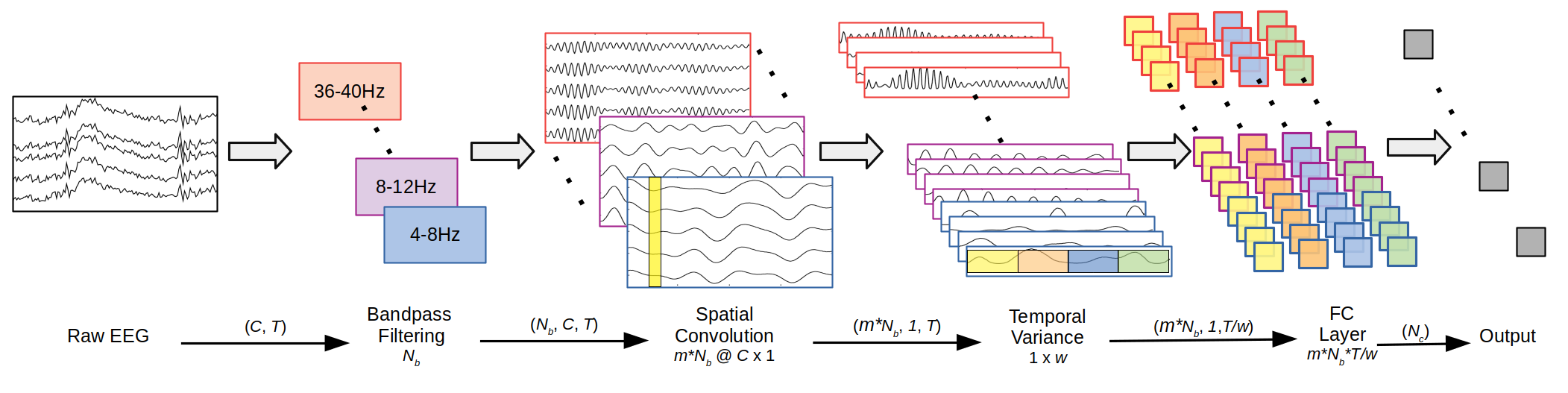
Architecture-only repository. Documents thebraindecode.models.FBCNetclass. No pretrained weights are distributed here. Instantiate the model and train it on your own data.
pip install braindecode1from braindecode.models import FBCNet
2
3model = FBCNet(
4 n_chans=22,
5 sfreq=250,
6 input_window_seconds=4.0,
7 n_outputs=4,
8)
| Parameter | Type | Description |
|---|---|---|
n_bands | int or None or list[tuple[int, int]]], default=9 | Number of frequency bands. Could |
n_filters_spat | int, default=32 | Number of spatial filters for the first convolution. |
n_dim: int, default=3 | — | Number of dimensions for the temporal reductor |
temporal_layer | str, default='LogVarLayer' | Type of temporal aggregator layer. Options: 'VarLayer', 'StdLayer', 'LogVarLayer', 'MeanLayer', 'MaxLayer'. |
stride_factor | int, default=4 | Stride factor for reshaping. |
activation | nn.Module, default=nn.SiLU | Activation function class to apply in Spatial Convolution Block. |
cnn_max_norm | float, default=2.0 | Maximum norm for the spatial convolution layer. |
linear_max_norm | float, default=0.5 | Maximum norm for the final linear layer. |
filter_parameters: dict, default None | — | Dictionary of parameters to use for the FilterBankLayer. If None, a default Chebyshev Type II filter with transition bandwidth of 2 Hz and stop-band ripple of 30 dB will be used. |
1@article{aristimunha2025braindecode,
2  title   = {Braindecode: a deep learning library for raw electrophysiological data},
3  author  = {Aristimunha, Bruno and others},
4  journal = {Zenodo},
5  year    = {2025},
6  doi     = {10.5281/zenodo.17699192},
7}