Native offline speech recognition and audio transcription for Russian, Kazakh,
Kyrgyz, and Uzbek on Apple Silicon with MLX. Core speech-to-text languages:
Russian (русский), Kazakh (қазақша), Kyrgyz (кыргызча), and Uzbek (o‘zbekcha).
For a Python project use uv add gigaam-multilingual-mlx==0.2.0.
The runtime downloads the immutable model-weight revision v0.1.0 once and
reuses the standard Hugging Face cache.
manifest.json records source and parent revisions, hashes, conversion metadata, quantization rules, strict-load validation, and compatibility without machine-local paths.
Benchmark highlights
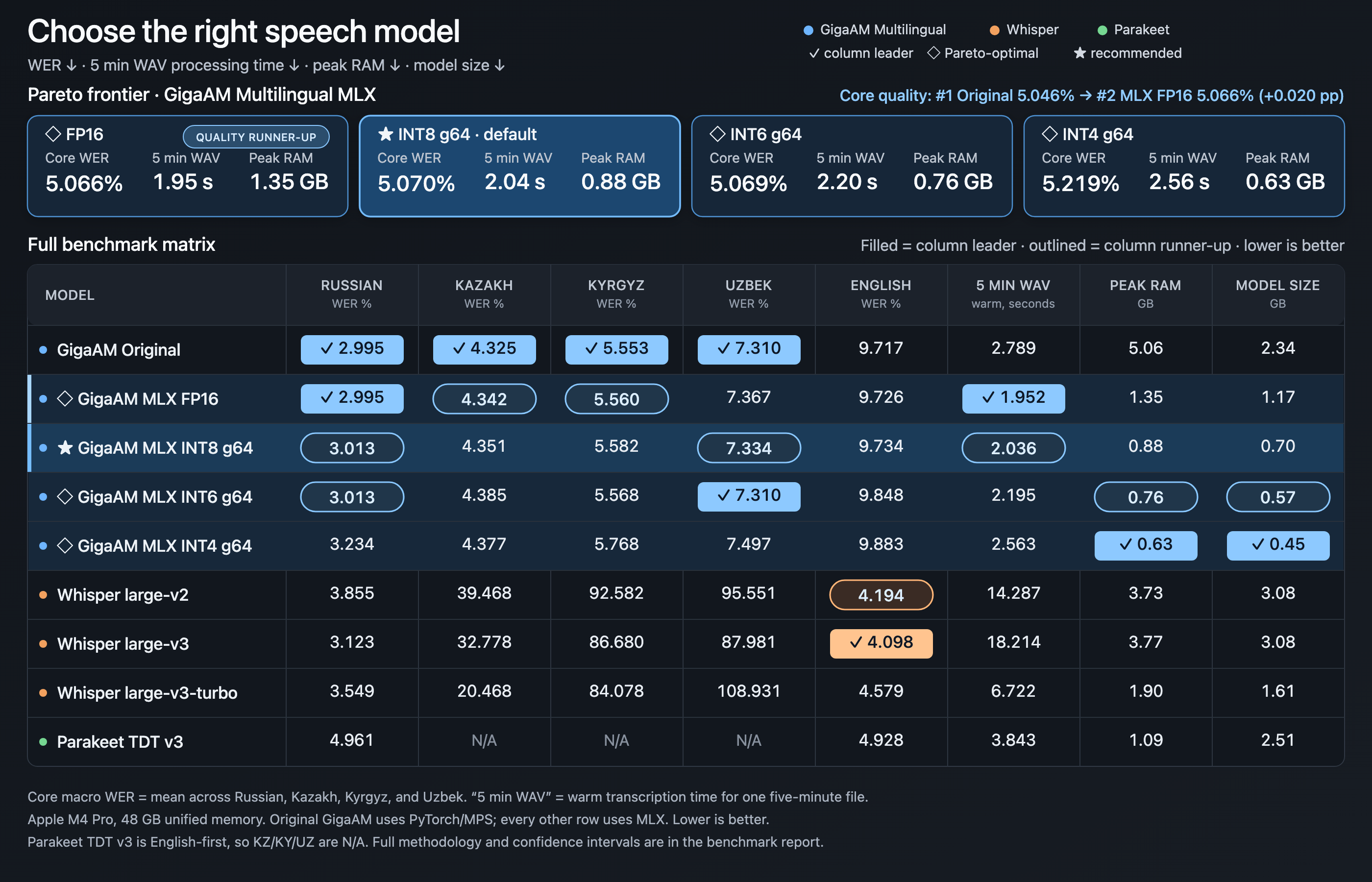
Original GigaAM ranks first at 5.046% core macro WER; MLX FP16 ranks
second at 5.066%, a difference of only +0.020 percentage points.
INT8 reached 3.013% Russian WER and 4.351% / 5.582% / 7.334% WER on Kazakh,
Kyrgyz, and Uzbek in the pinned public FLEURS selections.
On one Russian five-minute WAV, INT8 was 3.30× faster than Whisper v3 Turbo,
7.02× faster than large-v2, and 8.94× faster than large-v3.
Whisper and Parakeet were better on the English appendix. Results come from
one 14-inch MacBook Pro with Apple M4 Pro and 48 GB memory.
GigaAM MLX variant
Core macro WER
5-min WAV
Peak RAM
Model size
FP16
5.066%
1.952s
1.350 GB
1.171 GB
INT8 g64 (default)
5.070%
2.036s
0.877 GB
0.699 GB
INT6 g64
5.069%
2.195s
0.755 GB
0.573 GB
INT4 g64
5.219%
2.563s
0.626 GB
0.447 GB
See the full reproducible report for all nine compared models,
per-language WER/CER, paired-bootstrap confidence intervals, commands, hashes,
and limitations.
Local transcription server
Version 0.2.0 adds an optional OpenAI-compatible transcription endpoint:
See the server guide for curl and Python examples, network access, and limitations. whisper-1 is a compatibility alias; inference still uses GigaAM Multilingual MLX.
Intended use and limitations
Intended for local, offline automatic speech recognition in Russian, English, Kazakh, Kyrgyz, and Uzbek on Apple Silicon. It is not a diarization system, realtime streaming service, forced aligner, or cloud service. Word timestamps are approximate greedy-CTC frame timings. Accuracy can degrade with noise, far-field speech, accents, code-switching, music, overlapping speakers, or domains unlike the public evaluation subsets.
Only Apple M4 Pro was benchmarked for this release. M1-M5 machines are expected to be runtime-compatible within the documented macOS/MLX range, but they are not claimed to have the same speed or memory figures.
Please cite both this MLX software release and the original GigaAM-Multilingual work:
bibtex
1@software{popkov2026gigaammlx,
2 author = {Maksim Popkov},
3 title = {GigaAM-Multilingual MLX},
4 year = {2026},
5 version = {0.2.0},
6 url = {https://github.com/ai-babai/gigaam-multilingual-mlx}
7}
89@misc{gigaam_multilingual,
10 title = {GigaAM Multilingual: Foundation Model for Underrepresented Languages},
11 author = {Andrei Kuzmenko and Alexandr Maximenko and Aleksandr Kutsakov and Georgii Gospodinov and Dmitrii Bolotov and Oleg Kutuzov and Pavel Bogomolov and Fyodor Minkin},
12 year = {2026},
13 eprint = {2607.10371},
14 archivePrefix = {arXiv},
15 primaryClass = {eess.AS},
16 url = {https://arxiv.org/abs/2607.10371}
17}