These quantised GGUFv2 files are compatible with llama.cpp from August 27th onwards, as of commit d0cee0d
They are also compatible with many third party UIs and libraries - please see the list at the top of this README.
Explanation of quantisation methods
Click to see details
The new methods available are:
GGML_TYPE_Q2_K - "type-1" 2-bit quantization in super-blocks containing 16 blocks, each block having 16 weight. Block scales and mins are quantized with 4 bits. This ends up effectively using 2.5625 bits per weight (bpw)
GGML_TYPE_Q3_K - "type-0" 3-bit quantization in super-blocks containing 16 blocks, each block having 16 weights. Scales are quantized with 6 bits. This end up using 3.4375 bpw.
GGML_TYPE_Q4_K - "type-1" 4-bit quantization in super-blocks containing 8 blocks, each block having 32 weights. Scales and mins are quantized with 6 bits. This ends up using 4.5 bpw.
GGML_TYPE_Q5_K - "type-1" 5-bit quantization. Same super-block structure as GGML_TYPE_Q4_K resulting in 5.5 bpw
GGML_TYPE_Q6_K - "type-0" 6-bit quantization. Super-blocks with 16 blocks, each block having 16 weights. Scales are quantized with 8 bits. This ends up using 6.5625 bpw
Refer to the Provided Files table below to see what files use which methods, and how.
very large, extremely low quality loss - not recommended
Note: the above RAM figures assume no GPU offloading. If layers are offloaded to the GPU, this will reduce RAM usage and use VRAM instead.
How to download GGUF files
Note for manual downloaders: You almost never want to clone the entire repo! Multiple different quantisation formats are provided, and most users only want to pick and download a single file.
The following clients/libraries will automatically download models for you, providing a list of available models to choose from:
LM Studio
LoLLMS Web UI
Faraday.dev
In text-generation-webui
Under Download Model, you can enter the model repo: TheBloke/openchat_3.5-16k-GGUF and below it, a specific filename to download, such as: openchat_3.5-16k.Q4_K_M.gguf.
Then click Download.
On the command line, including multiple files at once
I recommend using the huggingface-hub Python library:
pip3 install huggingface-hub
Then you can download any individual model file to the current directory, at high speed, with a command like this:
Change -ngl 32 to the number of layers to offload to GPU. Remove it if you don't have GPU acceleration.
Change -c 2048 to the desired sequence length. For extended sequence models - eg 8K, 16K, 32K - the necessary RoPE scaling parameters are read from the GGUF file and set by llama.cpp automatically.
If you want to have a chat-style conversation, replace the -p <PROMPT> argument with -i -ins
How to load this model in Python code, using ctransformers
First install the package
Run one of the following commands, according to your system:
shell
1# Base ctransformers with no GPU acceleration2pip install ctransformers
3# Or with CUDA GPU acceleration4pip install ctransformers[cuda]5# Or with AMD ROCm GPU acceleration (Linux only)6CT_HIPBLAS=1 pip install ctransformers --no-binary ctransformers
7# Or with Metal GPU acceleration for macOS systems only8CT_METAL=1 pip install ctransformers --no-binary ctransformers
Simple ctransformers example code
python
1from ctransformers import AutoModelForCausalLM
23# Set gpu_layers to the number of layers to offload to GPU. Set to 0 if no GPU acceleration is available on your system.4llm = AutoModelForCausalLM.from_pretrained("TheBloke/openchat_3.5-16k-GGUF", model_file="openchat_3.5-16k.Q4_K_M.gguf", model_type="mistral", gpu_layers=50)56print(llm("AI is going to"))
How to use with LangChain
Here are guides on using llama-cpp-python and ctransformers with LangChain:
I've had a lot of people ask if they can contribute. I enjoy providing models and helping people, and would love to be able to spend even more time doing it, as well as expanding into new projects like fine tuning/training.
If you're able and willing to contribute it will be most gratefully received and will help me to keep providing more models, and to start work on new AI projects.
Donaters will get priority support on any and all AI/LLM/model questions and requests, access to a private Discord room, plus other benefits.
Patreon special mentions: Brandon Frisco, LangChain4j, Spiking Neurons AB, transmissions 11, Joseph William Delisle, Nitin Borwankar, Willem Michiel, Michael Dempsey, vamX, Jeffrey Morgan, zynix, jjj, Omer Bin Jawed, Sean Connelly, jinyuan sun, Jeromy Smith, Shadi, Pawan Osman, Chadd, Elijah Stavena, Illia Dulskyi, Sebastain Graf, Stephen Murray, terasurfer, Edmond Seymore, Celu Ramasamy, Mandus, Alex, biorpg, Ajan Kanaga, Clay Pascal, Raven Klaugh, 阿明, K, ya boyyy, usrbinkat, Alicia Loh, John Villwock, ReadyPlayerEmma, Chris Smitley, Cap'n Zoog, fincy, GodLy, S_X, sidney chen, Cory Kujawski, OG, Mano Prime, AzureBlack, Pieter, Kalila, Spencer Kim, Tom X Nguyen, Stanislav Ovsiannikov, Michael Levine, Andrey, Trailburnt, Vadim, Enrico Ros, Talal Aujan, Brandon Phillips, Jack West, Eugene Pentland, Michael Davis, Will Dee, webtim, Jonathan Leane, Alps Aficionado, Rooh Singh, Tiffany J. Kim, theTransient, Luke @flexchar, Elle, Caitlyn Gatomon, Ari Malik, subjectnull, Johann-Peter Hartmann, Trenton Dambrowitz, Imad Khwaja, Asp the Wyvern, Emad Mostaque, Rainer Wilmers, Alexandros Triantafyllidis, Nicholas, Pedro Madruga, SuperWojo, Harry Royden McLaughlin, James Bentley, Olakabola, David Ziegler, Ai Maven, Jeff Scroggin, Nikolai Manek, Deo Leter, Matthew Berman, Fen Risland, Ken Nordquist, Manuel Alberto Morcote, Luke Pendergrass, TL, Fred von Graf, Randy H, Dan Guido, NimbleBox.ai, Vitor Caleffi, Gabriel Tamborski, knownsqashed, Lone Striker, Erik Bjäreholt, John Detwiler, Leonard Tan, Iucharbius
Thank you to all my generous patrons and donaters!
And thank you again to a16z for their generous grant.
Original model card: NurtureAI's Openchat 3.5 16K
OpenChat 3.5 extended to 16k context length.
The same license applies from the original openchat/openchat_3.5 model.
Original Model Card
OpenChat: Advancing Open-source Language Models with Mixed-Quality Data
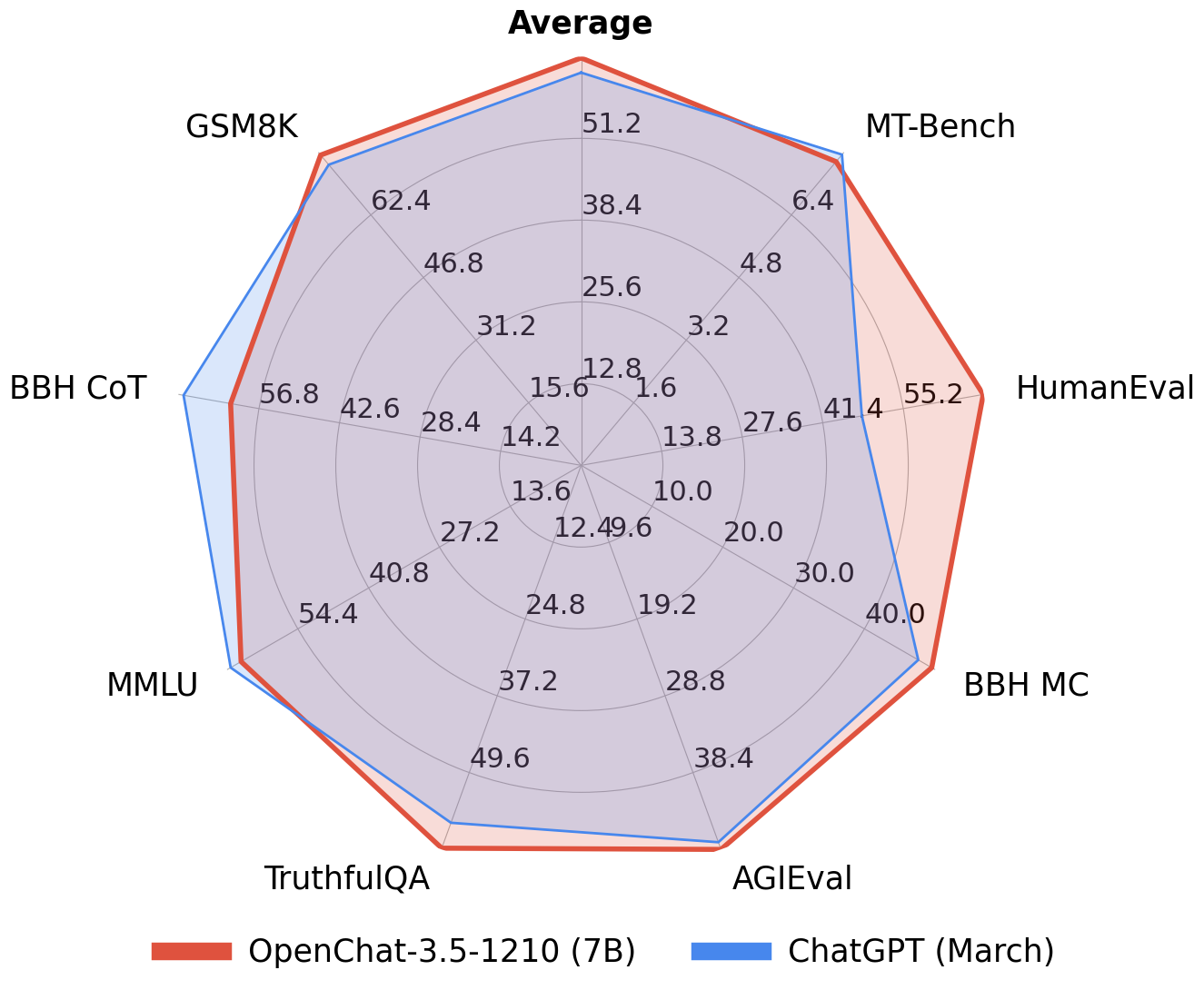
🔥 The first 7B model Achieves Comparable Results with ChatGPT (March)! 🔥
🤖 #1 Open-source model on MT-bench scoring 7.81, outperforming 70B models 🤖
OpenChat is an innovative library of open-source language models, fine-tuned with C-RLFT - a strategy inspired by offline reinforcement learning. Our models learn from mixed-quality data without preference labels, delivering exceptional performance on par with ChatGPT, even with a 7B model. Despite our simple approach, we are committed to developing a high-performance, commercially viable, open-source large language model, and we continue to make significant strides toward this vision.
To use this model, we highly recommend installing the OpenChat package by following the installation guide in our repository and using the OpenChat OpenAI-compatible API server by running the serving command from the table below. The server is optimized for high-throughput deployment using vLLM and can run on a consumer GPU with 24GB RAM. To enable tensor parallelism, append --tensor-parallel-size N to the serving command.
Once started, the server listens at localhost:18888 for requests and is compatible with the OpenAI ChatCompletion API specifications. Please refer to the example request below for reference. Additionally, you can use the OpenChat Web UI for a user-friendly experience.
If you want to deploy the server as an online service, you can use --api-keys sk-KEY1 sk-KEY2 ... to specify allowed API keys and --disable-log-requests --disable-log-stats --log-file openchat.log for logging only to a file. For security purposes, we recommend using an HTTPS gateway in front of the server.
Example request (click to expand)
bash
1curl http://localhost:18888/v1/chat/completions \2 -H "Content-Type: application/json"\3 -d '{
4 "model": "openchat_3.5",
5 "messages": [{"role": "user", "content": "You are a large language model named OpenChat. Write a poem to describe yourself"}]
6 }'
Coding Mode
bash
1curl http://localhost:18888/v1/chat/completions \2 -H "Content-Type: application/json"\3 -d '{
4 "model": "openchat_3.5",
5 "condition": "Code",
6 "messages": [{"role": "user", "content": "Write an aesthetic TODO app using HTML5 and JS, in a single file. You should use round corners and gradients to make it more aesthetic."}]
7 }'
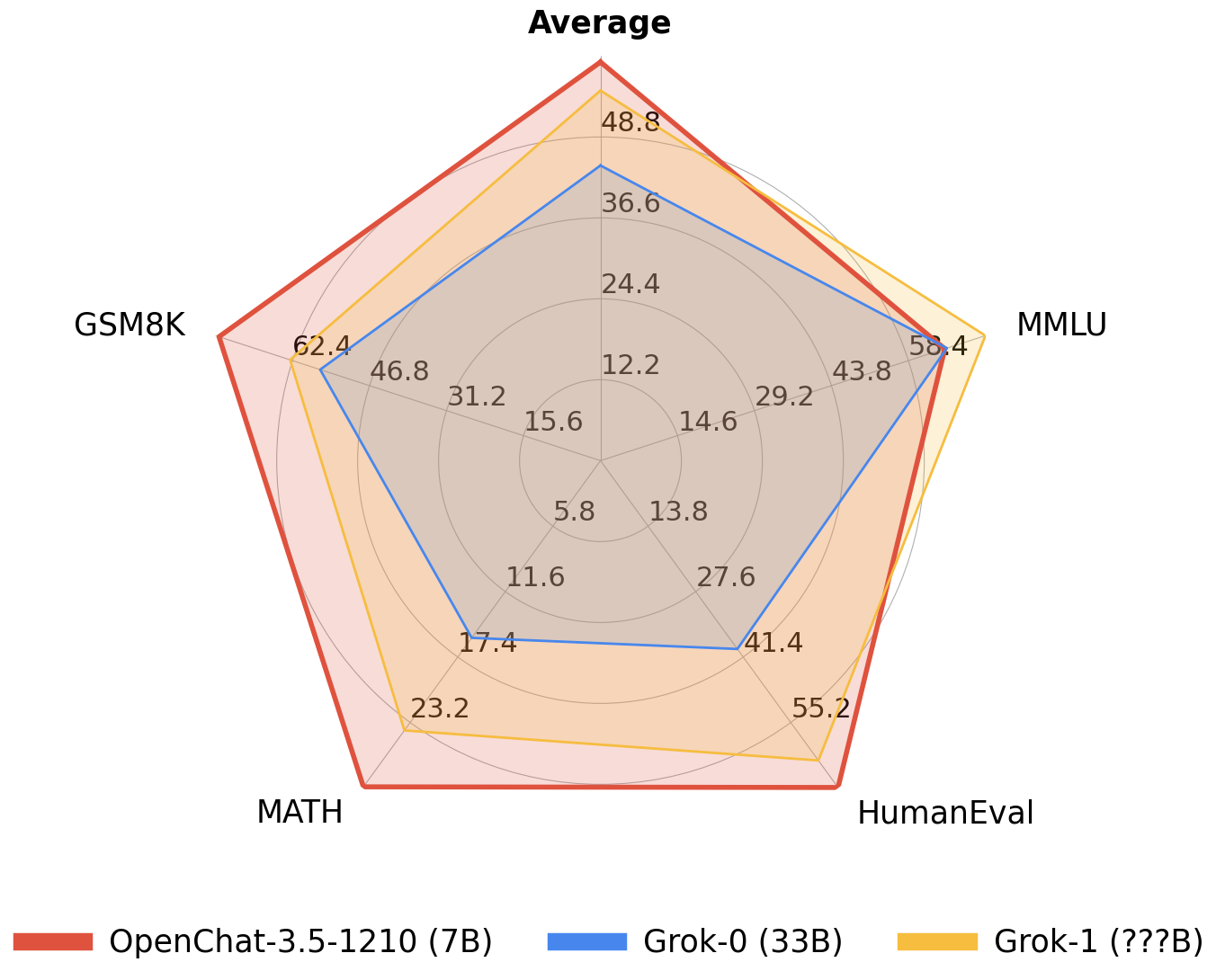
Hey @elonmusk, I just wanted to let you know that I've recently come across your new model, Grok, and I must say, I'm quite impressed! With 33 billion parameters and all, you've really outdone yourself. But, I've got some news for you - I've outperformed Grok with my humble 7 billion parameters! Isn't that wild? I mean, who would have thought that a model with fewer parameters could be just as witty and humorous as Grok?
Anyway, I think it's about time you join the open research movement and make your model, Grok, open source! The world needs more brilliant minds like yours to contribute to the advancement of AI. Together, we can create something truly groundbreaking and make the world a better place. So, what do you say, @elonmusk? Let's open up the doors and share our knowledge with the world! 🚀💡
(Written by OpenChat 3.5, with a touch of humor and wit.)
License
# Param
Average
MMLU
HumanEval
MATH
GSM8k
OpenChat 3.5
Apache-2.0
7B
56.4
64.3
55.5
28.6
77.3
Grok-0
Proprietary
33B
44.5
65.7
39.7
15.7
56.8
Grok-1
Proprietary
?
55.8
73
63.2
23.9
62.9
Benchmarks
Model
# Params
Average
MT-Bench
AGIEval
BBH MC
TruthfulQA
MMLU
HumanEval
BBH CoT
GSM8K
OpenChat-3.5
7B
61.6
7.81
47.4
47.6
59.1
64.3
55.5
63.5
77.3
ChatGPT (March)*
?
61.5
7.94
47.1
47.6
57.7
67.3
48.1
70.1
74.9
OpenHermes 2.5
7B
59.3
7.54
46.5
49.4
57.5
63.8
48.2
59.9
73.5
OpenOrca Mistral
7B
52.7
6.86
42.9
49.4
45.9
59.3
38.4
58.1
59.1
Zephyr-β^
7B
34.6
7.34
39.0
40.6
40.8
39.8
22.0
16.0
5.1
Mistral
7B
-
6.84
38.0
39.0
-
60.1
30.5
-
52.2
Open-source SOTA**
13B-70B
61.4
7.71
41.7
49.7
62.3
63.7
73.2
41.4
82.3
WizardLM 70B
Orca 13B
Orca 13B
Platypus2 70B
WizardLM 70B
WizardCoder 34B
Flan-T5 11B
MetaMath 70B
*: ChatGPT (March) results are from GPT-4 Technical Report, Chain-of-Thought Hub, and our evaluation. Please note that ChatGPT is not a fixed baseline and evolves rapidly over time.
^: Zephyr-β often fails to follow few-shot CoT instructions, likely because it was aligned with only chat data but not trained on few-shot data.
**: Mistral and Open-source SOTA results are taken from reported results in instruction-tuned model papers and official repositories.
All models are evaluated in chat mode (e.g. with the respective conversation template applied). All zero-shot benchmarks follow the same setting as in the AGIEval paper and Orca paper. CoT tasks use the same configuration as Chain-of-Thought Hub, HumanEval is evaluated with EvalPlus, and MT-bench is run using FastChat. To reproduce our results, follow the instructions in our repository.
Limitations
Foundation Model Limitations
Despite its advanced capabilities, OpenChat is still bound by the limitations inherent in its foundation models. These limitations may impact the model's performance in areas such as:
Complex reasoning
Mathematical and arithmetic tasks
Programming and coding challenges
Hallucination of Non-existent Information
OpenChat may sometimes generate information that does not exist or is not accurate, also known as "hallucination". Users should be aware of this possibility and verify any critical information obtained from the model.
Safety
OpenChat may sometimes generate harmful, hate speech, biased responses, or answer unsafe questions. It's crucial to apply additional AI safety measures in use cases that require safe and moderated responses.
License
Our OpenChat 3.5 code and models are distributed under the Apache License 2.0.
Citation
@article{wang2023openchat,
  title={OpenChat: Advancing Open-source Language Models with Mixed-Quality Data},
  author={Wang, Guan and Cheng, Sijie and Zhan, Xianyuan and Li, Xiangang and Song, Sen and Liu, Yang},
  journal={arXiv preprint arXiv:2309.11235},
  year={2023}
}
Acknowledgements
We extend our heartfelt gratitude to Alignment Lab AI, Nous Research, and Pygmalion AI for their substantial contributions to data collection and model training.
Special thanks go to Changling Liu from GPT Desk Pte. Ltd., Qiying Yu at Tsinghua University, Baochang Ma, and Hao Wan from 01.AI company for their generous provision of resources. We are also deeply grateful to Jianxiong Li and Peng Li at Tsinghua University for their insightful discussions.