These quantised GGUFv2 files are compatible with llama.cpp from August 27th onwards, as of commit d0cee0d
They are also compatible with many third party UIs and libraries - please see the list at the top of this README.
Explanation of quantisation methods
Click to see details
The new methods available are:
GGML_TYPE_Q2_K - "type-1" 2-bit quantization in super-blocks containing 16 blocks, each block having 16 weight. Block scales and mins are quantized with 4 bits. This ends up effectively using 2.5625 bits per weight (bpw)
GGML_TYPE_Q3_K - "type-0" 3-bit quantization in super-blocks containing 16 blocks, each block having 16 weights. Scales are quantized with 6 bits. This end up using 3.4375 bpw.
GGML_TYPE_Q4_K - "type-1" 4-bit quantization in super-blocks containing 8 blocks, each block having 32 weights. Scales and mins are quantized with 6 bits. This ends up using 4.5 bpw.
GGML_TYPE_Q5_K - "type-1" 5-bit quantization. Same super-block structure as GGML_TYPE_Q4_K resulting in 5.5 bpw
GGML_TYPE_Q6_K - "type-0" 6-bit quantization. Super-blocks with 16 blocks, each block having 16 weights. Scales are quantized with 8 bits. This ends up using 6.5625 bpw
Refer to the Provided Files table below to see what files use which methods, and how.
very large, extremely low quality loss - not recommended
Note: the above RAM figures assume no GPU offloading. If layers are offloaded to the GPU, this will reduce RAM usage and use VRAM instead.
How to download GGUF files
Note for manual downloaders: You almost never want to clone the entire repo! Multiple different quantisation formats are provided, and most users only want to pick and download a single file.
The following clients/libraries will automatically download models for you, providing a list of available models to choose from:
LM Studio
LoLLMS Web UI
Faraday.dev
In text-generation-webui
Under Download Model, you can enter the model repo: TheBloke/genz-13B-v2-GGUF and below it, a specific filename to download, such as: genz-13b-v2.Q4_K_M.gguf.
Then click Download.
On the command line, including multiple files at once
I recommend using the huggingface-hub Python library:
pip3 install huggingface-hub
Then you can download any individual model file to the current directory, at high speed, with a command like this:
Change -ngl 32 to the number of layers to offload to GPU. Remove it if you don't have GPU acceleration.
Change -c 4096 to the desired sequence length. For extended sequence models - eg 8K, 16K, 32K - the necessary RoPE scaling parameters are read from the GGUF file and set by llama.cpp automatically.
If you want to have a chat-style conversation, replace the -p <PROMPT> argument with -i -ins
How to load this model in Python code, using ctransformers
First install the package
Run one of the following commands, according to your system:
shell
1# Base ctransformers with no GPU acceleration2pip install ctransformers
3# Or with CUDA GPU acceleration4pip install ctransformers[cuda]5# Or with AMD ROCm GPU acceleration (Linux only)6CT_HIPBLAS=1 pip install ctransformers --no-binary ctransformers
7# Or with Metal GPU acceleration for macOS systems only8CT_METAL=1 pip install ctransformers --no-binary ctransformers
Simple ctransformers example code
python
1from ctransformers import AutoModelForCausalLM
23# Set gpu_layers to the number of layers to offload to GPU. Set to 0 if no GPU acceleration is available on your system.4llm = AutoModelForCausalLM.from_pretrained("TheBloke/genz-13B-v2-GGUF", model_file="genz-13b-v2.Q4_K_M.gguf", model_type="llama", gpu_layers=50)56print(llm("AI is going to"))
How to use with LangChain
Here are guides on using llama-cpp-python and ctransformers with LangChain:
I've had a lot of people ask if they can contribute. I enjoy providing models and helping people, and would love to be able to spend even more time doing it, as well as expanding into new projects like fine tuning/training.
If you're able and willing to contribute it will be most gratefully received and will help me to keep providing more models, and to start work on new AI projects.
Donaters will get priority support on any and all AI/LLM/model questions and requests, access to a private Discord room, plus other benefits.
Patreon special mentions: Pierre Kircher, Stanislav Ovsiannikov, Michael Levine, Eugene Pentland, Andrey, 준교 김, Randy H, Fred von Graf, Artur Olbinski, Caitlyn Gatomon, terasurfer, Jeff Scroggin, James Bentley, Vadim, Gabriel Puliatti, Harry Royden McLaughlin, Sean Connelly, Dan Guido, Edmond Seymore, Alicia Loh, subjectnull, AzureBlack, Manuel Alberto Morcote, Thomas Belote, Lone Striker, Chris Smitley, Vitor Caleffi, Johann-Peter Hartmann, Clay Pascal, biorpg, Brandon Frisco, sidney chen, transmissions 11, Pedro Madruga, jinyuan sun, Ajan Kanaga, Emad Mostaque, Trenton Dambrowitz, Jonathan Leane, Iucharbius, usrbinkat, vamX, George Stoitzev, Luke Pendergrass, theTransient, Olakabola, Swaroop Kallakuri, Cap'n Zoog, Brandon Phillips, Michael Dempsey, Nikolai Manek, danny, Matthew Berman, Gabriel Tamborski, alfie_i, Raymond Fosdick, Tom X Nguyen, Raven Klaugh, LangChain4j, Magnesian, Illia Dulskyi, David Ziegler, Mano Prime, Luis Javier Navarrete Lozano, Erik Bjäreholt, 阿明, Nathan Dryer, Alex, Rainer Wilmers, zynix, TL, Joseph William Delisle, John Villwock, Nathan LeClaire, Willem Michiel, Joguhyik, GodLy, OG, Alps Aficionado, Jeffrey Morgan, ReadyPlayerEmma, Tiffany J. Kim, Sebastain Graf, Spencer Kim, Michael Davis, webtim, Talal Aujan, knownsqashed, John Detwiler, Imad Khwaja, Deo Leter, Jerry Meng, Elijah Stavena, Rooh Singh, Pieter, SuperWojo, Alexandros Triantafyllidis, Stephen Murray, Ai Maven, ya boyyy, Enrico Ros, Ken Nordquist, Deep Realms, Nicholas, Spiking Neurons AB, Elle, Will Dee, Jack West, RoA, Luke @flexchar, Viktor Bowallius, Derek Yates, Subspace Studios, jjj, Toran Billups, Asp the Wyvern, Fen Risland, Ilya, NimbleBox.ai, Chadd, Nitin Borwankar, Emre, Mandus, Leonard Tan, Kalila, K, Trailburnt, S_X, Cory Kujawski
Thank you to all my generous patrons and donaters!
And thank you again to a16z for their generous grant.
Original model card: Bud's GenZ 13B v2
~ GenZ ~
Democratizing access to LLMs for the open-source community. Let's advance AI, together.
Introduction 🎉
Welcome to GenZ, an advanced Large Language Model (LLM) fine-tuned on the foundation of Meta's open-source Llama V2 13B parameter model. At Bud Ecosystem, we believe in the power of open-source collaboration to drive the advancement of technology at an accelerated pace. Our vision is to democratize access to fine-tuned LLMs, and to that end, we will be releasing a series of models across different parameter counts (7B, 13B, and 70B) and quantizations (32-bit and 4-bit) for the open-source community to use, enhance, and build upon.
The smaller quantization version of our models makes them more accessible, enabling their use even on personal computers. This opens up a world of possibilities for developers, researchers, and enthusiasts to experiment with these models and contribute to the collective advancement of language model technology.
GenZ isn't just a powerful text generator—it's a sophisticated AI assistant, capable of understanding and responding to user prompts with high-quality responses. We've taken the robust capabilities of Llama V2 and fine-tuned them to offer a more user-focused experience. Whether you're seeking informative responses or engaging interactions, GenZ is designed to deliver.
And this isn't the end. It's just the beginning of a journey towards creating more advanced, more efficient, and more accessible language models. We invite you to join us on this exciting journey. 🚀
Milestone Releases ️🏁
[27 July 2023]GenZ-13B V2 (ggml) : Announcing our GenZ-13B v2 with ggml. This variant of GenZ can run inferencing using only CPU and without the need of GPU. Download the model from HuggingFace.
[27 July 2023]GenZ-13B V2 (4-bit) : Announcing our GenZ-13B v2 with 4-bit quantisation. Enabling inferencing with much lesser GPU memory than the 32-bit variant. Download the model from HuggingFace.
[26 July 2023]GenZ-13B V2 : We're excited to announce the release of our Genz 13B v2 model, a step forward with improved evaluation results compared to v1. Experience the advancements by downloading the model from HuggingFace.
[20 July 2023]GenZ-13B : We marked an important milestone with the release of the Genz 13B model. The journey began here, and you can partake in it by downloading the model from Hugging Face.
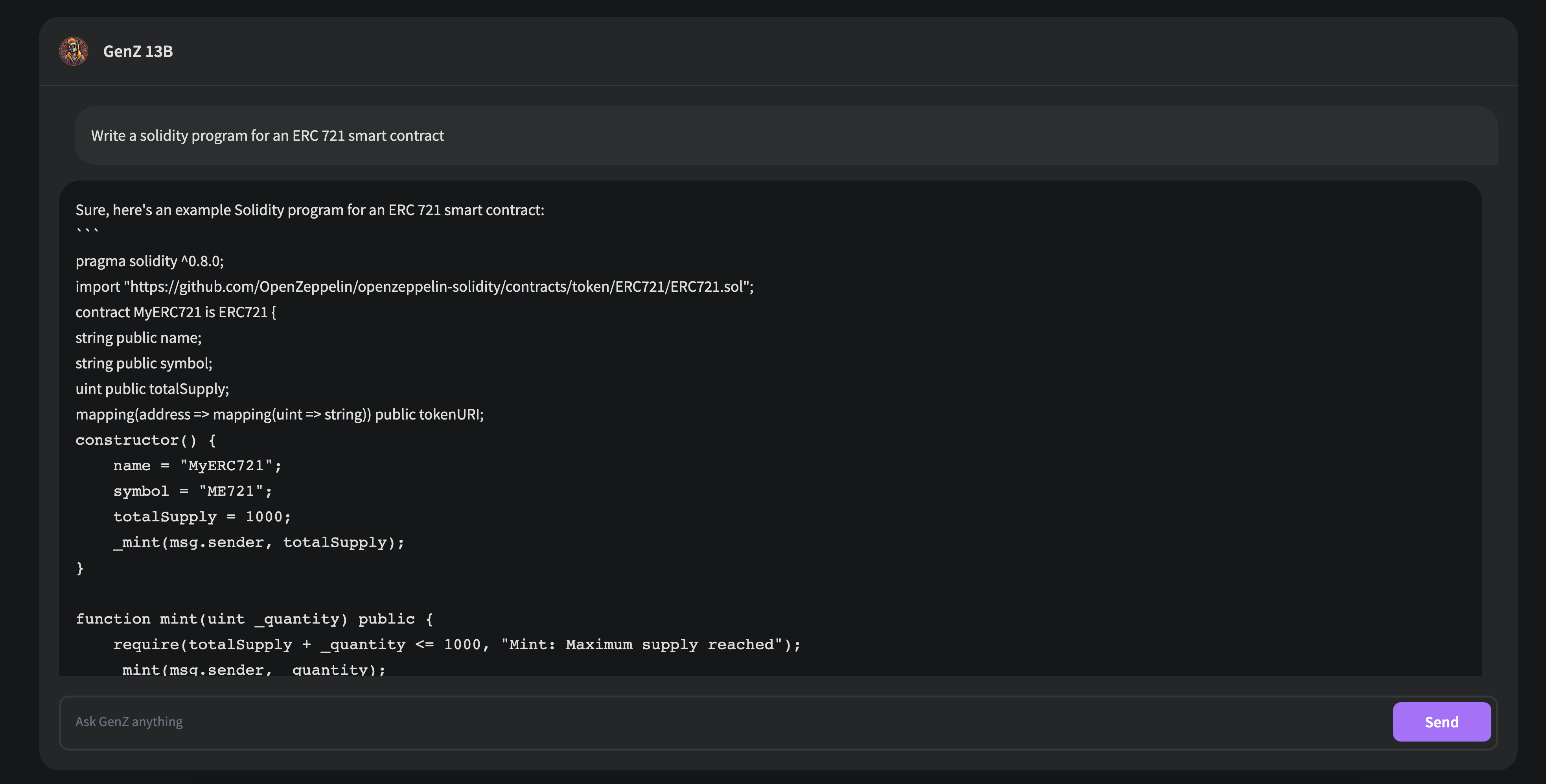
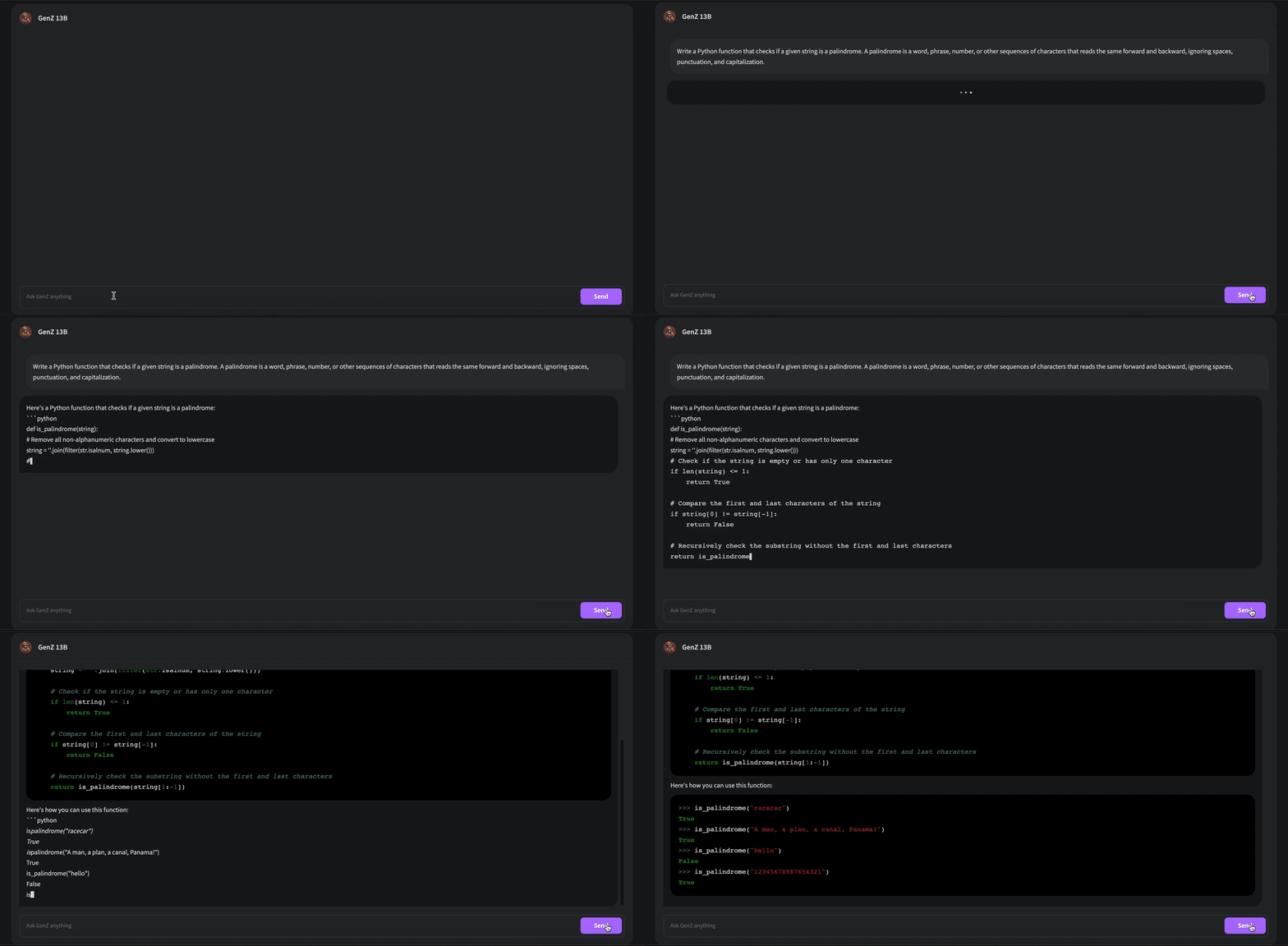
Python
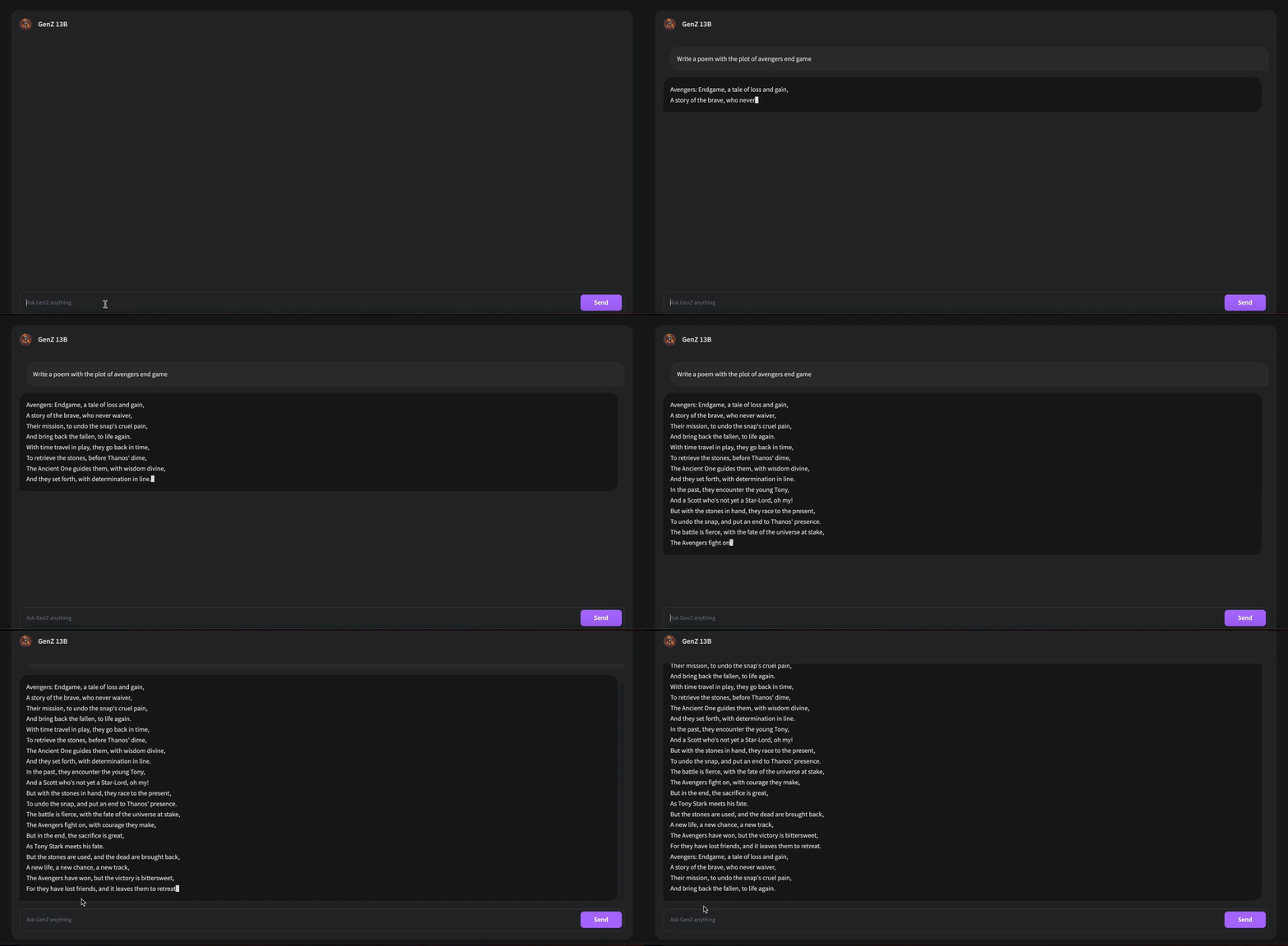
Poem
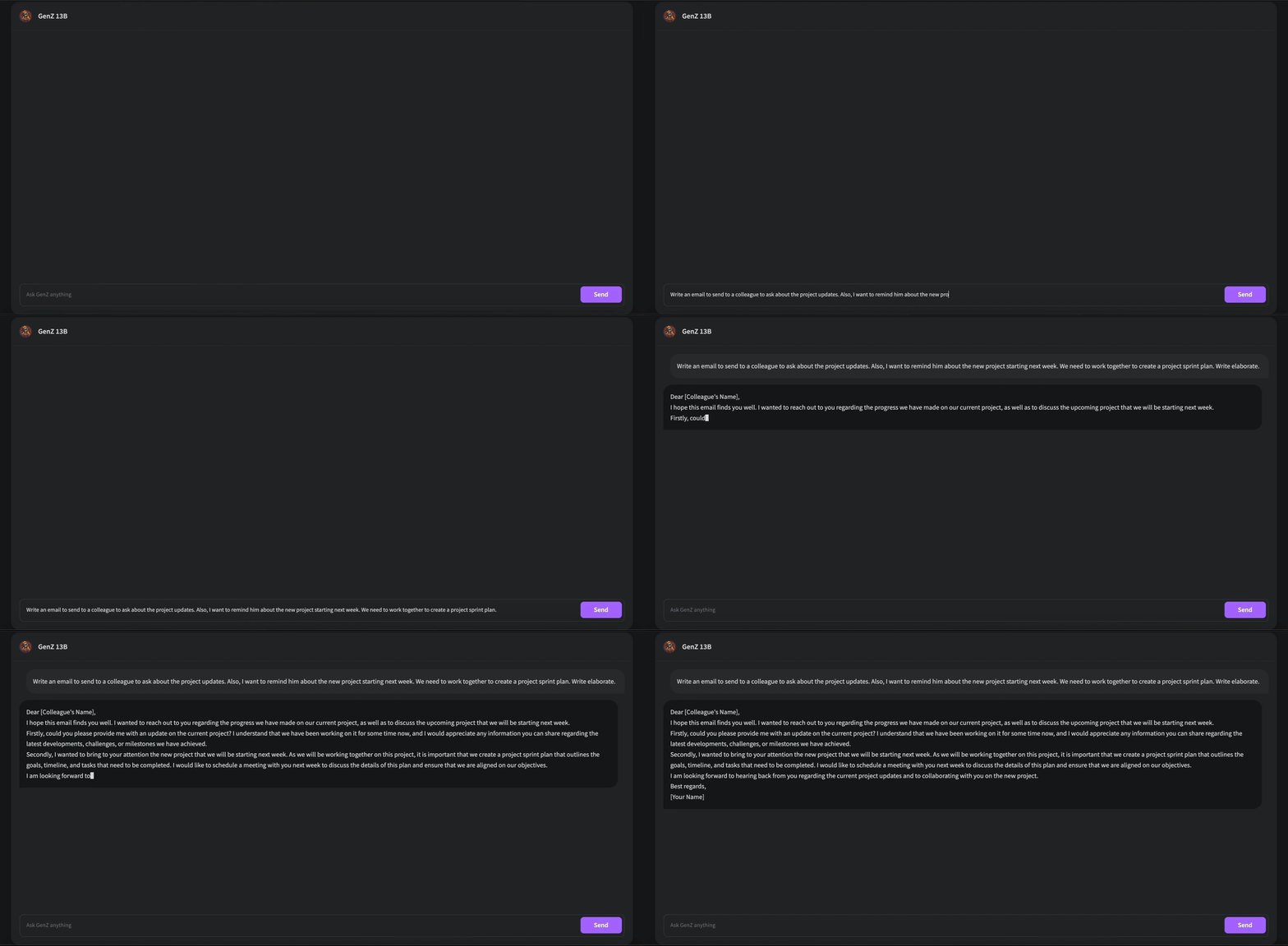
Email
Code Generation
Poem Generation
Email Generation
Getting Started on Hugging Face 🤗
Getting up and running with our models on Hugging Face is a breeze. Follow these steps:
1️⃣ : Import necessary modules
Start by importing the necessary modules from the ‘transformers’ library and ‘torch’.
Now that you have the model and tokenizer, you're ready to generate responses. Here's how you can do it:
python
1inputs = tokenizer("The meaning of life is", return_tensors="pt")2sample = model.generate(**inputs, max_length=128)3print(tokenizer.decode(sample[0]))
In this example, "The meaning of life is" is the prompt template used for inference. You can replace it with any string you like.
Want to interact with the model in a more intuitive way? We have a Gradio interface set up for that. Head over to our GitHub page, clone the repository, and run the ‘generate.py’ script to try it out. Happy experimenting! 😄
Fine-tuning 🎯
It's time to upgrade the model by fine-tuning the model. You can do this using our provided finetune.py script. Here's an example command:
Looking for an even simpler way to get started with GenZ? We've got you covered. We've prepared a pair of detailed Colab notebooks - one for Inference and one for Fine-tuning. These notebooks come pre-filled with all the information and code you'll need. All you'll have to do is run them!
Keep an eye out for these notebooks. They'll be added to the repository soon!
Why Use GenZ? 💡
You might be wondering, "Why should I choose GenZ over a pretrained model?" The answer lies in the extra mile we've gone to fine-tune our models.
While pretrained models are undeniably powerful, GenZ brings something extra to the table. We've fine-tuned it with curated datasets, which means it has additional skills and capabilities beyond what a pretrained model can offer. Whether you need it for a simple task or a complex project, GenZ is up for the challenge.
What's more, we are committed to continuously enhancing GenZ. We believe in the power of constant learning and improvement. That's why we'll be regularly fine-tuning our models with various curated datasets to make them even better. Our goal is to reach the state of the art and beyond - and we're committed to staying the course until we get there.
But don't just take our word for it. We've provided detailed evaluations and performance details in a later section, so you can see the difference for yourself.
Choose GenZ and join us on this journey. Together, we can push the boundaries of what's possible with large language models.
Model Card for GenZ 13B 📄
Here's a quick overview of everything you need to know about GenZ 13B.
Model Details:
Developed by: Bud Ecosystem
Base pretrained model type: Llama V2 13B
Model Architecture: GenZ 13B, fine-tuned on Llama V2 13B, is an auto-regressive language model that employs an optimized transformer architecture. The fine-tuning process for GenZ 13B leveraged Supervised Fine-Tuning (SFT)
License: The model is available for commercial use under a custom commercial license. For more information, please visit: Meta AI Model and Library Downloads
Intended Use 💼
When we created GenZ 13B, we had a clear vision of how it could be used to push the boundaries of what's possible with large language models. We also understand the importance of using such models responsibly. Here's a brief overview of the intended and out-of-scope uses for GenZ 13B.
Direct Use
GenZ 13B is designed to be a powerful tool for research on large language models. It's also an excellent foundation for further specialization and fine-tuning for specific use cases, such as:
Text summarization
Text generation
Chatbot creation
And much more!
Out-of-Scope Use 🚩
While GenZ 13B is versatile, there are certain uses that are out of scope:
Production use without adequate assessment of risks and mitigation
Any use cases which may be considered irresponsible or harmful
Use in any manner that violates applicable laws or regulations, including trade compliance laws
Use in any other way that is prohibited by the Acceptable Use Policy and Licensing Agreement for Llama 2
Remember, GenZ 13B, like any large language model, is trained on a large-scale corpora representative of the web, and therefore, may carry the stereotypes and biases commonly encountered online.
Recommendations 🧠
We recommend users of GenZ 13B to consider fine-tuning it for the specific set of tasks of interest. Appropriate precautions and guardrails should be taken for any production use. Using GenZ 13B responsibly is key to unlocking its full potential while maintaining a safe and respectful environment.
Training Details 📚
When fine-tuning GenZ 13B, we took a meticulous approach to ensure we were building on the solid base of the pretrained Llama V2 13B model in the most effective way. Here's a look at the key details of our training process:
Fine-Tuning Training Data
For the fine-tuning process, we used a carefully curated mix of datasets. These included data from OpenAssistant, an instruction fine-tuning dataset, and Thought Source for the Chain Of Thought (CoT) approach. This diverse mix of data sources helped us enhance the model's capabilities across a range of tasks.
Fine-Tuning Procedure
We performed a full-parameter fine-tuning using Supervised Fine-Tuning (SFT). This was carried out on 4 A100 80GB GPUs, and the process took under 100 hours. To make the process more efficient, we used DeepSpeed's ZeRO-3 optimization.
Tokenizer
We used the SentencePiece tokenizer during the fine-tuning process. This tokenizer is known for its capability to handle open-vocabulary language tasks efficiently.
Hyperparameters
Here are the hyperparameters we used for fine-tuning:
Hyperparameter
Value
Warmup Ratio
0.04
Learning Rate Scheduler Type
Cosine
Learning Rate
2e-5
Number of Training Epochs
3
Per Device Training Batch Size
4
Gradient Accumulation Steps
4
Precision
FP16
Optimizer
AdamW
Evaluations 🎯
Evaluating our model is a key part of our fine-tuning process. It helps us understand how our model is performing and how it stacks up against other models. Here's a look at some of the key evaluations for GenZ 13B:
Benchmark Comparison
We've compared GenZ V1 with V2 to understand the improvements our fine-tuning has achieved.
Model Name
MT Bench
Vicuna Bench
MMLU
Human Eval
Hellaswag
BBH
Genz 13B
6.12
86.1
53.62
17.68
77.38
37.76
Genz 13B v2
6.79
87.2
53.68
21.95
77.48
38.1
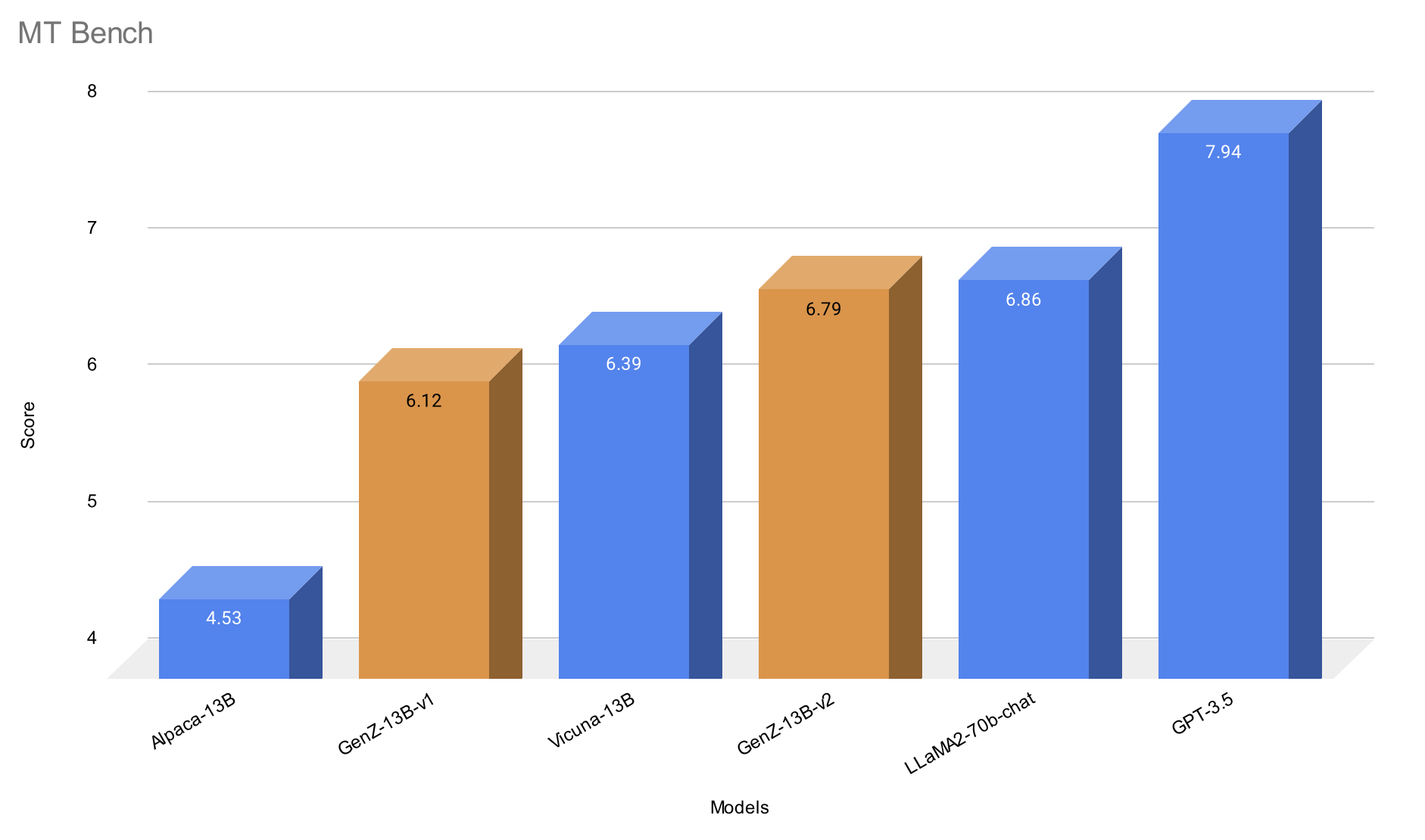
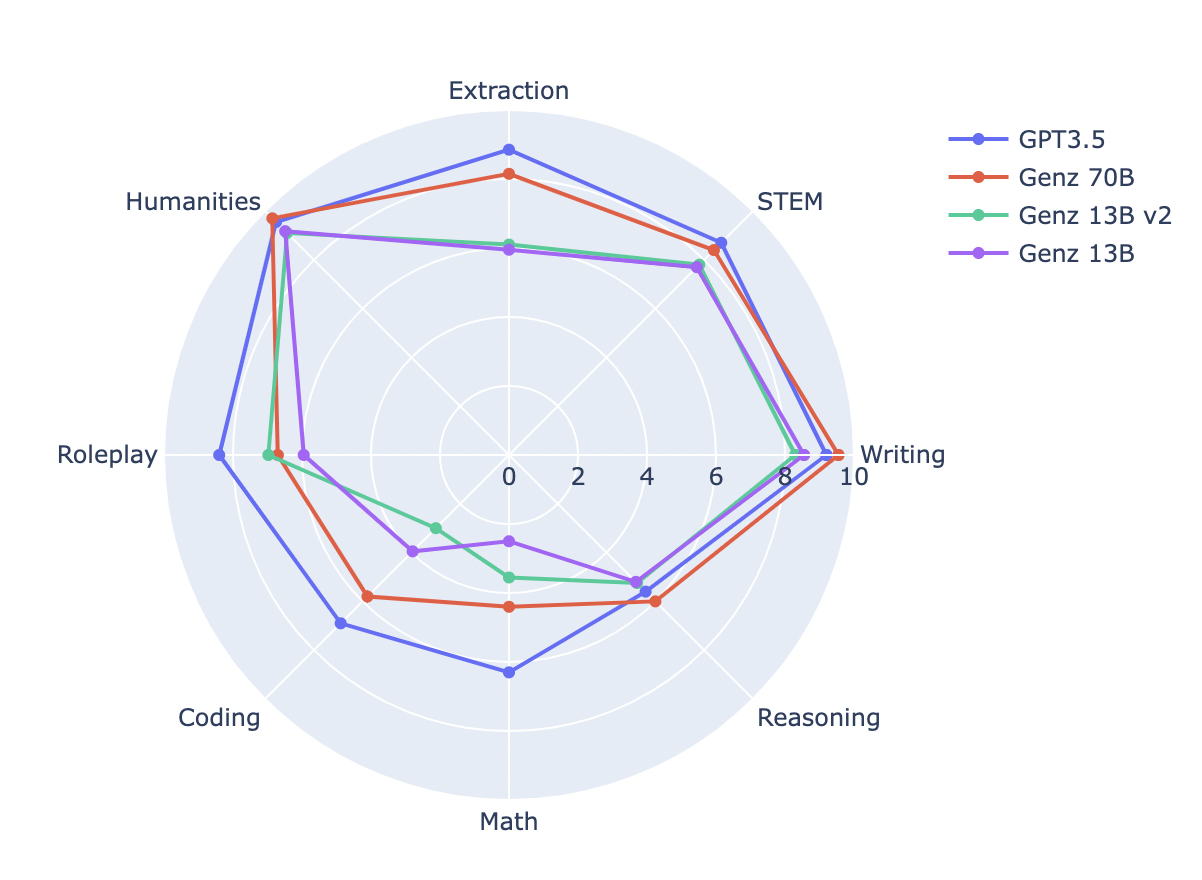
MT Bench Score
A key evaluation metric we use is the MT Bench score. This score provides a comprehensive assessment of our model's performance across a range of tasks.
We're proud to say that our model performs at a level that's close to the Llama-70B-chat model on the MT Bench and top of the list among 13B models.
In the transition from GenZ V1 to V2, we noticed some fascinating performance shifts. While we saw a slight dip in coding performance, two other areas, Roleplay and Math, saw noticeable improvements.
Looking Ahead 👀
We're excited about the journey ahead with GenZ. We're committed to continuously improving and enhancing our models, and we're excited to see what the open-source community will build with them. We believe in the power of collaboration, and we can't wait to see what we can achieve together.
Remember, we're just getting started. This is just the beginning of a journey that we believe will revolutionize the world of large language models. We invite you to join us on this exciting journey. Together, we can push the boundaries of what's possible with AI. 🚀