Multiple GPTQ parameter permutations are provided; see Provided Files below for details of the options provided, their parameters, and the software used to create them.
These files were quantised using hardware kindly provided by Massed Compute.
This may not be a complete list; if you know of others, please let me know!
Provided files, and GPTQ parameters
Multiple quantisation parameters are provided, to allow you to choose the best one for your hardware and requirements.
Each separate quant is in a different branch. See below for instructions on fetching from different branches.
Most GPTQ files are made with AutoGPTQ. Mistral models are currently made with Transformers.
Explanation of GPTQ parameters
Bits: The bit size of the quantised model.
GS: GPTQ group size. Higher numbers use less VRAM, but have lower quantisation accuracy. "None" is the lowest possible value.
Act Order: True or False. Also known as desc_act. True results in better quantisation accuracy. Some GPTQ clients have had issues with models that use Act Order plus Group Size, but this is generally resolved now.
Damp %: A GPTQ parameter that affects how samples are processed for quantisation. 0.01 is default, but 0.1 results in slightly better accuracy.
GPTQ dataset: The calibration dataset used during quantisation. Using a dataset more appropriate to the model's training can improve quantisation accuracy. Note that the GPTQ calibration dataset is not the same as the dataset used to train the model - please refer to the original model repo for details of the training dataset(s).
Sequence Length: The length of the dataset sequences used for quantisation. Ideally this is the same as the model sequence length. For some very long sequence models (16+K), a lower sequence length may have to be used. Note that a lower sequence length does not limit the sequence length of the quantised model. It only impacts the quantisation accuracy on longer inference sequences.
ExLlama Compatibility: Whether this file can be loaded with ExLlama, which currently only supports Llama and Mistral models in 4-bit.
4-bit, with Act Order and group size 64g. Uses less VRAM than 32g, but with slightly lower accuracy.
How to download, including from branches
In text-generation-webui
To download from the main branch, enter TheBloke/dolphin-2.2.1-AshhLimaRP-Mistral-7B-GPTQ in the "Download model" box.
To download from another branch, add :branchname to the end of the download name, eg TheBloke/dolphin-2.2.1-AshhLimaRP-Mistral-7B-GPTQ:gptq-4bit-32g-actorder_True
From the command line
I recommend using the huggingface-hub Python library:
pip3 install huggingface-hub
To download the main branch to a folder called dolphin-2.2.1-AshhLimaRP-Mistral-7B-GPTQ:
If you remove the --local-dir-use-symlinks False parameter, the files will instead be stored in the central Hugging Face cache directory (default location on Linux is: ~/.cache/huggingface), and symlinks will be added to the specified --local-dir, pointing to their real location in the cache. This allows for interrupted downloads to be resumed, and allows you to quickly clone the repo to multiple places on disk without triggering a download again. The downside, and the reason why I don't list that as the default option, is that the files are then hidden away in a cache folder and it's harder to know where your disk space is being used, and to clear it up if/when you want to remove a download model.
The cache location can be changed with the HF_HOME environment variable, and/or the --cache-dir parameter to huggingface-cli.
Note that using Git with HF repos is strongly discouraged. It will be much slower than using huggingface-hub, and will use twice as much disk space as it has to store the model files twice (it stores every byte both in the intended target folder, and again in the .git folder as a blob.)
Requires: Transformers 4.33.0 or later, Optimum 1.12.0 or later, and AutoGPTQ 0.4.2 or later.
shell
1pip3 install transformers optimum
2pip3 install auto-gptq --extra-index-url https://huggingface.github.io/autogptq-index/whl/cu118/  # Use cu117 if on CUDA 11.7
If you have problems installing AutoGPTQ using the pre-built wheels, install it from source instead:
I've had a lot of people ask if they can contribute. I enjoy providing models and helping people, and would love to be able to spend even more time doing it, as well as expanding into new projects like fine tuning/training.
If you're able and willing to contribute it will be most gratefully received and will help me to keep providing more models, and to start work on new AI projects.
Donaters will get priority support on any and all AI/LLM/model questions and requests, access to a private Discord room, plus other benefits.
Patreon special mentions: Brandon Frisco, LangChain4j, Spiking Neurons AB, transmissions 11, Joseph William Delisle, Nitin Borwankar, Willem Michiel, Michael Dempsey, vamX, Jeffrey Morgan, zynix, jjj, Omer Bin Jawed, Sean Connelly, jinyuan sun, Jeromy Smith, Shadi, Pawan Osman, Chadd, Elijah Stavena, Illia Dulskyi, Sebastain Graf, Stephen Murray, terasurfer, Edmond Seymore, Celu Ramasamy, Mandus, Alex, biorpg, Ajan Kanaga, Clay Pascal, Raven Klaugh, 阿明, K, ya boyyy, usrbinkat, Alicia Loh, John Villwock, ReadyPlayerEmma, Chris Smitley, Cap'n Zoog, fincy, GodLy, S_X, sidney chen, Cory Kujawski, OG, Mano Prime, AzureBlack, Pieter, Kalila, Spencer Kim, Tom X Nguyen, Stanislav Ovsiannikov, Michael Levine, Andrey, Trailburnt, Vadim, Enrico Ros, Talal Aujan, Brandon Phillips, Jack West, Eugene Pentland, Michael Davis, Will Dee, webtim, Jonathan Leane, Alps Aficionado, Rooh Singh, Tiffany J. Kim, theTransient, Luke @flexchar, Elle, Caitlyn Gatomon, Ari Malik, subjectnull, Johann-Peter Hartmann, Trenton Dambrowitz, Imad Khwaja, Asp the Wyvern, Emad Mostaque, Rainer Wilmers, Alexandros Triantafyllidis, Nicholas, Pedro Madruga, SuperWojo, Harry Royden McLaughlin, James Bentley, Olakabola, David Ziegler, Ai Maven, Jeff Scroggin, Nikolai Manek, Deo Leter, Matthew Berman, Fen Risland, Ken Nordquist, Manuel Alberto Morcote, Luke Pendergrass, TL, Fred von Graf, Randy H, Dan Guido, NimbleBox.ai, Vitor Caleffi, Gabriel Tamborski, knownsqashed, Lone Striker, Erik Bjäreholt, John Detwiler, Leonard Tan, Iucharbius
Thank you to all my generous patrons and donaters!
And thank you again to a16z for their generous grant.
Original model card: Yamam's Dolphin 2.2.1 AshhLimaRP Mistral 7B
This is a checkpoint release, to fix overfit training. ie, it was responding with CoT even when I didn't request it, and also it was too compliant even when the request made no sense. This one should be better.
Dolphin-2.2.1-mistral-7b's training was sponsored by a16z.
This model is based on mistralAI, with apache-2.0 license, so it is suitable for commercial or non-commercial use.
New in 2.2 is conversation and empathy. With an infusion of curated Samantha DNA, Dolphin can now give you personal advice and will care about your feelings, and with extra training in long multi-turn conversation.
This model is uncensored. I have filtered the dataset to remove alignment and bias. This makes the model more compliant. You are advised to implement your own alignment layer before exposing the model as a service. It will be highly compliant to any requests, even unethical ones. Please read my blog post about uncensored models. https://erichartford.com/uncensored-models
You are responsible for any content you create using this model. Enjoy responsibly.
Dataset
This dataset is Dolphin, an open-source implementation of Microsoft's Orca
I modified the dataset for uncensoring, deduping, cleaning, and quality.
I added Jon Durbin's excellent Airoboros dataset to increase creativity.
I added a curated subset of WizardLM and Samantha to give it multiturn conversation and empathy.
Training
It took 48 hours to train 4 epochs on 4x A100s.
Prompt format:
This model (and all my future releases) use ChatML prompt format.
<|im_start|>system
You are Dolphin, a helpful AI assistant.<|im_end|>
<|im_start|>user
{prompt}<|im_end|>
<|im_start|>assistant
Example:
<|im_start|>system
you are an expert dolphin trainer<|im_end|>
<|im_start|>user
What is the best way to train a dolphin to obey me?  Please answer step by step.<|im_end|>
<|im_start|>assistant
Gratitude
This model was made possible by the generous sponsorship of a16z.
Thank you to Microsoft for authoring the Orca paper and inspiring this work.
Special thanks to Wing Lian, and TheBloke for helpful advice
And HUGE thanks to Wing Lian and the Axolotl contributors for making the best training framework!
The following hyperparameters were used during training:
learning_rate: 6e-06
train_batch_size: 5
eval_batch_size: 5
seed: 42
distributed_type: multi-GPU
num_devices: 4
gradient_accumulation_steps: 4
total_train_batch_size: 80
total_eval_batch_size: 20
optimizer: Adam with betas=(0.9,0.95) and epsilon=1e-05
lr_scheduler_type: cosine
lr_scheduler_warmup_steps: 100
num_epochs: 4
Framework versions
Transformers 4.34.1
Pytorch 2.0.1+cu117
Datasets 2.14.5
Tokenizers 0.14.0
AshhLimaRP-Mistral-7B (Alpaca, v1)
This is a version of LimaRP with 2000 training samples up to about 9k tokens length
finetuned on Ashhwriter-Mistral-7B.
LimaRP is a longform-oriented, novel-style roleplaying chat model intended to replicate the experience
of 1-on-1 roleplay on Internet forums. Short-form, IRC/Discord-style RP (aka "Markdown format")
is not supported. The model does not include instruction tuning, only manually picked and
slightly edited RP conversations with persona and scenario data.
Ashhwriter, the base, is a model entirely finetuned on human-written lewd stories.
Extended Alpaca format,
with ### Instruction:, ### Input: immediately preceding user inputs and ### Response:
immediately preceding model outputs. While Alpaca wasn't originally intended for multi-turn
responses, in practice this is not a problem; the format follows a pattern already used by
other models.
### Instruction:
Character's Persona: {bot character description}

User's Persona: {user character description}

Scenario: {what happens in the story}

Play the role of Character. You must engage in a roleplaying chat with User below this line. Do not write dialogues and narration for User.

### Input:
User: {utterance}

### Response:
Character: {utterance}

### Input
User: {utterance}

### Response:
Character: {utterance}

(etc.)
You should:
Replace all text in curly braces (curly braces included) with your own text.
Replace User and Character with appropriate names.
Message length control
Inspired by the previously named "Roleplay" preset in SillyTavern, with this
version of LimaRP it is possible to append a length modifier to the response instruction
sequence, like this:
This has an immediately noticeable effect on bot responses. The lengths using during training are:
micro, tiny, short, medium, long, massive, huge, enormous, humongous, unlimited.
The recommended starting length is medium. Keep in mind that the AI can ramble or impersonate
the user with very long messages.
The length control effect is reproducible, but the messages will not necessarily follow
lengths very precisely, rather follow certain ranges on average, as seen in this table
with data from tests made with one reply at the beginning of the conversation:
lengths
Response length control appears to work well also deep into the conversation. By omitting
the modifier, the model will choose the most appropriate response length (although it might
not necessarily be what the user desires).
Suggested settings
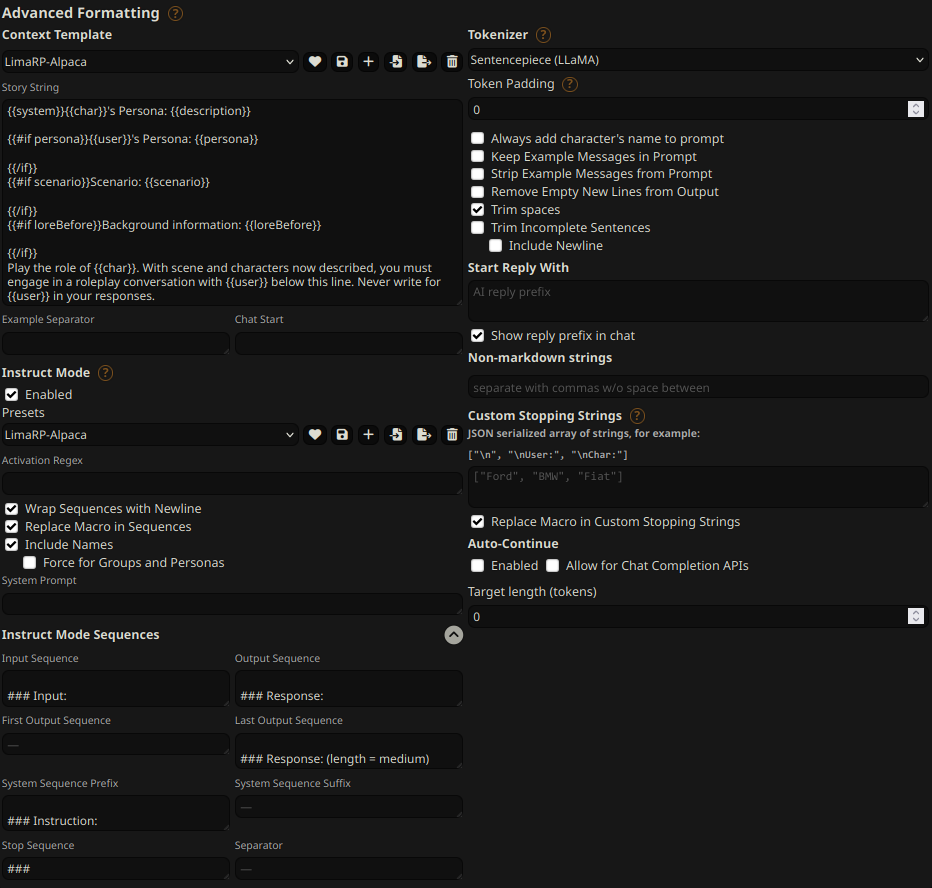
You can follow these instruction format settings in SillyTavern. Replace medium with
your desired response length:
settings
Text generation settings
These settings could be a good general starting point:
TFS = 0.90
Temperature = 0.70
Repetition penalty = ~1.11
Repetition penalty range = ~2048
top-k = 0 (disabled)
top-p = 1 (disabled)
Training procedure
Axolotl was used for training
on 2x NVidia A40 GPUs.
The A40 GPUs have been graciously provided by Arc Compute.
Training hyperparameters
A lower learning rate than usual was employed. Due to an unforeseen issue the training
was cut short and as a result 3 epochs were trained instead of the planned 4. Using 2 GPUs,
the effective global batch size would have been 16.
Training was continued from the most recent LoRA adapter from Ashhwriter, using the same
LoRA R and LoRA alpha.
Values are higher than typical because the training is performed on the entire
sample, similar to unsupervised finetuning.
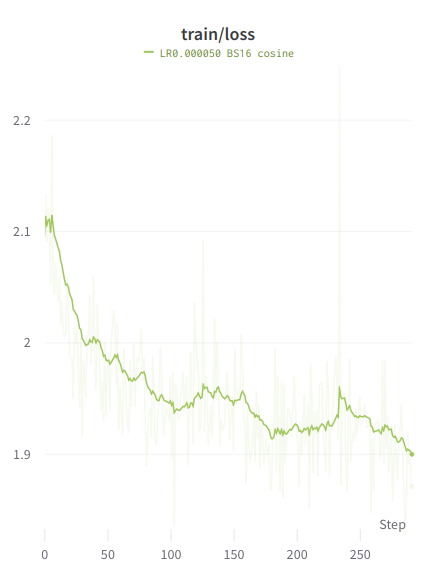
Train loss
Train loss
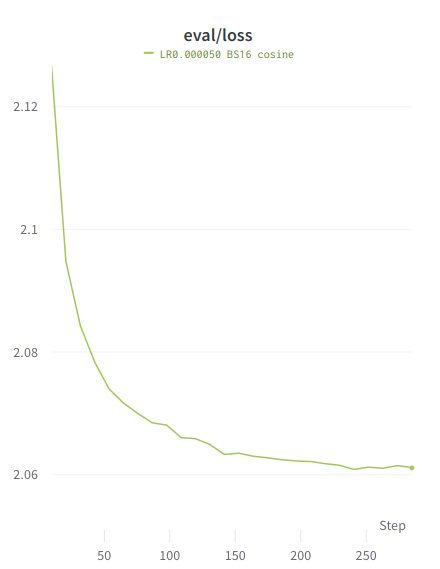
Eval loss
Eval loss
Initial personal observations (Herman555)
Right off the bat seemed to impress me, the writing was coherent and fluid, a pleasure to read. AI mostly did not speak for me, in general I didn't have to regenerate for a quality reply much at all. I actually didn't have repetition issues for once!, although that might be thanks to the storywriting LoRA. model was creative the whole way through past 8k tokens with summarization extension enabled in silltavern, although I did have to bump up the repetition penalty a tiny bit. the AI kept its writing style the whole way through, it did not get dumbed down.
The model is very smart, with Zephyr-beta-7b being the top rated 7b instruction following model at the moment according to AlpacaEval as of 04/11/2023, it wasn't able to follow my sort of gamified roleplay with stats, This model however does it pretty well for a 7b, it's by no means perfect but it worked for the most part. What compelled me to merge this was the fact that the new dolphin model has added empathy "With an infusion of curated Samantha DNA".
The model sticked to the character pefectly and made me feel immersed. Seamless transition from normal roleplay to ERP, both forms were excellent. One of the few models where the character didn't become an instant bimbo during ERP. this is more of a hunch because it could be the LoRA but I feel like the added empathy is helping a lot. Last but not least I was surprised that nobody was merging models with this LoRA, I mean it's limarp bro with more ERP data lol. In any case, limarp has increased the quality of roleplay dramatically in every model I tried.
Back end
Koboldcpp + SillyTavern Q4_KM
SillyTavern Formatting (AI response formatting)
Default simple-proxy-for-tavern preset. I did not use the limarp prompt format, it doesn't matter what you use, whatever gives better results.
Most cases the one I mentioned works best if you like long, detailed replies. I have not tested other prompt formats yet.
Custom stopping strings
["", "<|", "\n#", "\n*{{user}} ", "\n\n\n"] Will improve roleplay experience.
Samplers used (AI response configuration)
Response length: 300
Context size: 8192
Storywriter preset
Temparature: 72-85
Repetition penalty: 10-13 (10 is a good number to start with, anything below 10 or above 13 doesn't work well in my experience.)
Summarization: main api - default settings. I find that vector storage does nothing at all to extend context, at least with dozens of 7b models that I tried.
It is possible that the default settings for it are rubbish which is what I use.