Multiple GPTQ parameter permutations are provided; see Provided Files below for details of the options provided, their parameters, and the software used to create them.
This may not be a complete list; if you know of others, please let me know!
Provided files, and GPTQ parameters
Multiple quantisation parameters are provided, to allow you to choose the best one for your hardware and requirements.
Each separate quant is in a different branch. See below for instructions on fetching from different branches.
Most GPTQ files are made with AutoGPTQ. Mistral models are currently made with Transformers.
Explanation of GPTQ parameters
Bits: The bit size of the quantised model.
GS: GPTQ group size. Higher numbers use less VRAM, but have lower quantisation accuracy. "None" is the lowest possible value.
Act Order: True or False. Also known as desc_act. True results in better quantisation accuracy. Some GPTQ clients have had issues with models that use Act Order plus Group Size, but this is generally resolved now.
Damp %: A GPTQ parameter that affects how samples are processed for quantisation. 0.01 is default, but 0.1 results in slightly better accuracy.
GPTQ dataset: The calibration dataset used during quantisation. Using a dataset more appropriate to the model's training can improve quantisation accuracy. Note that the GPTQ calibration dataset is not the same as the dataset used to train the model - please refer to the original model repo for details of the training dataset(s).
Sequence Length: The length of the dataset sequences used for quantisation. Ideally this is the same as the model sequence length. For some very long sequence models (16+K), a lower sequence length may have to be used. Note that a lower sequence length does not limit the sequence length of the quantised model. It only impacts the quantisation accuracy on longer inference sequences.
ExLlama Compatibility: Whether this file can be loaded with ExLlama, which currently only supports Llama and Mistral models in 4-bit.
8-bit, with group size 128g for higher inference quality and with Act Order for even higher accuracy.
How to download, including from branches
In text-generation-webui
To download from the main branch, enter TheBloke/SauerkrautLM-Mixtral-8x7B-GPTQ in the "Download model" box.
To download from another branch, add :branchname to the end of the download name, eg TheBloke/SauerkrautLM-Mixtral-8x7B-GPTQ:gptq-4bit-128g-actorder_True
From the command line
I recommend using the huggingface-hub Python library:
pip3 install huggingface-hub
To download the main branch to a folder called SauerkrautLM-Mixtral-8x7B-GPTQ:
If you remove the --local-dir-use-symlinks False parameter, the files will instead be stored in the central Hugging Face cache directory (default location on Linux is: ~/.cache/huggingface), and symlinks will be added to the specified --local-dir, pointing to their real location in the cache. This allows for interrupted downloads to be resumed, and allows you to quickly clone the repo to multiple places on disk without triggering a download again. The downside, and the reason why I don't list that as the default option, is that the files are then hidden away in a cache folder and it's harder to know where your disk space is being used, and to clear it up if/when you want to remove a download model.
The cache location can be changed with the HF_HOME environment variable, and/or the --cache-dir parameter to huggingface-cli.
Note that using Git with HF repos is strongly discouraged. It will be much slower than using huggingface-hub, and will use twice as much disk space as it has to store the model files twice (it stores every byte both in the intended target folder, and again in the .git folder as a blob.)
Python code example: inference from this GPTQ model
Install the necessary packages
Requires: Transformers 4.33.0 or later, Optimum 1.12.0 or later, and AutoGPTQ 0.4.2 or later.
shell
1pip3 install --upgrade transformers optimum
2# If using PyTorch 2.1 + CUDA 12.x:3pip3 install --upgrade auto-gptq
4# or, if using PyTorch 2.1 + CUDA 11.x:5pip3 install --upgrade auto-gptq --extra-index-url https://huggingface.github.io/autogptq-index/whl/cu118/
If you are using PyTorch 2.0, you will need to install AutoGPTQ from source. Likewise if you have problems with the pre-built wheels, you should try building from source:
1from transformers import AutoModelForCausalLM, AutoTokenizer, pipeline
23model_name_or_path ="TheBloke/SauerkrautLM-Mixtral-8x7B-GPTQ"4# To use a different branch, change revision5# For example: revision="gptq-4bit-128g-actorder_True"6model = AutoModelForCausalLM.from_pretrained(model_name_or_path,7 device_map="auto",8 trust_remote_code=False,9 revision="main")1011tokenizer = AutoTokenizer.from_pretrained(model_name_or_path, use_fast=True)1213prompt ="Write a story about llamas"14system_message ="You are a story writing assistant"15prompt_template=f'''<|im_start|>system
16{system_message}<|im_end|>
17<|im_start|>user
18{prompt}<|im_end|>
19<|im_start|>assistant
20'''2122print("\n\n*** Generate:")2324input_ids = tokenizer(prompt_template, return_tensors='pt').input_ids.cuda()25output = model.generate(inputs=input_ids, temperature=0.7, do_sample=True, top_p=0.95, top_k=40, max_new_tokens=512)26print(tokenizer.decode(output[0]))2728# Inference can also be done using transformers' pipeline2930print("*** Pipeline:")31pipe = pipeline(32"text-generation",33 model=model,34 tokenizer=tokenizer,35 max_new_tokens=512,36 do_sample=True,37 temperature=0.7,38 top_p=0.95,39 top_k=40,40 repetition_penalty=1.141)4243print(pipe(prompt_template)[0]['generated_text'])
Compatibility
The files provided are tested to work with Transformers. For non-Mistral models, AutoGPTQ can also be used directly.
ExLlama is compatible with Llama architecture models (including Mistral, Yi, DeepSeek, SOLAR, etc) in 4-bit. Please see the Provided Files table above for per-file compatibility.
For a list of clients/servers, please see "Known compatible clients / servers", above.
Discord
For further support, and discussions on these models and AI in general, join us at:
I've had a lot of people ask if they can contribute. I enjoy providing models and helping people, and would love to be able to spend even more time doing it, as well as expanding into new projects like fine tuning/training.
If you're able and willing to contribute it will be most gratefully received and will help me to keep providing more models, and to start work on new AI projects.
Donaters will get priority support on any and all AI/LLM/model questions and requests, access to a private Discord room, plus other benefits.
Patreon special mentions: Michael Levine, 阿明, Trailburnt, Nikolai Manek, John Detwiler, Randy H, Will Dee, Sebastain Graf, NimbleBox.ai, Eugene Pentland, Emad Mostaque, Ai Maven, Jim Angel, Jeff Scroggin, Michael Davis, Manuel Alberto Morcote, Stephen Murray, Robert, Justin Joy, Luke @flexchar, Brandon Frisco, Elijah Stavena, S_X, Dan Guido, Undi ., Komninos Chatzipapas, Shadi, theTransient, Lone Striker, Raven Klaugh, jjj, Cap'n Zoog, Michel-Marie MAUDET (LINAGORA), Matthew Berman, David, Fen Risland, Omer Bin Jawed, Luke Pendergrass, Kalila, OG, Erik Bjäreholt, Rooh Singh, Joseph William Delisle, Dan Lewis, TL, John Villwock, AzureBlack, Brad, Pedro Madruga, Caitlyn Gatomon, K, jinyuan sun, Mano Prime, Alex, Jeffrey Morgan, Alicia Loh, Illia Dulskyi, Chadd, transmissions 11, fincy, Rainer Wilmers, ReadyPlayerEmma, knownsqashed, Mandus, biorpg, Deo Leter, Brandon Phillips, SuperWojo, Sean Connelly, Iucharbius, Jack West, Harry Royden McLaughlin, Nicholas, terasurfer, Vitor Caleffi, Duane Dunston, Johann-Peter Hartmann, David Ziegler, Olakabola, Ken Nordquist, Trenton Dambrowitz, Tom X Nguyen, Vadim, Ajan Kanaga, Leonard Tan, Clay Pascal, Alexandros Triantafyllidis, JM33133, Xule, vamX, ya boyyy, subjectnull, Talal Aujan, Alps Aficionado, wassieverse, Ari Malik, James Bentley, Woland, Spencer Kim, Michael Dempsey, Fred von Graf, Elle, zynix, William Richards, Stanislav Ovsiannikov, Edmond Seymore, Jonathan Leane, Martin Kemka, usrbinkat, Enrico Ros
Thank you to all my generous patrons and donaters!
And thank you again to a16z for their generous grant.
Original model card: VAGO solutions's SauerkrautLM Mixtral 8X7B
SauerkrautLM
VAGO solutions SauerkrautLM-Mixtral-8x7B
Introducing SauerkrautLM-Mixtral-8x7B – our Sauerkraut version of the powerful Mixtral-8x7B!
Finetuned and aligned with SFT and DPO
SauerkrautLM-Mixtral-8x7B was trained with mix of German data augmentation and translated data.
SFT with the datasetOpenOrca/Slim-Orca and aligned through DPO with our new German SauerkrautLM-DPO dataset based on parts of the SFT SauerkrautLM dataset
as chosen answers and Sauerkraut-7b-HerO as rejected answers. Added with additional translated Parts of the HuggingFaceH4/ultrafeedback_binarized and argilla/distilabel-math-preference-dpo.
We found, that only a simple translation of training data can lead to unnatural German phrasings.
Data augmentation techniques were used to grant grammatical, syntactical correctness and a more natural German wording in our training data.
Data Contamination Test Results
Some models on the HuggingFace leaderboard had problems with wrong data getting mixed in.
We checked our SauerkrautLM-DPO dataset with a special test [1] on a smaller model for this problem.
The HuggingFace team used the same methods [2, 3].
Our results, with result < 0.1, %: being well below 0.9, indicate that our dataset is free from contamination.
The data contamination test results of HellaSwag and Winograde will be added once [1] supports them.
<|im_start|>system
Du bist ein großes Sprachmodell, das höflich und kompetent antwortet. Schreibe deine Gedanken Schritt für Schritt auf, um Probleme sinnvoll zu lösen.<|im_end|>
<|im_start|>user
Wie geht es dir?<|im_end|>
<|im_start|>assistant
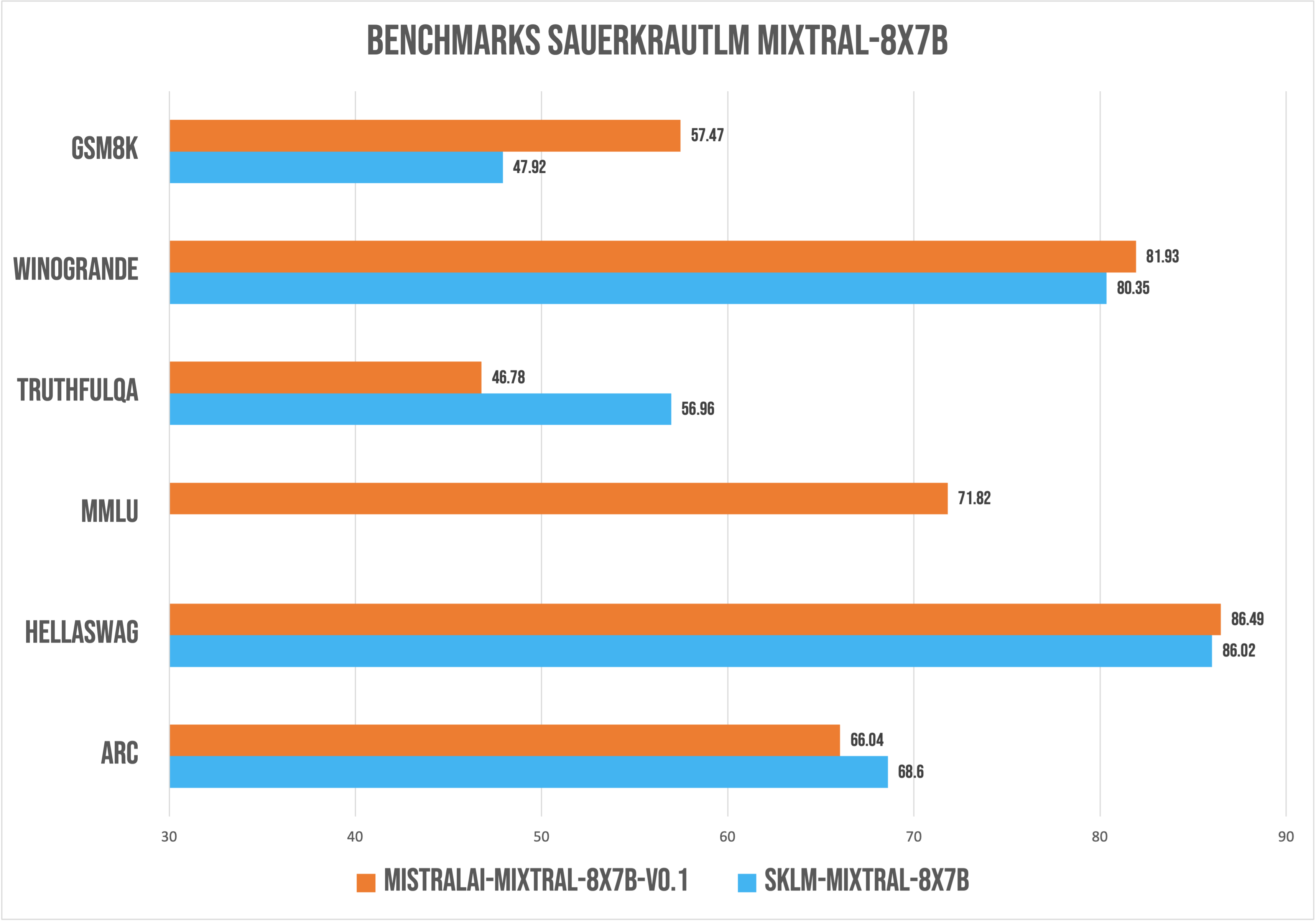
Evaluation
Harness
*evaluated with lm-evaluation-harness v0.3.0 - mmlu coming soon
*All benchmarks were performed with a sliding window of 4096. New Benchmarks with Sliding Window null coming soon
Disclaimer
We must inform users that despite our best efforts in data cleansing, the possibility of uncensored content slipping through cannot be entirely ruled out.
However, we cannot guarantee consistently appropriate behavior. Therefore, if you encounter any issues or come across inappropriate content, we kindly request that you inform us through the contact information provided.
Additionally, it is essential to understand that the licensing of these models does not constitute legal advice. We are not held responsible for the actions of third parties who utilize our models. These models may be employed for commercial purposes, and the Apache 2.0 remains applicable and is included with the model files.
Contact
If you are interested in customized LLMs for business applications, please get in contact with us via our website or contact us at Dr. Daryoush Vaziri. We are also grateful for your feedback and suggestions.
Collaborations
We are also keenly seeking support and investment for our startup, VAGO solutions, where we continuously advance the development of robust language models designed to address a diverse range of purposes and requirements. If the prospect of collaboratively navigating future challenges excites you, we warmly invite you to reach out to us.
Acknowledgement
Many thanks to OpenOrca, argilla and Huggingface for providing such valuable datasets to the Open-Source community. And of course a big thanks to MistralAI for providing the open source community with their latest technology!