Multiple GPTQ parameter permutations are provided; see Provided Files below for details of the options provided, their parameters, and the software used to create them.
Multiple quantisation parameters are provided, to allow you to choose the best one for your hardware and requirements.
Each separate quant is in a different branch. See below for instructions on fetching from different branches.
All recent GPTQ files are made with AutoGPTQ, and all files in non-main branches are made with AutoGPTQ. Files in the main branch which were uploaded before August 2023 were made with GPTQ-for-LLaMa.
Explanation of GPTQ parameters
Bits: The bit size of the quantised model.
GS: GPTQ group size. Higher numbers use less VRAM, but have lower quantisation accuracy. "None" is the lowest possible value.
Act Order: True or False. Also known as desc_act. True results in better quantisation accuracy. Some GPTQ clients have had issues with models that use Act Order plus Group Size, but this is generally resolved now.
Damp %: A GPTQ parameter that affects how samples are processed for quantisation. 0.01 is default, but 0.1 results in slightly better accuracy.
GPTQ dataset: The dataset used for quantisation. Using a dataset more appropriate to the model's training can improve quantisation accuracy. Note that the GPTQ dataset is not the same as the dataset used to train the model - please refer to the original model repo for details of the training dataset(s).
Sequence Length: The length of the dataset sequences used for quantisation. Ideally this is the same as the model sequence length. For some very long sequence models (16+K), a lower sequence length may have to be used. Note that a lower sequence length does not limit the sequence length of the quantised model. It only impacts the quantisation accuracy on longer inference sequences.
ExLlama Compatibility: Whether this file can be loaded with ExLlama, which currently only supports Llama models in 4-bit.
It is strongly recommended to use the text-generation-webui one-click-installers unless you're sure you know how to make a manual install.
Click the Model tab.
Under Download custom model or LoRA, enter TheBloke/Baichuan2-13B-Chat-GPTQ.
To download from a specific branch, enter for example TheBloke/Baichuan2-13B-Chat-GPTQ:gptq-4bit-32g-actorder_True
see Provided Files above for the list of branches for each option.
Click Download.
The model will start downloading. Once it's finished it will say "Done".
In the top left, click the refresh icon next to Model.
In the Model dropdown, choose the model you just downloaded: Baichuan2-13B-Chat-GPTQ
The model will automatically load, and is now ready for use!
If you want any custom settings, set them and then click Save settings for this model followed by Reload the Model in the top right.
Note that you do not need to and should not set manual GPTQ parameters any more. These are set automatically from the file quantize_config.json.
Once you're ready, click the Text Generation tab and enter a prompt to get started!
How to use this GPTQ model from Python code
Install the necessary packages
Requires: Transformers 4.32.0 or later, Optimum 1.12.0 or later, and AutoGPTQ 0.4.2 or later.
shell
1pip3 install transformers>=4.32.0 optimum>=1.12.0
2pip3 install auto-gptq --extra-index-url https://huggingface.github.io/autogptq-index/whl/cu118/  # Use cu117 if on CUDA 11.7
If you have problems installing AutoGPTQ using the pre-built wheels, install it from source instead:
1from transformers import AutoModelForCausalLM, AutoTokenizer, pipeline
23model_name_or_path ="TheBloke/Baichuan2-13B-Chat-GPTQ"4# To use a different branch, change revision5# For example: revision="gptq-4bit-32g-actorder_True"6model = AutoModelForCausalLM.from_pretrained(model_name_or_path,7 device_map="auto",8 revision="main")910tokenizer = AutoTokenizer.from_pretrained(model_name_or_path, use_fast=True)1112prompt ="Tell me about AI"13prompt_template=f'''Info on prompt template will be added shortly.
1415'''1617print("\n\n*** Generate:")1819input_ids = tokenizer(prompt_template, return_tensors='pt').input_ids.cuda()20output = model.generate(inputs=input_ids, temperature=0.7, max_new_tokens=512)21print(tokenizer.decode(output[0]))2223# Inference can also be done using transformers' pipeline2425print("*** Pipeline:")26pipe = pipeline(27"text-generation",28 model=model,29 tokenizer=tokenizer,30 max_new_tokens=512,31 temperature=0.7,32 top_p=0.95,33 repetition_penalty=1.1534)3536print(pipe(prompt_template)[0]['generated_text'])
Compatibility
The files provided are tested to work with AutoGPTQ, both via Transformers and using AutoGPTQ directly. They should also work with Occ4m's GPTQ-for-LLaMa fork.
ExLlama is compatible with Llama models in 4-bit. Please see the Provided Files table above for per-file compatibility.
I've had a lot of people ask if they can contribute. I enjoy providing models and helping people, and would love to be able to spend even more time doing it, as well as expanding into new projects like fine tuning/training.
If you're able and willing to contribute it will be most gratefully received and will help me to keep providing more models, and to start work on new AI projects.
Donaters will get priority support on any and all AI/LLM/model questions and requests, access to a private Discord room, plus other benefits.
Patreon special mentions: Russ Johnson, J, alfie_i, Alex, NimbleBox.ai, Chadd, Mandus, Nikolai Manek, Ken Nordquist, ya boyyy, Illia Dulskyi, Viktor Bowallius, vamX, Iucharbius, zynix, Magnesian, Clay Pascal, Pierre Kircher, Enrico Ros, Tony Hughes, Elle, Andrey, knownsqashed, Deep Realms, Jerry Meng, Lone Striker, Derek Yates, Pyrater, Mesiah Bishop, James Bentley, Femi Adebogun, Brandon Frisco, SuperWojo, Alps Aficionado, Michael Dempsey, Vitor Caleffi, Will Dee, Edmond Seymore, usrbinkat, LangChain4j, Kacper Wikieł, Luke Pendergrass, John Detwiler, theTransient, Nathan LeClaire, Tiffany J. Kim, biorpg, Eugene Pentland, Stanislav Ovsiannikov, Fred von Graf, terasurfer, Kalila, Dan Guido, Nitin Borwankar, 阿明, Ai Maven, John Villwock, Gabriel Puliatti, Stephen Murray, Asp the Wyvern, danny, Chris Smitley, ReadyPlayerEmma, S_X, Daniel P. Andersen, Olakabola, Jeffrey Morgan, Imad Khwaja, Caitlyn Gatomon, webtim, Alicia Loh, Trenton Dambrowitz, Swaroop Kallakuri, Erik Bjäreholt, Leonard Tan, Spiking Neurons AB, Luke @flexchar, Ajan Kanaga, Thomas Belote, Deo Leter, RoA, Willem Michiel, transmissions 11, subjectnull, Matthew Berman, Joseph William Delisle, David Ziegler, Michael Davis, Johann-Peter Hartmann, Talal Aujan, senxiiz, Artur Olbinski, Rainer Wilmers, Spencer Kim, Fen Risland, Cap'n Zoog, Rishabh Srivastava, Michael Levine, Geoffrey Montalvo, Sean Connelly, Alexandros Triantafyllidis, Pieter, Gabriel Tamborski, Sam, Subspace Studios, Junyu Yang, Pedro Madruga, Vadim, Cory Kujawski, K, Raven Klaugh, Randy H, Mano Prime, Sebastain Graf, Space Cruiser
Thank you to all my generous patrons and donaters!
And thank you again to a16z for their generous grant.
Original model card: Baichuan Intelligent Technology's Baichuan2-13B-Chat
Baichuan 2 is the new generation of large-scale open-source language models launched by Baichuan Intelligence inc..
It is trained on a high-quality corpus with 2.6 trillion tokens and has achieved the best performance in authoritative Chinese and English benchmarks of the same size.
This release includes 7B and 13B versions for both Base and Chat models, along with a 4bits quantized version for the Chat model.
All versions are fully open to academic research, and developers can also use them for free in commercial applications after obtaining an official commercial license through email request.
The specific release versions and download links are listed in the table below:
In the Baichuan 2 series models, we have utilized the new feature F.scaled_dot_product_attention introduced in PyTorch 2.0 to accelerate inference speed. Therefore, the model needs to be run in a PyTorch 2.0 environment.
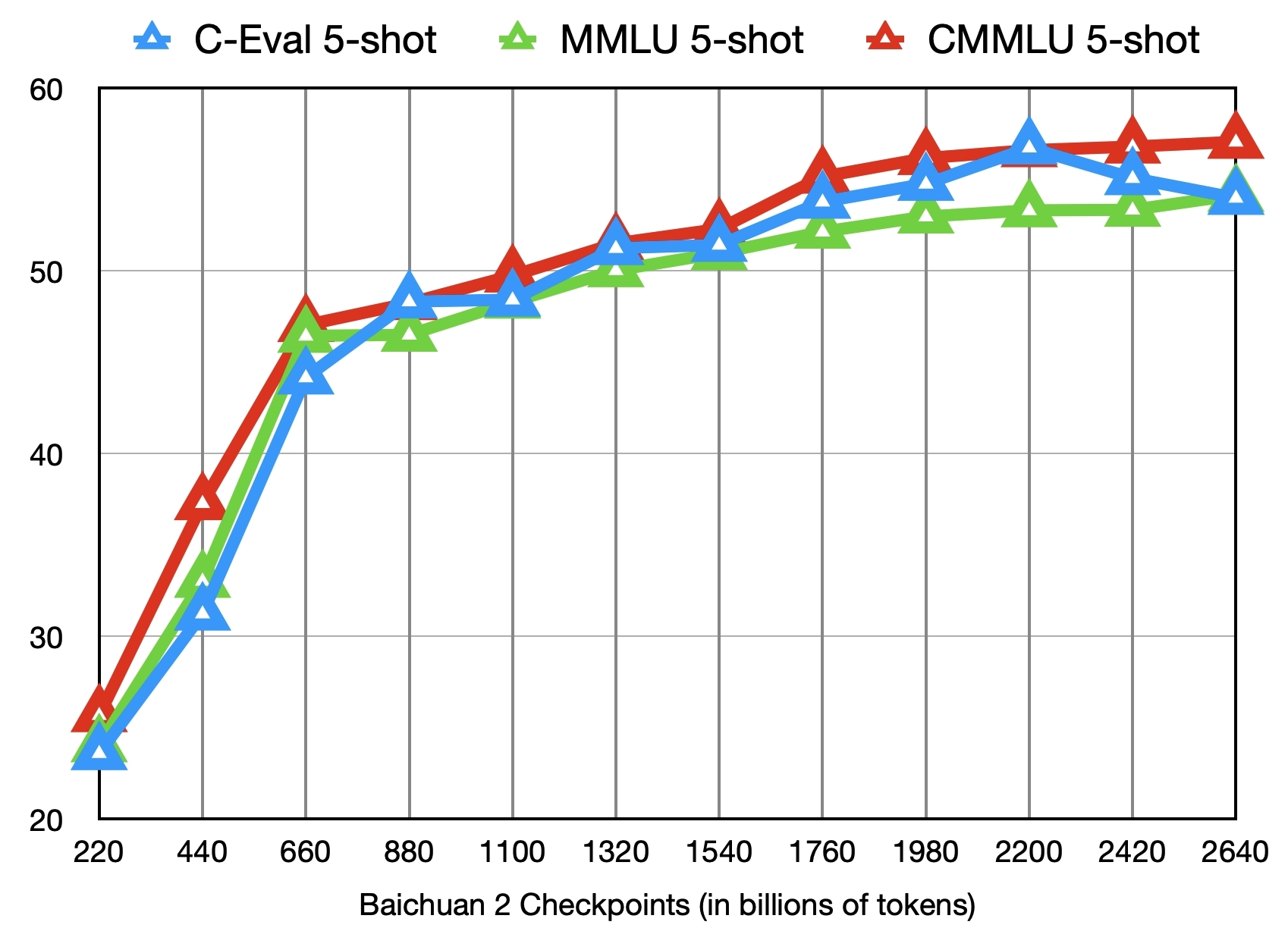
In addition to the Baichuan2-7B-Base model trained on 2.6 trillion tokens, we also offer 11 additional intermediate-stage models for community research, corresponding to training on approximately 0.2 to 2.4 trillion tokens each (Intermediate Checkpoints Download). The graph below shows the performance changes of these checkpoints on three benchmarks: C-Eval, MMLU, and CMMLU.
We hereby declare that our team has not developed any applications based on Baichuan 2 models, not on iOS, Android, the web, or any other platform. We strongly call on all users not to use Baichuan 2 models for any activities that harm national / social security or violate the law. Also, we ask users not to use Baichuan 2 models for Internet services that have not undergone appropriate security reviews and filings. We hope that all users can abide by this principle and ensure that the development of technology proceeds in a regulated and legal environment.
We have done our best to ensure the compliance of the data used in the model training process. However, despite our considerable efforts, there may still be some unforeseeable issues due to the complexity of the model and data. Therefore, if any problems arise due to the use of Baichuan 2 open-source models, including but not limited to data security issues, public opinion risks, or any risks and problems brought about by the model being misled, abused, spread or improperly exploited, we will not assume any responsibility.
The use of the source code in this repository follows the open-source license Apache 2.0. Community use of the Baichuan 2 model must adhere to the Community License for Baichuan 2 Model. Baichuan 2 supports commercial use. If you are using the Baichuan 2 models or their derivatives for commercial purposes, please contact the licensor in the following manner for registration and to apply for written authorization: Email opensource@baichuan-inc.com.