The difference with normal quantizations is that I quantize the output and embed tensors to f16.and the other tensors to 15_k,q6_k or q8_0.This creates models that are little or not degraded at all and have a smaller size.They run at about 3-6 t/sec on CPU only using llama.cpp And obviously faster on computers with potent GPUs
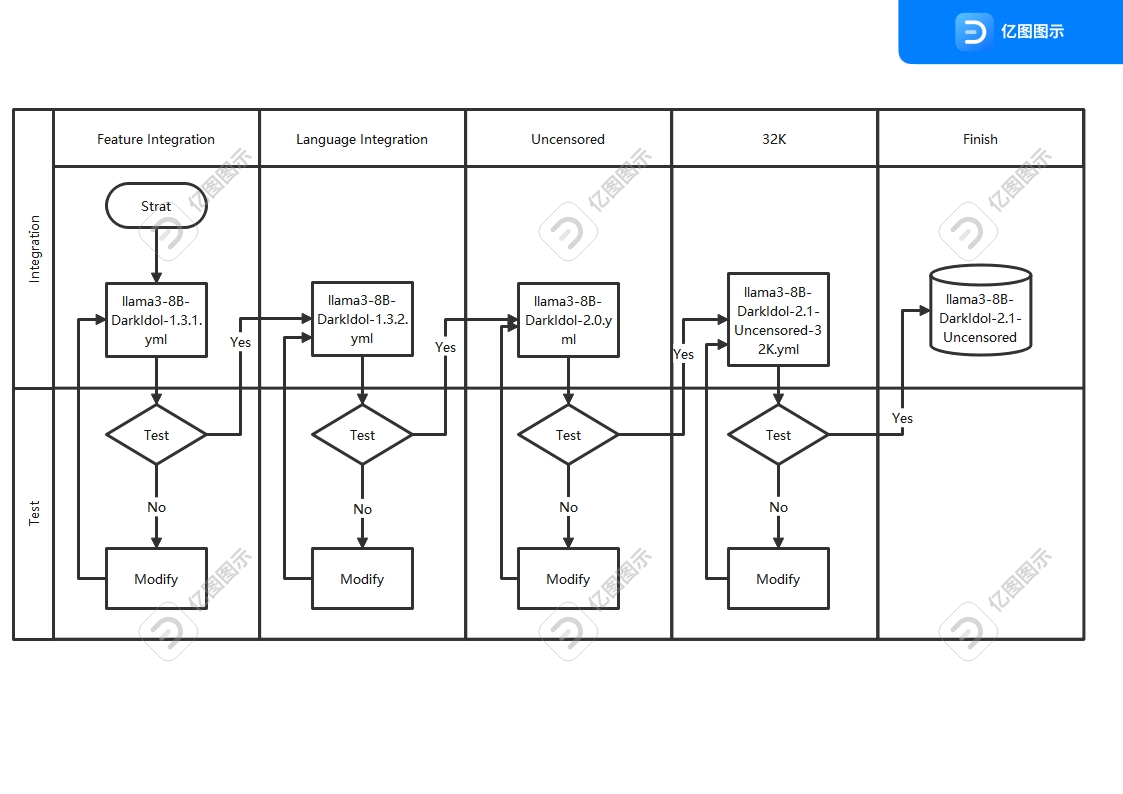
The previous version had undergone excessive iterations, resulting in overfitting. We have recreated the model using a new process, which, although more complex to produce, has yielded excellent results. The new iterative process is depicted in the figure.
image/png
Questions
The model's response results are for reference only, please do not fully trust them.
I am unable to test Japanese and Korean parts very well. Based on my testing, Korean performs excellently, but sometimes Japanese may have furigana (if anyone knows a good Japanese language module, - I need to replace the module for integration).
With the new manufacturing process, overfitting and crashes have been reduced, but there may be new issues, so please leave a message if you encounter any.
testing with other tools is not comprehensive.but there may be new issues, so please leave a message if you encounter any.
The range between 32K and 64K was not tested, and the approach was somewhat casual. I didn't expect the results to be exceptionally good.
Meet Layla,Layla is an AI chatbot that runs offline on your device.No internet connection required.No censorship.Complete privacy.Layla Lite https://www.layla-network.ai/
To use the multimodal capabilities of this model and use vision you need to load the specified mmproj file, this can be found inside this model repo. Llava MMProj
You can load the mmproj by using the corresponding section in the interface:
image/png
Thank you:
To the authors for their hard work, which has given me more options to easily create what I want. Thank you for your efforts.