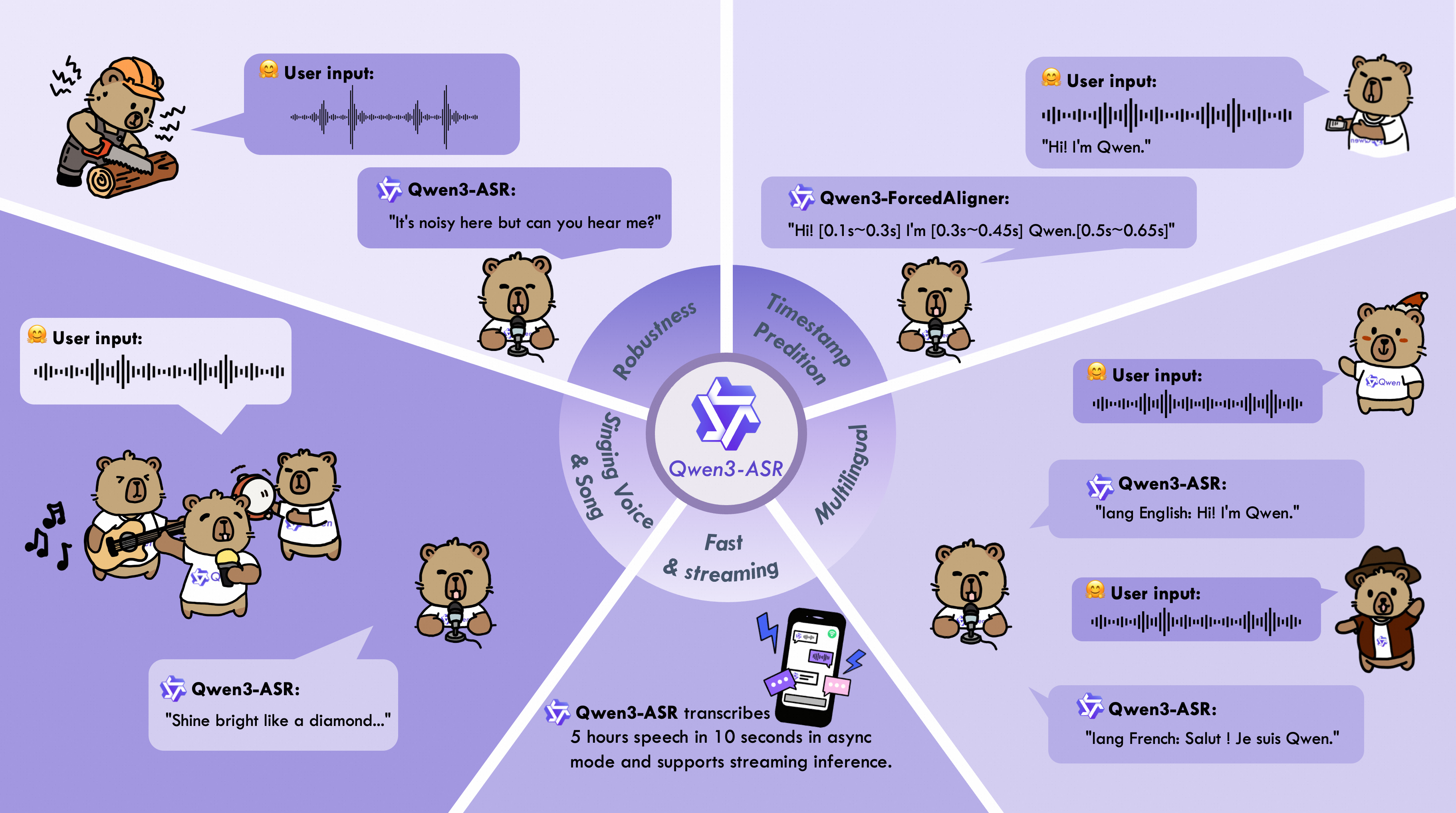
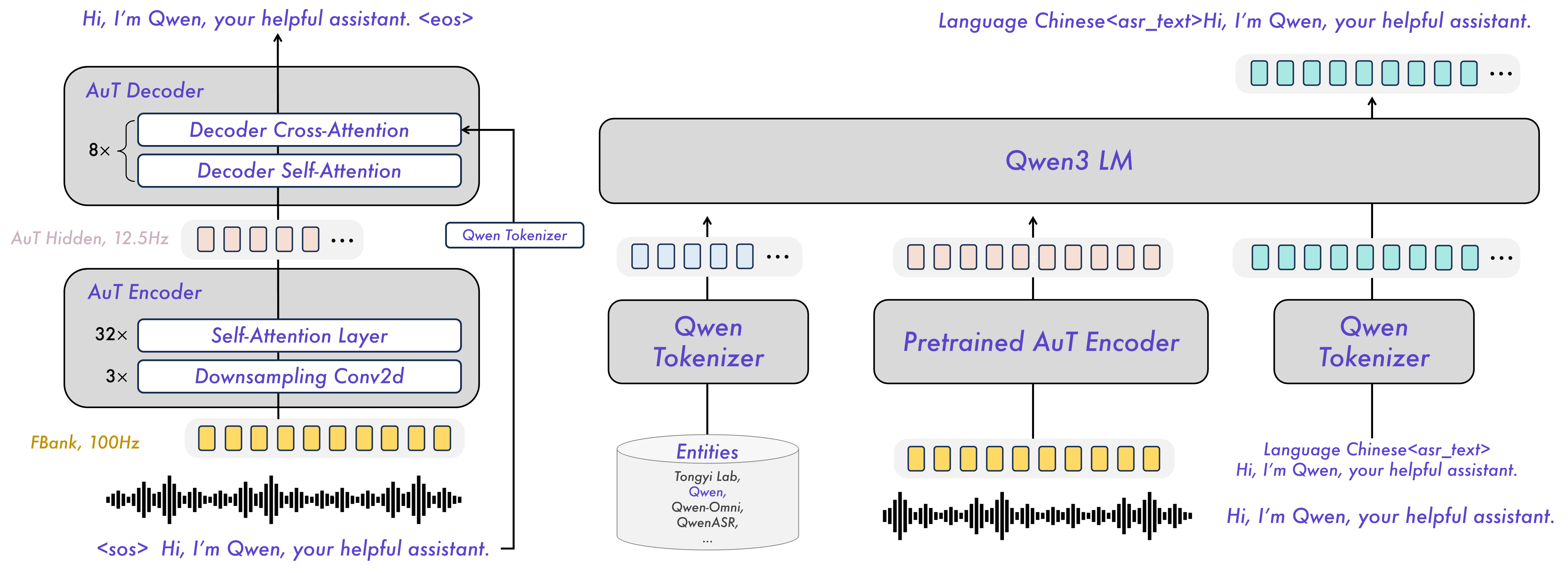
The Qwen3-ASR family includes Qwen3-ASR-1.7B and Qwen3-ASR-0.6B, which support language identification and ASR for 52 languages and dialects. Both leverage large-scale speech training data and the strong audio understanding capability of their foundation model, Qwen3-Omni. The 1.7B version achieves state-of-the-art performance among open-source ASR models and is competitive with the strongest proprietary commercial APIs.
Key features:
All-in-one: Supports language identification and speech recognition for 30 languages and 22 Chinese dialects, including English accents from multiple countries and regions.
Excellent and Fast: High-quality and robust recognition under complex acoustic environments. Qwen3-ASR-0.6B reaches 2000× throughput at a concurrency of 128. Both models support streaming/offline unified inference with a single model and handle long audio.
Forced Alignment: Qwen3-ForcedAligner-0.6B supports timestamp prediction for arbitrary units within up to 5 minutes of speech in 11 languages, surpassing E2E-based forced-alignment models in accuracy.
Chinese (zh), English (en), Cantonese (yue), Arabic (ar), German (de), French (fr), Spanish (es), Portuguese (pt), Indonesian (id), Italian (it), Korean (ko), Russian (ru), Thai (th), Vietnamese (vi), Japanese (ja), Turkish (tr), Hindi (hi), Malay (ms), Dutch (nl), Swedish (sv), Danish (da), Finnish (fi), Polish (pl), Czech (cs), Filipino (fil), Persian (fa), Greek (el), Hungarian (hu), Macedonian (mk), Romanian (ro)
Qwen3-ASR is supported natively in 🤗 Transformers, starting from v5.13.0.
pip install "transformers>=5.13.0"
Simple transcription
apply_transcription_request handles chat-template formatting for you and is the recommended entry point.
python
1from transformers import AutoProcessor, AutoModelForMultimodalLM
23model_id ="Qwen/Qwen3-ASR-1.7B-hf"4processor = AutoProcessor.from_pretrained(model_id)5model = AutoModelForMultimodalLM.from_pretrained(model_id, device_map="auto")6print(f"Model loaded on {model.device} with dtype {model.dtype}")78inputs = processor.apply_transcription_request(9 audio="https://qianwen-res.oss-cn-beijing.aliyuncs.com/Qwen3-ASR-Repo/asr_en.wav",10).to(model.device, model.dtype)1112output_ids = model.generate(**inputs, max_new_tokens=256)13generated_ids = output_ids[:, inputs["input_ids"].shape[1]:]1415# Raw output includes language tag and <asr_text> marker16raw = processor.decode(generated_ids)[0]17print(f"Raw: {raw}")1819# Parsed output: dict with "language" and "transcription"20parsed = processor.decode(generated_ids, return_format="parsed")[0]21print(f"Parsed: {parsed}")2223# Extract only the transcription text24transcription = processor.decode(generated_ids, return_format="transcription_only")[0]25print(f"Transcription: {transcription}")2627"""
28Raw: language English<asr_text>Mr. Quilter is the apostle of the middle classes, and we are glad to welcome his gospel.
29Parsed: {'language': 'English', 'transcription': 'Mr. Quilter is the apostle of the middle classes, and we are glad to welcome his gospel.'}
30Transcription: Mr. Quilter is the apostle of the middle classes, and we are glad to welcome his gospel.
31"""
Forcing the language
You can force the transcription language as shown below.
python
1from transformers import AutoProcessor, AutoModelForMultimodalLM
23model_id ="Qwen/Qwen3-ASR-1.7B-hf"4processor = AutoProcessor.from_pretrained(model_id)5model = AutoModelForMultimodalLM.from_pretrained(model_id, device_map="auto")67# Without language hint (auto-detect)8inputs = processor.apply_transcription_request(9 audio="https://qianwen-res.oss-cn-beijing.aliyuncs.com/Qwen3-ASR-Repo/asr_zh.wav",10).to(model.device, model.dtype)11output_ids = model.generate(**inputs, max_new_tokens=256)12generated_ids = output_ids[:, inputs["input_ids"].shape[1]:]13print(f"Auto-detect: {processor.decode(generated_ids, return_format='transcription_only')[0]}")1415# With forced language16inputs = processor.apply_transcription_request(17 audio="https://qianwen-res.oss-cn-beijing.aliyuncs.com/Qwen3-ASR-Repo/asr_zh.wav",18 language="Chinese",# or language code "zh"19).to(model.device, model.dtype)20output_ids = model.generate(**inputs, max_new_tokens=256)21generated_ids = output_ids[:, inputs["input_ids"].shape[1]:]22print(f"Forced: {processor.decode(generated_ids, return_format='transcription_only')[0]}")
Context / hotwords
You can pass free-form context (e.g. domain-specific vocabulary, names, or background information) via prompt to bias the transcription.
Qwen3 ASR also accepts chat template inputs. The apply_transcription_request usage above is a convenience wrapper for apply_chat_template.
The language can be forced through the chat template by prefilling the assistant turn with language <NAME><asr_text> and passing continue_final_message=True, which is what apply_transcription_request does under the hood. Note that if forcing the language, a prefill should be set for all audio in a batch (as shown below).
python
1from transformers import AutoProcessor, Qwen3ASRForConditionalGeneration
23model_id ="Qwen/Qwen3-ASR-1.7B-hf"4processor = AutoProcessor.from_pretrained(model_id)5model = Qwen3ASRForConditionalGeneration.from_pretrained(model_id, device_map="auto")67chat_template =[8[9# Context/hotwords as system message10{"role":"system","content":[{"type":"text","text":"Vocabulary: Quilter, apostle, gospel."}]},11{12"role":"user",13"content":[14{15"type":"audio",16"path":"https://huggingface.co/datasets/bezzam/audio_samples/resolve/main/librispeech_mr_quilter.wav",17},18],19},20# empty prefill since forcing language in the other sample21{"role":"assistant","content":[{"type":"text","text":""}]},22],23[24{25"role":"user",26"content":[27{28"type":"audio",29"path":"https://qianwen-res.oss-cn-beijing.aliyuncs.com/Qwen3-ASR-Repo/asr_zh.wav",30},31],32},33{"role":"assistant","content":[{"type":"text","text":"language Chinese<asr_text>"}]},34],35]3637inputs = processor.apply_chat_template(38 chat_template, tokenize=True, return_dict=True, continue_final_message=True,39).to(model.device, model.dtype)4041output_ids = model.generate(**inputs, max_new_tokens=256)42generated_ids = output_ids[:, inputs["input_ids"].shape[1]:]43transcriptions = processor.decode(generated_ids, return_format="transcription_only")44for text in transcriptions:45print(text)
Training / fine-tuning
Qwen3 ASR can be trained with the loss outputted by the model. Put the target transcript in the assistant turn — in the model's output format language <NAME><asr_text>... to preserve the pretrained behavior — and pass output_labels=True. Audio and padding positions are masked automatically.
python
1from transformers import AutoProcessor, Qwen3ASRForConditionalGeneration
23model_id ="Qwen/Qwen3-ASR-1.7B-hf"4processor = AutoProcessor.from_pretrained(model_id)5model = Qwen3ASRForConditionalGeneration.from_pretrained(model_id, device_map="auto")6model.train()78transcript ="Mr. Quilter is the apostle of the middle classes, and we are glad to welcome his gospel."9conversation =[10[11{12"role":"user",13"content":[14{15"type":"audio",16"path":"https://huggingface.co/datasets/bezzam/audio_samples/resolve/main/librispeech_mr_quilter.wav",17},18],19},20{"role":"assistant","content":[{"type":"text","text":f"language English<asr_text>{transcript}"}]},21],22]2324inputs = processor.apply_chat_template(25 conversation, tokenize=True, return_dict=True, processor_kwargs={"output_labels":True},26).to(model.device, model.dtype)2728loss = model(**inputs).loss
29print("Loss:", loss.item())30loss.backward()
Forced alignment (word-level timestamping)
Use Qwen3ASRForTokenClassification to obtain word-level timestamps from a transcript. Transcribe first with the ASR model, then align with the forced aligner.
Both the ASR and forced aligner models support torch.compile. The forced aligner is a particularly good fit because it runs a single forward pass with no autoregressive decoding, making it ideal for bulk timestamping workflows.
On an A100 we observed ~2.5× speed-up for the forced aligner and ~2.4× for ASR generate at batch size 4.