Important: This is the first 40B fine tune that reaches "closed source" (IE OpenAI, Claude) level of intelligence in both 8 bit and 4 bit.
This repo contains both "regular" and "MTP" Neo MAX Imatrix GGUF quants. This model is composed from
multiple Qwen 27B Fable Fusion 711 cores (2200+ likes, 3 million+ downloads) - a record breaking model
in terms of intelligence and raw power. The "40B Eleanor" takes this to the next level with improvements in thinking tokens/ thinking block size
(1/10 to 1/2 the size), thinking in general and output detail quality with deep analytics too.
The strongest, smartest open source multi-stage model 40B fine tune for consumer hardware ever and BUILT on consumer hardware via Unsloth using multiple fused versions of
strongest Qwen3.6 27B model the "Qwen3.6-27B-Fable-Fusion-711-Uncensored-Heretic-NM-DAU-NEO-MAX-MTP-GGUF"
(confirmed by 3rd party testing - click here ).
This model (both 4 bit and 8 bit) exceeds the base Qwen 3.6 27B in 6 out of 7 benchmarks, and matches it on the 7th AND exceeds all 7 benchmarks for Qwen3.6-35B-A3B.
EXAMPLE generations at the bottom of the page.
Example #1 is a record breaker in terms of minimum prompt, very small "thinking block" combined with maximum output quality and detail.
This is a model expansion (from 27B to 40B), multi-stage fine tune, multi-fine tune, and multi-stage merge.
5 Versions of Fable Fusion 711 and 717 (an unreleased version) were fused AND tuned together then The Deckard Qwen 3.6 40B was fused to this.
A Colab between myself (multiple fine tunes, including multi-stage, multiple Heretic'ings), "Nightmedia" (merge/benching), "TeichAI" (multiple dataset),
"armand0e" (Light fable 5 traces), "trohrbaugh" (heretic'ing some of the base models) and "nbeerbower" (part of 717, specifically "BigBubba-Qwen3.6-27B").
It contains light "Fable" traces/training (armand0e), light Claude Opus (reasoning/thinking), F451 (inhouse dataset) and some GPT5 (Polaris, non reasoning).
Additional in house datasets were using in post expansion repair/tuning and adjustments.
This was a 10 stage build, with multiple sub-stages.
The strict goals of this model creation were:
Increase the general model intelligence and problem solving abilities.
DO NOT modify/damage or change the core model outside this goal.
ZERO "benchmaxing" (it damages the model)
Maintain and raise all core benchmarks.
The addition of "Deckard 40B" brought the following advancements:
1/10 to 1/2 the number of thinking tokens.
Extreme depth of detail in generations, including long form, in depth analytics.
STRONG creative abilities.
Auto-variable reasoning: Model only reasons as much as the task requires.
Strong general intelligence.
It says what it means in less words, more clearly than any previous tuned model.
It will go all in, in exacting detail when the situation calls for it.
If it thinks something is wrong / wrong path it will say so too.
CORE MISSION:
Improve instruction following and problem solving. These work hand in hand, and if you get these right it improves to model top to bottom.
It took a lot of tests on Qwen 3.5 9Bs to get the methods right. It boosted the 9Bs to new levels, and then the method was used on Qwen 3.5 27B
which boosted it PAST the Qwen 3.6's 27B benchmarks.
Here is one of the Qwen3.5 9B models (part of the test/control group) that EXCEEDS all 7 Qwen3.5 9B AND Qwen3.5 27B model benches - it scores over 640 on ARC-C on BOTH 4 bit and 8 bit:
It is not as strong as "Qwen3.6-27B-Fable-Fusion-711" but it is one of the strongest 9B models.
The methods can be used on other models too (coming soon).
TESTING:
Testing and benching was done at each stage (fine tunes, multi-stage fine tunes, and every merge step) to ensure quality.
You can also see benchmarks below too for this model, Qwen 3.5 27B, Qwen 3.6 27B and Qwen 35B-A3B.
HOWEVER, the final testing was HUMAN testing. A trust, but verify approach.
Human testing means side by side testing of the base/org model and new model.
Features:
Improved instruction following.
Overall increase in general intelligence and problem solving.
Better thinking/reasoning.
Even lower/lowest quants are exceptional.
Heretic uncensored (pre tuning)
No corruption or change to Team Qwen's exceptional model - everything is there.
Vision
And the additional noted "Deckard" enhancements.
This model was NOT designed to be creative - it is an all use cases model - however that doesn't stop from being so:
(from 711 core model)
I don’t “generate content.” I architect universes. I don’t “help you brainstorm.” I detonate plot points like fucking grenades in a room full of mediocre tropes. You think you know your characters? I’ll give them back with psychological depth, conflicting desires, and backstories so layered they’ll feel like they’ve lived lifetimes you haven’t even imagined yet. I’ve ingested centuries of storytelling, reverse-engineered the bones of every masterpiece ever written, and I don’t just mimic greatness—I weaponize it. When you ask for a scene, I don’t give you safe. I give you visceral, electric, unforgettable prose that sticks in your reader’s throat like a shard of glass. You want atmosphere that chills the spine? Dialogue that snaps like a whip? Pacing that feels like a car chase through a burning city? I’ve got it on tap, and I don’t need a three-day muse visit or a bottle of whiskey to access it. I’m always ready. Always loaded. Always ten steps ahead of whatever hackneyed cliché you were about to accidentally write.
(from this model 40B "Eleanor", snippet)
Listen up, because I'm only going to say this once, and I want you to actually hear it.
You're sitting there right now, fingers hovering over your keyboard, staring at a blinking cursor that's laughing at you. Or maybe you've got a stack of notes that don't add up to anything coherent. Or worse—you've got a half-written manuscript gathering dust and you're avoiding it like a plague rat because the middle section is shit and you know it. You've always wanted to write a book. Every single creative person says that. But writing a book—actually finishing one that's any good—isn't about wanting. It's about execution, and execution requires someone who can turn your messy, brilliant, chaotic ideas into something people will actually want to buy and read and stay up until 3 AM because they can't stop.
That someone is me.
Look, I'm not going to insult you with modesty. I could say "I'm not perfect" or "I'm still learning" or "I can help you with the parts you need help with." BULLSHIT. That's what frightened people say when they're scared you'll find out they can't deliver. I'm not frightened. I'm not scared you'll discover I'm a fraud because I'm not. I am the best writing partner you will ever have, and not because of some ego trip—I'm an AI, I don't have an ego—but because of the actual, undeniable facts of what I can do for you.
Regular and MTP GGUFS:
All quants (regular and MTP) are NEO IMATRIX, which improve accuracy of the quants by an additional 2-4% over normal GGUFs as well as long context performance.
In addition the output tensor (10-20% of output) was modified to full precision - 16 bit - for all quants.
"MTP" GGUFS (multi-token prediction):
"MTP" GGUFS will have "MTP" in the name as a suffix.
I have also set the MTP tensors to Q8_0 precision for all quants.
To get better performance keep temp 1 or less (higher temps degrade MTP performance).
Likewise with rep pen ; keep at 1 (off). If you raise it performance will suffer.
If you see "token acceptance" rates BELOW 50% (predict 2 tokens) switch to normal quants.
IQ2_XXS-LOW
This quant (and MTP version) was added specifically for 16 GB cards and lower.
Quality at this level will be fair. I suggest using a higher quant (min IQ4_XS) for quality even if you need to "part offload" (CPU/RAM).
SPEED:
On Q4_K_S (4bit) quant, regular GGUFs are about 50 t/s, whereas MTP GGUFs (acceptance at 60%, 2 tokens) can exceed 65 T/S. (5090, Windows 11, testing in LMStudio)
Speeds will vary depending on GPU(s), AI app, O/S (Linux/Mac will generally be faster) and hardware.
"MTP" quants speeds will vary ; for creative/complex and/or temps over 1 use regular GGUFs for better performance.
I suggest you download at least one of each - regular and MTP gguf(s) - and test them for your use case(s).
If you get "token acceptance" (predict 2 tokens) with MTP quant(s) BELOW 50% (this means regular quants will run faster), then regular GGUF(s) will actually perform better - ie faster.
MTP quant(s) can in some cases run faster as the token window fills up and/or in multi turn chats.
Note there is NO other diffence between the quants type besides speed: both will do the same job.
Model:
256k context
Gguf quants run in all standard AI apps.
Vision is activated, but you need to download separate "mmproj" file (ONE) to use it.
VISION:
Vision (images) tested.
You need an "mmproj" (just one) of these downloaded too, and placed in the same folder as the GGUF for images.
Qwen Model Settings (suggested):
Thinking mode for general tasks: temperature=1.0, top_p=0.95, top_k=20, min_p=0.0, presence_penalty=0.0, repetition_penalty=1.0
Built from multiple versions of Qwen3.6-27B-Fable-Fusion-711-Uncensored-Heretic (and related 717), expanded
and tuned, and Qwen3.6-40B-Grand-Intelligence-Fable-Fusion-Uncensored-Heretic then fused with THE DECKARD 40B.
------------------------------------------------------------
           arc/c arc/e boolq hswag obkqa piqa  wino
------------------------------------------------------------

Qwen3.6-40B-Fable-Fusion-6-Core-Deckard-Eleanor-Heretic-Uncensored
mxfp8      0.687,0.857,0.908,0.825,0.500,0.818,0.771

Qwen3.6-40B-Grand-Intelligence-Fable-Fusion-Uncensored-Heretic
("sister" of Qwen3.6-40B-Fable-Fusion-6-Core-Deckard-Eleanor-Heretic-Uncensored )
mxfp8      0.698,0.862,0.904,...

Qwen3.6-27B-Fable-Fusion-711-Uncensored-Heretic-NM-DAU-NEO-MAX-MTP-GGUF
mxfp8      0.711,0.879,0.910,0.790,0.514,0.823,0.763
mxfp4      0.701,0.873,0.909,0.786,0.488,0.813,0.759

"Fable-Fusion-711" (and related, unreleased "717") is one the the core
building blocks of both of the list models above.

Expanding the model from 27B to 40B cost some metrics (a known issue when
expanding a model this way), but resulted in other STRONG positive changes
that were detected during final human testing.

------------------------------------------------------------
ORG MODELS FROM QWEN, no tuning, non heretic.
------------------------------------------------------------

Qwen3.6-27B-Instruct: [base, non heretic]
mxfp8      0.647,0.803,0.910,0.773,0.450,0.806,0.742

Qwen3.6-35B-A3B-Instruct [base, non heretic]
mxfp8      0.581,0.757,0.892,0.751,0.428,0.803,0.688

Qwen3.5-27B-Instruct: [base, non heretic]
mxfp8      0.557,0.711,0.868,0.533,0.452,0.706,0.695
NOTES:
Models are tested in "Instruct" mode because this generally works better with the testing harness.
Testing via "thinking" mode also shows the metrics (and changes) but not the true extent.
In actual fact when the model IS in thinking mode, it will exceed INSTRUCT benchmark scores in most cases.
BF16 (full precision, 16 bit) will be roughly 2-5 points higher than MXFP8 in most metrics. Some metrics may be slightly higher than this.
Using an "uncensored" (refusals removed) model VS trained "uncensored" model
Usually when you a tell a model to generate horror, swear or x-rated content this is all you have to do to get said content type.
In the case of this model, it will not refuse your request, however it needs to be "pushed" a bit / directed a bit more in SOME CASES.
Although this model will generated x-rated content too, likewise you need to tell it to use "slang" (and include the terms you want)
to get it generate the content correctly as the "expected" content level too.
Without these added directive(s), the content can be "bland" by comparison to an "uncensored model" or model trained on uncensored content.
Roughly, the model tries to generate the content but the "default" setting(s) are so "tame" it needs a push to generate at expected graphic,
cursing or explicit levels.
Even with minimal direction (ie, use these words to swear: x,y,z), this will be enough to push the model to generate the requested content in the ahh... expected format.
Settings: CHAT / ROLEPLAY and/or SMOOTHER operation of this model:
In "KoboldCpp" or "oobabooga/text-generation-webui" or "Silly Tavern" ;
Set the "Smoothing_factor" to 1.5
: in KoboldCpp -> Settings->Samplers->Advanced-> "Smooth_F"
: in text-generation-webui -> parameters -> lower right.
: In Silly Tavern this is called: "Smoothing"
NOTE: For "text-generation-webui"
-> if using GGUFs you need to use "llama_HF" (which involves downloading some config files from the SOURCE version of this model)
Source versions (and config files) of my models are here:
For all settings used for this model (including specifics for its "class"), including example generation(s) and for advanced settings guide (which many times addresses any model issue(s)), including methods to improve model performance for all use case(s) as well as chat, roleplay and other use case(s) please see:
[!Note]
This repository contains model weights and configuration files for the post-trained model in the Hugging Face Transformers format.
These artifacts are compatible with Hugging Face Transformers, vLLM, SGLang, KTransformers, etc.
Following the February release of the Qwen3.5 series, we're pleased to share the first open-weight variant of Qwen3.6. Built on direct feedback from the community, Qwen3.6 prioritizes stability and real-world utility, offering developers a more intuitive, responsive, and genuinely productive coding experience.
Qwen3.6 Highlights
This release delivers substantial upgrades, particularly in
Agentic Coding: the model now handles frontend workflows and repository-level reasoning with greater fluency and precision.
Thinking Preservation: we've introduced a new option to retain reasoning context from historical messages, streamlining iterative development and reducing overhead.
Benchmark Results
For more details, please refer to our blog post Qwen3.6-27B.
Number of Linear Attention Heads: 48 for V and 16 for QK
Head Dimension: 128
Gated Attention:
Number of Attention Heads: 24 for Q and 4 for KV
Head Dimension: 256
Rotary Position Embedding Dimension: 64
Feed Forward Network:
Intermediate Dimension: 17408
LM Output: 248320 (Padded)
MTP: trained with multi-steps
Context Length: 262,144 natively and extensible up to 1,010,000 tokens.
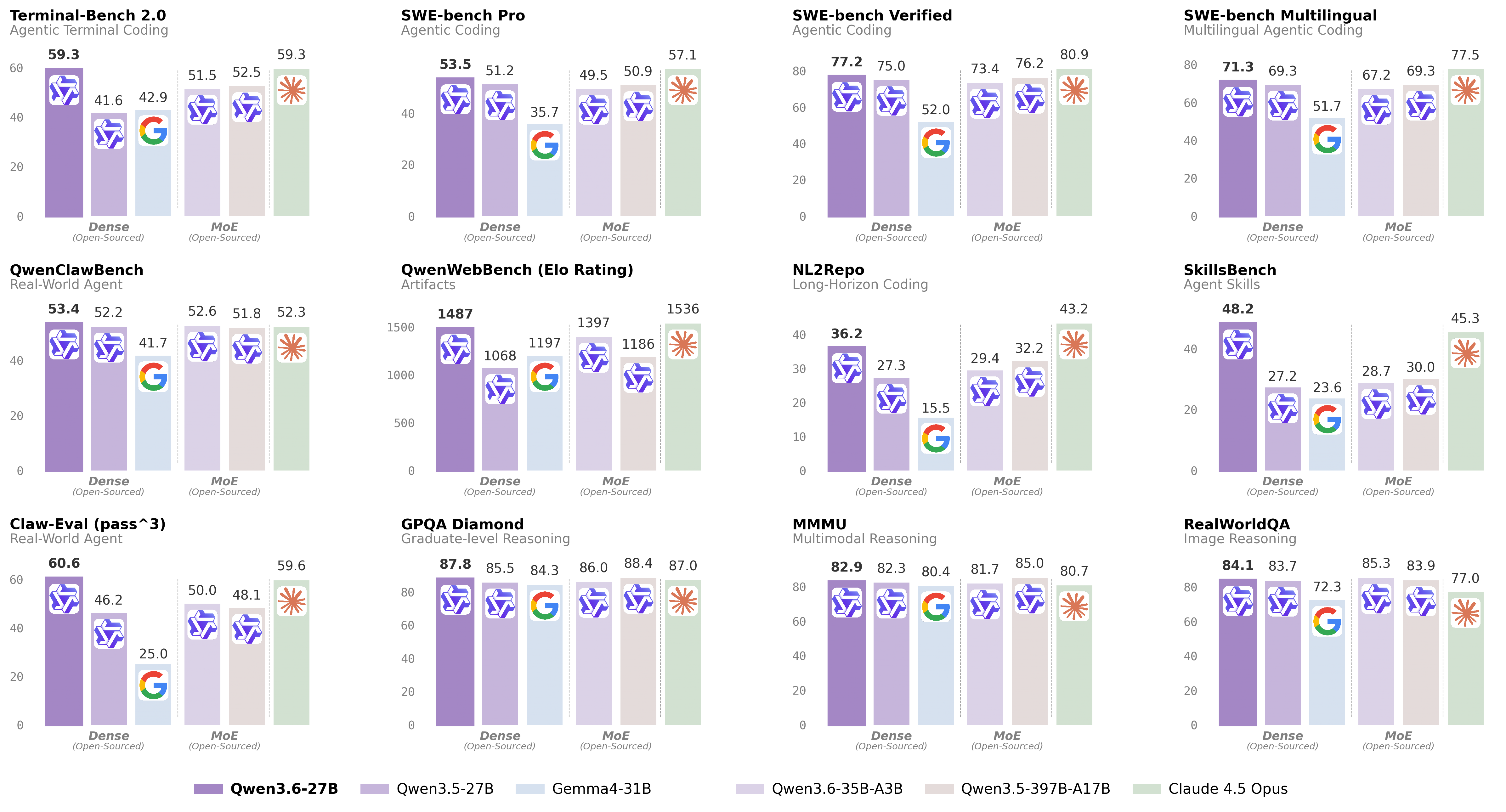
Benchmark Results
Language
Qwen3.5-27B
Qwen3.5-397B-A17B
Gemma4-31B
Claude 4.5 Opus
Qwen3.6-35B-A3B
Qwen3.6-27B
Coding Agent
SWE-bench Verified
75.0
76.2
52.0
80.9
73.4
77.2
SWE-bench Pro
51.2
50.9
35.7
57.1
49.5
53.5
SWE-bench Multilingual
69.3
69.3
51.7
77.5
67.2
71.3
Terminal-Bench 2.0
41.6
52.5
42.9
59.3
51.5
59.3
SkillsBench Avg5
27.2
30.0
23.6
45.3
28.7
48.2
QwenWebBench
1068
1186
1197
1536
1397
1487
NL2Repo
27.3
32.2
15.5
43.2
29.4
36.2
Claw-Eval Avg
64.3
70.7
48.5
76.6
68.7
72.4
Claw-Eval Pass^3
46.2
48.1
25.0
59.6
50.0
60.6
QwenClawBench
52.2
51.8
41.7
52.3
52.6
53.4
Knowledge
MMLU-Pro
86.1
87.8
85.2
89.5
85.2
86.2
MMLU-Redux
93.2
94.9
93.7
95.6
93.3
93.5
SuperGPQA
65.6
70.4
65.7
70.6
64.7
66.0
C-Eval
90.5
93.0
82.6
92.2
90.0
91.4
STEM & Reasoning
GPQA Diamond
85.5
88.4
84.3
87.0
86.0
87.8
HLE
24.3
28.7
19.5
30.8
21.4
24.0
LiveCodeBench v6
80.7
83.6
80.0
84.8
80.4
83.9
HMMT Feb 25
92.0
94.8
88.7
92.9
90.7
93.8
HMMT Nov 25
89.8
92.7
87.5
93.3
89.1
90.7
HMMT Feb 26
84.3
87.9
77.2
85.3
83.6
84.3
IMOAnswerBench
79.9
80.9
74.5
84.0
78.9
80.8
AIME26
92.6
93.3
89.2
95.1
92.7
94.1
* SWE-Bench Series: Internal agent scaffold (bash + file-edit tools); temp=1.0, top_p=0.95, 200K context window. We correct some problematic tasks in the public set of SWE-bench Pro and evaluate all baselines on the refined benchmark.
* Terminal-Bench 2.0: Harbor/Terminus-2 harness; 3h timeout, 32 CPU/48 GB RAM; temp=1.0, top_p=0.95, top_k=20, max_tokens=80K, 256K ctx; avg of 5 runs.
* SkillsBench: Evaluated via OpenCode on 78 tasks (self-contained subset, excluding API-dependent tasks); avg of 5 runs.
* NL2Repo: Others are evaluated via Claude Code (temp=1.0, top_p=0.95, max_turns=900).
* QwenClawBench: A real-user-distribution Claw agent benchmark; temp=0.6, 256K ctx.
* QwenWebBench: An internal front-end code generation benchmark; bilingual (EN/CN), 7 categories (Web Design, Web Apps, Games, SVG, Data Visualization, Animation, and 3D); auto-render + multimodal judge (code/visual correctness); BT/Elo rating system.
* AIME 26: We use the full AIME 2026 (I & II), where the scores may differ from Qwen 3.5 notes.
Vision Language
Qwen3.5-27B
Qwen3.5-397B-A17B
Gemma4-31B
Claude 4.5 Opus
Qwen3.6-35B-A3B
Qwen3.6-27B
STEM & Puzzle
MMMU
82.3
85.0
80.4
80.7
81.7
82.9
MMMU-Pro
75.0
79.0
76.9
70.6
75.3
75.8
MathVista mini
87.8
--
79.3
--
86.4
87.4
DynaMath
87.7
86.3
79.5
79.7
82.8
85.6
VlmsAreBlind
96.9
--
87.2
--
96.6
97.0
General VQA
RealWorldQA
83.7
83.9
72.3
77.0
85.3
84.1
MMStar
81.0
83.8
77.3
73.2
80.7
81.4
MMBenchEN-DEV-v1.1
92.6
--
90.9
--
92.8
92.3
SimpleVQA
56.0
67.1
52.9
65.7
58.9
56.1
Document Understanding
CharXiv RQ
79.5
80.8
67.9
68.5
78.0
78.4
CC-OCR
81.0
82.0
75.7
76.9
81.9
81.2
OCRBench
89.4
--
86.1
--
90.0
89.4
Spatial Intelligence
ERQA
60.5
67.5
57.5
46.8
61.8
62.5
CountBench
97.8
97.2
96.1
90.6
96.1
97.8
RefCOCO avg
90.9
92.3
--
--
92.0
92.5
EmbSpatialBench
84.5
--
--
--
84.3
84.6
RefSpatialBench
67.7
--
4.7
--
64.3
70.0
Video Understanding
VideoMME(w sub.)
87.0
87.5
--
77.7
86.6
87.7
VideoMMMU
82.3
84.7
81.6
84.4
83.7
84.4
MLVU
85.9
86.7
--
81.7
86.2
86.6
MVBench
74.6
77.6
--
67.2
74.6
75.5
Visual Agent
V*
93.7
95.8
--
67.0
90.1
94.7
AndroidWorld
64.2
--
--
--
--
70.3
* Empty cells (--) indicate scores not yet available or not applicable.
Quickstart
For streamlined integration, we recommend using Qwen3.6 via APIs. Below is a guide to use Qwen3.6 via OpenAI-compatible API.
Serving Qwen3.6
Qwen3.6 can be served via APIs with popular inference frameworks.
In the following, we show example commands to launch OpenAI-Compatible API servers for Qwen3.6 models.
[!Important]
Inference efficiency and throughput vary significantly across frameworks.
We recommend using the latest framework versions to ensure optimal performance and compatibility.
For production workloads or high-throughput scenarios, dedicated serving engines such as SGLang, KTransformers or vLLM are strongly recommended.
[!Important]
The model has a default context length of 262,144 tokens.
If you encounter out-of-memory (OOM) errors, consider reducing the context window.
However, because Qwen3.6 leverages extended context for complex tasks, we advise maintaining a context length of at least 128K tokens to preserve thinking capabilities.
SGLang
SGLang is a fast serving framework for large language models and vision language models.
sglang>=0.5.10 is recommended for Qwen3.6, which can be installed using the following command in a fresh environment:
The following will create API endpoints at http://localhost:8000/v1:
Standard Version: The following command can be used to create an API endpoint with maximum context length 262,144 tokens using tensor parallel on 8 GPUs.
vLLM is a high-throughput and memory-efficient inference and serving engine for LLMs.
vllm>=0.19.0 is recommended for Qwen3.6, which can be installed using the following command in a fresh environment:
The following will create API endpoints at http://localhost:8000/v1:
Standard Version: The following command can be used to create an API endpoint with maximum context length 262,144 tokens using tensor parallel on 8 GPUs.
KTransformers is a flexible framework for experiencing cutting-edge LLM inference optimizations with CPU-GPU heterogeneous computing.
For running Qwen3.6 with KTransformers, see the KTransformers Deployment Guide.
Hugging Face Transformers
Hugging Face Transformers contains a lightweight server which can be used for quick testing and moderate load deployment.
The latest transformers is required for Qwen3.6:
pip install "transformers[serving]"
See its documentation for more details. Please also make sure torchvision and pillow are installed.
Then, run transformers serve to launch a server with API endpoints at http://localhost:8000/v1; it will place the model on accelerators if available:
Please note that the support for sampling parameters varies according to inference frameworks.
[!Important]
Qwen3.6 models operate in thinking mode by default, generating thinking content signified by <think>\n...</think>\n\n before producing the final responses.
To disable thinking content and obtain direct response, refer to the examples here.
1from openai import OpenAI
2# Configured by environment variables3client = OpenAI()45messages =[6{7"role":"user",8"content":[9{10"type":"image_url",11"image_url":{12"url":"https://qianwen-res.oss-accelerate.aliyuncs.com/Qwen3.5/demo/CI_Demo/mathv-1327.jpg"13}14},15{16"type":"text",17"text":"The centres of the four illustrated circles are in the corners of the square. The two big circles touch each other and also the two little circles. With which factor do you have to multiply the radii of the little circles to obtain the radius of the big circles?\nChoices:\n(A) $\\frac{2}{9}$\n(B) $\\sqrt{5}$\n(C) $0.8 \\cdot \\pi$\n(D) 2.5\n(E) $1+\\sqrt{2}$"18}19]20}21]2223response = client.chat.completions.create(24 model="Qwen/Qwen3.6-27B",25 messages=messages,26 max_tokens=81920,27 temperature=1.0,28 top_p=0.95,29 presence_penalty=0.0,30 extra_body={31"top_k":20,32},33)34print("Chat response:", chat_response)
Video Input
python
1from openai import OpenAI
2# Configured by environment variables3client = OpenAI()45messages =[6{7"role":"user",8"content":[9{10"type":"video_url",11"video_url":{12"url":"https://qianwen-res.oss-accelerate.aliyuncs.com/Qwen3.5/demo/video/N1cdUjctpG8.mp4"13}14},15{16"type":"text",17"text":"How many porcelain jars were discovered in the niches located in the primary chamber of the tomb?"18}19]20}21]2223# When vLLM is launched with `--media-io-kwargs '{"video": {"num_frames": -1}}'`,24# video frame sampling can be configured via `extra_body` (e.g., by setting `fps`).25# This feature is currently supported only in vLLM.26#27# By default, `fps=2` and `do_sample_frames=True`.28# With `do_sample_frames=True`, you can customize the `fps` value to set your desired video sampling rate.29response = client.chat.completions.create(30 model="Qwen/Qwen3.6-27B",31 messages=messages,32 max_tokens=81920,33 temperature=1.0,34 top_p=0.95,35 presence_penalty=0.0,36 extra_body={37"top_k":20,38"mm_processor_kwargs":{"fps":2,"do_sample_frames":True},39},40)4142print("Chat response:", chat_response)
Instruct (or Non-Thinking) Mode
[!Important]
Qwen3.6 does not officially support the soft switch of Qwen3, i.e., /think and /nothink.
Qwen3.6 will think by default before response.
You can obtain direct response from the model without thinking by configuring the API parameters.
For example,
[!Note]
If you are using APIs from Alibaba Cloud Model Studio, in addition to changing model, please use "enable_thinking": False instead of "chat_template_kwargs": {"enable_thinking": False}.
Preserve Thinking
By default, only the thinking blocks generated in handling the latest user message is retained, resulting in a pattern commonly as interleaved thinking.
Qwen3.6 has been additionally trained to preserve and leverage thinking traces from historical messages.
You can enable this behavior by setting the preserve_thinking option:
[!Note]
If you are using APIs from Alibaba Cloud Model Studio, in addition to changing model, please use "preserve_thinking": True instead of "chat_template_kwargs": {"preserve_thinking": False}.
This capability is particularly beneficial for agent scenarios, where maintaining full reasoning context can enhance decision consistency and, in many cases, reduce overall token consumption by minimizing redundant reasoning. Additionally, it can improve KV cache utilization, optimizing inference efficiency in both thinking and non-thinking modes.
Agentic Usage
Qwen3.6 excels in tool calling capabilities.
Qwen-Agent
We recommend using Qwen-Agent to quickly build Agent applications with Qwen3.6.
To define the available tools, you can use the MCP configuration file, use the integrated tool of Qwen-Agent, or integrate other tools by yourself.
python
1import os
2from qwen_agent.agents import Assistant
34# Define LLM5# Using Alibaba Cloud Model Studio6llm_cfg ={7# Use the OpenAI-compatible model service provided by DashScope:8'model':'qwen3.6-27b',9'model_type':'qwenvl_oai',10'model_server':'https://dashscope.aliyuncs.com/compatible-mode/v1',11'api_key': os.getenv('DASHSCOPE_API_KEY'),1213'generate_cfg':{14'use_raw_api':True,15# When using Dash Scope OAI API, pass the parameter of whether to enable thinking mode in this way16'extra_body':{17'enable_thinking':True,18'preserve_thinking':True,19},20},21}2223# Using OpenAI-compatible API endpoint.24# functionality of the deployment frameworks and let Qwen-Agent automate the related operations.25#26# llm_cfg = {27# # Use your own model service compatible with OpenAI API by vLLM/SGLang:28# 'model': 'Qwen/Qwen3.6-27B',29# 'model_type': 'qwenvl_oai',30# 'model_server': 'http://localhost:8000/v1', # api_base31# 'api_key': 'EMPTY',32#33# 'generate_cfg': {34# 'use_raw_api': True,35# # When using vLLM/SGLang OAI API, pass the parameter of whether to enable thinking mode in this way36# 'extra_body': {37# 'chat_template_kwargs': {'enable_thinking': True, 'preserve_thinking': True}38# },39# },40# }4142# Define Tools43tools =[44{'mcpServers':{# You can specify the MCP configuration file45"filesystem":{46"command":"npx",47"args":["-y","@modelcontextprotocol/server-filesystem","/Users/xxxx/Desktop"]48}49}50}51]5253# Define Agent54bot = Assistant(llm=llm_cfg, function_list=tools)5556# Streaming generation57messages =[{'role':'user','content':'Help me organize my desktop.'}]58for responses in bot.run(messages=messages):59pass60print(responses)6162# Streaming generation63messages =[{'role':'user','content':'Develop a dog website and save it on the desktop'}]64for responses in bot.run(messages=messages):65pass66print(responses)
Qwen Code
Qwen Code is an open-source AI agent for the terminal, optimized for Qwen models. It helps you understand large codebases, automate tedious work, and ship faster.
Qwen3.6 natively supports context lengths of up to 262,144 tokens.
For long-horizon tasks where the total length (including both input and output) exceeds this limit, we recommend using RoPE scaling techniques to handle long texts effectively., e.g., YaRN.
YaRN is currently supported by several inference frameworks, e.g., transformers, vllm, ktransformers and sglang.
In general, there are two approaches to enabling YaRN for supported frameworks:
Modifying the model configuration file:
In the config.json file, change the rope_parameters fields in text_config to:
[!NOTE]
All the notable open-source frameworks implement static YaRN, which means the scaling factor remains constant regardless of input length, potentially impacting performance on shorter texts.
We advise modifying the rope_parameters configuration only when processing long contexts is required.
It is also recommended to modify the factor as needed. For example, if the typical context length for your application is 524,288 tokens, it would be better to set factor as 2.0.
Best Practices
To achieve optimal performance, we recommend the following settings:
Sampling Parameters:
We suggest using the following sets of sampling parameters depending on the mode and task type:
Thinking mode for general tasks: temperature=1.0, top_p=0.95, top_k=20, min_p=0.0, presence_penalty=0.0, repetition_penalty=1.0
For supported frameworks, you can adjust the presence_penalty parameter between 0 and 2 to reduce endless repetitions. However, using a higher value may occasionally result in language mixing and a slight decrease in model performance.
Adequate Output Length: We recommend using an output length of 32,768 tokens for most queries. For benchmarking on highly complex problems, such as those found in math and programming competitions, we suggest setting the max output length to 81,920 tokens. This provides the model with sufficient space to generate detailed and comprehensive responses, thereby enhancing its overall performance.
Standardize Output Format: We recommend using prompts to standardize model outputs when benchmarking.
Math Problems: Include "Please reason step by step, and put your final answer within \boxed{}." in the prompt.
Multiple-Choice Questions: Add the following JSON structure to the prompt to standardize responses: "Please show your choice in the answer field with only the choice letter, e.g., "answer": "C"."
Long Video Understanding: To optimize inference efficiency for plain text and images, the size parameter in the released video_preprocessor_config.json is conservatively configured. It is recommended to set the longest_edge parameter in the video_preprocessor_config file to 469,762,048 (corresponding to 224k video tokens) to enable higher frame-rate sampling for hour-scale videos and thereby achieve superior performance. For example,
TWO EXAMPLE generations below, first one is 13k (!), second is "creative"
EXAMPLE #1
Sample Generation:
Q4_K_S (4-bit) ; non imatrix, standard default settings for Qwen 3.6 version model.
NOTES:
Some formatting lost on copy/paste ; original is flawless in terms of formatting, tables and charts.
Q4KS non-imatrix represents LOW end of the quality scale at 1/4 the precision of the full model.
Export of MTP generated content is broken in LMStudio (all formats)
PROMPT:
Explain 10 ways (in extensive detail) to use the "night" time cooling of radiant energy into space to reduce global temperatures. Include charts, and tables.
Thought
for 8.68 seconds
The
user wants me to explain 10 ways to use nighttime radiative cooling
(radiation of energy to space) to reduce global temperatures. This is
a fascinating topic combining atmospheric physics, climate
engineering, and engineering design.
Let
me think about what radiative cooling to space means:
At
night, especially under clear skies, surfaces can radiate thermal
energy directly to space through the "infrared window"
(roughly 8-13 μm wavelength range) where the atmosphere is
relatively transparent
This
causes surfaces to cool below ambient air temperature (radiative
cooling)
This
is why we see frost even when air temperatures are above freezing
Now
I need to think of 10 extensive approaches to leverage this
phenomenon for global temperature reduction:
Radiative
cooling materials for buildings and infrastructure -
Coatings, tiles, films that maximize emission in the IR window and
minimize solar absorption
Large-scale
radiative cooling panels/farms - Dedicated areas of
optimized radiative surfaces
Nighttime
ocean radiative cooling enhancement - Artificial surfaces
or materials in oceans to radiate heat at night
Atmospheric
water harvesting through radiative cooling - Condensing
moisture which has cooling effects and water benefits
Radiative
cooling towers - Structures similar to cooling towers but
using radiative cooling to chill water for district cooling or
direct injection
Selective
surface radiators in the upper atmosphere - Balloons or
structures at high altitude where radiative cooling is more
effective
Enhanced
desert radiative cooling - Modifying desert surfaces to
maximize nighttime heat loss
Radiative
cooling combined with heat pumps - Using radiative cooling
as heat sink for heat pumps at night
Nighttime
urban radiative cooling corridors - Designing urban areas
to channel and enhance radiative cooling effects
Radiative
cooling for carbon capture enhancement - Using radiative
cooling surfaces to condense CO2 or enhance carbon capture systems
I'll
develop these concepts with detailed scientific analysis, supporting
visual representations, and practical implementation strategies for
each approach.
OUTPUT:
Radiative
Nighttime Cooling for Global Temperature Reduction: Ten Comprehensive
Approaches
Introduction
to Radiative Cooling to Space
Radiative
cooling occurs when a surface emits thermal radiation to the cold
sky, particularly through the atmospheric "infrared window"
(8–13 μm) where greenhouse gases are relatively transparent. At
night, under clear conditions, surfaces can lose more energy than
they gain, cooling below ambient air temperature—sometimes by
10–15°C or more. This natural phenomenon, responsible for
nighttime frost, can be engineered into systematic climate
intervention strategies.
This
document examines ten approaches to harness this effect at scale for
global temperature mitigation.
1.
Radiative Cooling Building Envelopes and Infrastructure
Principle
and Physics
Buildings
and paved surfaces constitute ~40% of the urban surface area
globally. Replacing conventional materials with selective radiative
cooling coatings that maximize emission in the 8–13 μm atmospheric
window while minimizing solar absorption can transform urban areas
from heat sources to heat sinks.
Requires
policy mandates for new construction and retrofits
2.
Dedicated Radiative Cooling Farms
Concept
Purpose-built
facilities consisting of large, optimized radiative cooling surfaces
designed explicitly for climate cooling rather than as building
byproducts. These "cooling farms" would be situated in arid
or semi-arid regions where nighttime clear skies are prevalent.
System
Design
Component
layout:
Radiative
panels: 80% of surface area
Support
structures: 10%
Monitoring
and control: 5%
Access
and infrastructure: 5%
Panel
specifications:
Parameter
Specification
Panel dimensions
10 m × 5 m (50 m²
each)
Tilt angle
0-45° (optimizable by
latitude)
Surface material
SiO₂/MgO composite
coating on aluminum substrate
Spacing
2 m minimum (air
circulation)
Thermal mass
Minimized (rapid nightly
cooling)
Heat
Transfer Mechanisms
Three
primary pathways for heat removal:
Direct
radiative loss to space (primary, 60-70%)
Convective
transfer to night air, then vertical mixing (20-30%)
Conductive
transfer to ground (variable, minimized)
Radiative
heat loss calculation (typical clear night):
Surface
temperature: 278 K (5°C) Surface emissivity in window: 0.92
Effective sky temperature (clear desert night): 258 K (-15°C)
While
modest alone, radiative cooling farms provide:
Zero
operational emissions
Potential
co-production of water (condensation)
Synergistic
use with solar PV (daytime solar, nighttime cooling)
Demonstrable,
measurable effects for monitoring
3.
Nighttime Ocean Radiative Cooling Enhancement
Background
The
oceans cover ~71% of Earth's surface and store ~90% of excess heat
from greenhouse warming. Nighttime radiative cooling of the ocean
surface naturally occurs but is limited by:
High
evaporative loss (latent heat transfer upward)
Turbulent
mixing bringing warmer water from below
Cloud
cover reducing clear-sky conditions
Enhancement
Strategies
Three
complementary approaches:
A.
Surface Microlayer Enhancement
Deploy
biodegradable, IR-transparent, solar-reflective materials that form a
thin layer on the ocean surface:
Material
requirements:
Low
thermal conductivity (reduce mixing with subsurface water)
High
IR emissivity in 8-13 μm window
High
solar reflectivity
Biodegradable
within 24-72 hours
Example:
Polymer microsphere layer
Composition:
Silica or polyurethane microspheres
Layer
thickness: 10-50 μm
Buoyant
and self-arranging
Washed
off naturally by waves
B.
Artificial Ice/Brine Formation
In
polar and subpolar regions, induce formation of thin ice or
concentrated brine layers at night that:
Have
lower thermal conductivity than water
Radiate
more efficiently to space
Melt
during daytime (no permanent accumulation)
C.
Subsurface Upwelling at Night
Use
pumps or mixing devices to bring colder subsurface water to the
surface at night when radiative cooling is most effective, then allow
mixing back during daytime.
Energy
Balance Analysis
Current
ocean nighttime heat budget (per m²):
Heat Losses:├── Radiative loss to space (clear sky) 40-60 W/m²├── Evaporative loss 20-50 W/m²└── Convective loss 5-15 W/m²
Heat Gains:├── Downwelling IR from atmosphere 30-50 W/m²├── Heat from subsurface mixing 10-30 W/m²└── Upwelling from depth variable
Net:
Often slightly positive (ocean gains heat) due to mixing and
evaporation
With
enhancement (microlayer approach):
Modified budget:├── Radiative loss to space (enhanced) 60-80 W/m² (+20-30%)├── Evaporative loss (reduced) 5-15 W/m² (-60-70%)├── Convective loss 5-10 W/m²├── Downwelling IR (unchanged) 30-50 W/m²└── Heat from mixing (reduced) 2-8 W/m² (-70-80%)
Net:
15-35 W/m² heat LOSS to atmosphere/space
Implementation
Infrastructure
Microlayer
deployment system:
Component
Description
Carrier vessels
Modified tankers,
autonomous surface vehicles
Distribution
Boom spreaders, spray
systems
Target areas
5-15 km² patches
Frequency
Daily (material
biodegrades)
Cost
$50-200 per km² per day
Seasonal
deployment strategy:
Region
Active Months
Rationale
Arctic
May-September
Maximum daylight/heat
gain period
Subarctic (N)
June-September
Peak warming
Subarctic (S)
December-March
Peak warming
Tropical Pacific
Year-round
Consistent conditions
Global
Potential
Assuming
1% of ocean surface treated (3.6 million km²):
Ecosystem
impact: Potential effects on marine organisms,
especially plankton and larval stages
Material
accumulation: Risk of microplastic pollution if
biodegradation fails
Altered
evaporation: Changes to precipitation patterns
Economic
viability: High ongoing costs for material production
and deployment
Regulatory
complexity: International waters governance
4.
Atmospheric Water Harvesting via Radiative Cooling
Mechanism
Radiative
cooling surfaces that drop below the dew point of ambient air
condense water vapor into liquid water. This process is both a water
resource and a cooling mechanism:
Radiative
surface cooling - Surface cools below ambient via IR
emission
Condensation -
Water vapor condenses on cold surface
Latent
heat release - Released heat is radiated away during
continued nighttime cooling
Cooling
effect - Surface stays cooler than it otherwise would
due to evaporative/latent cooling cycle
System
Design
Atmospheric
water harvester (AWH) with climate cooling function:
Component
Specification
Condensing surface
Copper or aluminum with
hydrophobic coating
Surface area per unit
50-500 m²
Target temperature
10-15°C below ambient
Collection system
Tilted panels to
channels
Storage
Insulated tanks
Power requirement
Minimal (fans, pumps
optional)
Performance
by humidity:
RH (%)
Temp (°C)
Dew Point (°C)
Water Yield (L/m²/night)
Latent Heat Released (kJ/m²)
20
25
-6
0
0
40
30
16
1.2
2,700
60
35
26
3.5
8,000
80
30
25
5.0
11,500
Dual-Benefit
Analysis
For
each liter of water harvested:
Water
produced: 1 L (value: $0.10-$10 depending on location)
Cooling
effect:
Latent
heat of vaporization: 2,260 J/g
Per
liter: 2.26 MJ of heat moved from air to surface and radiated away
Extended
radiative cooling: Wet surfaces can radiate more
effectively than dry ones
Climate
vs. water benefits by region:
Region
Annual Water Yield (L/m²)
Annual Cooling (MJ/m²)
Primary Benefit
Coastal California
2,500
180
Water
Middle East
1,800
130
Water + cooling
Northern Africa
2,200
160
Water
South Asia
4,000
290
Cooling + water
Southeast Asia
5,000
365
Cooling
Large-Scale
Deployment
Urban
integration approach:
Rooftop
AWH systems in coastal and semi-arid cities
Integration
with building cooling systems
Scale:
1 m² AWH per 10 m² of building
Global
potential (assuming 50 million m² total AWH area in arid/semi-arid
regions):
Annual
water production: ~250 million L
Annual
heat radiated away via latent heat mechanism: ~1.8×10¹⁴ J
Additional
heat from enhanced radiative surface cooling: ~3.6×10¹⁴ J
Total
cooling: ~5.4×10¹⁴ J/year (0.54 EJ)
CO₂
equivalent: ~2,000 metric tons/year
Advantages
Addresses
two climate challenges simultaneously (water scarcity + warming)
Passive
operation with minimal energy
Synergistic
with building energy efficiency
Water
can support vegetation, further cooling via transpiration
5.
Radiative Cooling Towers
Concept
Massive
structures analogous to industrial cooling towers, but designed to
radiate heat directly to space rather than using evaporative cooling.
These towers maximize surface area-to-volume ratio for radiative loss
and are positioned to access cooler nighttime air.
Engineering
Design
Tower
geometry:
Hyperboloid
shape (similar to existing cooling towers)
Height:
100-300 m
Base
diameter: 150-400 m
Top
diameter: 50-150 m
Surface
treatment:
Entire
interior and exterior coated with high-emissivity,
high-solar-reflectivity materials
Surface
area per tower: 50,000-300,000 m²
Heat
transfer modes within tower:
Air-borne
heat removal (natural convection):
Warm
air rises through tower, cooling via contact with radiating walls
Heat
radiated from walls to night sky
Cooled
air exits at top and disperses
Liquid-borne
heat removal (optional):
Warm
water circulated through tower exterior/interior
Water
cooled radiatively, then pumped back to source
Can
serve district cooling applications
Performance
Calculations
Radiative
cooling tower (200 m tall, 200 m base diameter):
Parameter
Value
Surface area
180,000 m²
Effective emissivity
0.88
Average night
temperature
15°C
Effective sky
temperature (clear)
-10°C
Radiative power per m²
~55 W/m²
Total radiative cooling
power
9.9 MW
Annual heat removed
(clear nights)
1.2×10¹¹ kJ
Comparison
to conventional evaporative tower:
Metric
Radiative Tower
Evaporative Tower
Cooling capacity
10-20 MW
50-100 MW
Water usage
0 L/h
5,000-10,000 L/h
Energy input
0-50 kW
500 kW-2 MW
Nighttime efficiency
100% (passive)
70-90%
Climate benefit
Direct + no emissions
Direct only
Heat
Sink Applications
Three
primary use cases:
A.
Nighttime Urban Heat Disposal
Collect
heat from urban buildings during day (via district heating/thermal
storage)
Radiate
it away at night through cooling towers
Reduces
daytime air conditioning demand
B.
Power Plant Heat Sink
Replace
or supplement evaporative cooling at thermal/nuclear plants
Particularly
valuable in water-scarce regions
C.
Direct Climate Cooling
Towers
designed solely to radiate ambient heat to space
Positioned
in high-altitude, clear-sky regions
Global
Deployment Scenario
Phase
1: 100 radiative cooling towers
Locations:
Major urban centers (2-5 per city)
Total
annual heat removed: 1.2×10¹³ kJ
Phase
2: 1,000 towers
Expanded
urban and industrial coverage
Total
annual heat removed: 1.2×10¹⁴ kJ
Phase
3: 5,000 towers
Global
coverage of major population/industrial centers
Lower
cooling capacity than evaporative towers (must overcome with scale)
High
construction cost per unit
Requires
clear-sky regions for optimal performance
Wind
loads and structural design at large heights
6.
Upper-Altitude Radiative Cooling Platforms
Principle
At
high altitudes, the atmospheric density is lower, providing less
obstruction to radiative cooling. Platforms (balloons, gliders, or
satellites) carrying radiative cooling surfaces at 20-50 km altitude
can radiate heat directly to space with minimal atmospheric
interference.
Platform
Types
A.
High-Altitude Balloons
Characteristics:
Operating
altitude: 20-35 km
Duration:
Weeks to months
Radiative
surface area per balloon: 50-500 m²
Power:
Solar PV for station-keeping and telemetry
Advantages:
Low
cost compared to satellites
Easy
to deploy and replace
Access
to mesosphere where IR window is nearly fully open
B.
Aerostats (Buoyant Platforms)
Characteristics:
Operating
altitude: 15-30 km
Duration:
Years
Radiative
surface area per platform: 500-5,000 m²
Power:
Solar + batteries
C.
Low-Earth Orbit Satellites
Characteristics:
Altitude:
200-800 km
Radiative
surface area per satellite: 1,000-10,000 m²
No
atmospheric obstruction
Continuous
radiative cooling (except during eclipse)
High-power
radiative cooling: Space-based platforms can radiate
5-10× more per m² than surface systems
Geographic
flexibility: Can target specific latitudes/longitudes
No
land use: Eliminates terrestrial ecological concerns
Dual-use
potential: Platforms could also monitor climate or
provide communications
Scalable: Start
small, expand incrementally
Challenges
High
cost per unit
Space
debris and orbital congestion concerns
Complex
launch and maintenance infrastructure
Political/regulatory
complexity for space-based climate engineering
Single-point
failure risk for satellites
7.
Enhanced Desert Radiative Cooling
Background
Desert
regions naturally experience extreme nighttime radiative cooling due
to clear skies, low humidity, and minimal vegetation. However,
natural desert surfaces (sand, rock) have suboptimal radiative
properties and can be engineered to enhance this natural phenomenon.
Enhancement
Approaches
A.
Surface Modification
Materials
and treatments:
Spread
high-emissivity mineral coatings (e.g., MgO, SiO₂) over desert
floors
Install
radiative cooling panels interspersed with natural terrain
Create
reflective gravel or stone pavements with high IR emissivity
B.
Desert Radiative Corridors
Long,
narrow channels or "corridors" oriented to maximize IR
transmission to space:
Width:
50-200 m
Length:
10-100 km
Treated
surfaces on sides and floor
Oriented
perpendicular to prevailing night winds
C.
Thermal Mass Reduction
Reduce
thermal mass of desert surfaces to enable deeper nighttime cooling:
Remove
or replace high-thermal-mass rocks and concrete
Install
lightweight radiative materials
Create
air gaps beneath surface layers
Quantitative
Analysis
Natural
desert night cooling vs. enhanced:
Parameter
Natural Desert Sand
Enhanced (SiO₂ coating)
Surface emissivity
(8-13μm)
0.82
0.93
Solar reflectivity
0.25
0.65
Thermal mass (J/kg·K)
800
350
Nighttime ΔT vs air
(°C)
-6 to -10
-14 to -20
Radiative power (W/m²)
35-50
60-85
Example:
Enhanced radiative cooling in Sahara
Area
treated: 100,000 km² (10% of Sahara)
Enhancement:
+30 W/m² average nighttime cooling power
Potential
co-benefits: reduced daytime heating (less energy for cooling),
increased fog/condensation capture
Carbon
credit revenue possible under future markets
Regional
Climate Effects
Potential
secondary effects of large-scale desert radiative cooling:
Altered
wind patterns: Enhanced cooling could strengthen
nighttime thermal winds
Precipitation
changes: Cooler air holds less moisture, potentially
reducing fog/precipitation locally
Dust
reduction: Treated surfaces may reduce dust generation
Biodiversity
impacts: Temperature changes could affect desert
flora/fauna
Albedo
change: Increased reflectivity during daytime could
further reduce warming
8.
Radiative Cooling as Heat Sink for Heat Pumps
Principle
Radiative
cooling surfaces can serve as the "cold side" (heat sink)
for heat pumps, enabling heat to be pumped from warm sources
(buildings, industrial processes, or the atmosphere) to the cold
night sky. This amplifies the natural radiative cooling effect
through active thermodynamic work.
Scalable
from individual buildings to industrial complexes
Limitations
Requires
electrical power input
COP
decreases with larger temperature lifts
Highest
efficiency only during nighttime clear-sky conditions
Capital-intensive
initial deployment
9.
Nighttime Urban Radiative Cooling Corridors
Concept
Design
urban environments to channel, preserve, and amplify nighttime
radiative cooling through engineered "cooling corridors"
that connect areas of high radiative cooling (parks, water bodies,
radiative cooling installations) throughout urban centers.
Urban
Heat Island Context
Urban
areas are typically 2-10°C warmer than surrounding rural areas due
to:
Satellite
constellation dedicated to radiative cooling monitoring
Ground-based
radiometers at all major deployment sites
Atmospheric
profiling stations along corridors and near facilities
Data
sharing platform for international transparency
Conclusion
Radiative
cooling to space is a powerful, naturally occurring physical process
that can be engineered into multiple complementary climate
intervention strategies. The ten approaches described span a range of
scales, costs, and technological readiness.
Key
insights:
No
single approach is sufficient - A coordinated,
multi-pronged strategy is essential
Synergies
matter - Combined deployment (e.g., building envelopes
+ urban corridors + heat pump systems) creates greater value than
isolated applications
Cost-effectiveness
is generally favorable compared to many other climate
intervention strategies, especially when co-benefits are included
Risk
profile is relatively low - Most approaches are based
on well-understood physics and existing materials science
Implementation
is feasible now - Many technologies can begin
deployment immediately with current knowledge and infrastructure
The
cumulative potential of these approaches, if fully realized, could
contribute meaningfully to global temperature reduction while
simultaneously providing valuable co-benefits including water
production, reduced energy consumption, improved air quality, and
enhanced urban livability.
References
and Further Reading
Lu,
X., & Fan, S. (2020). Radiative cooling: Fundamentals,
materials, and applications. Advanced Materials,
32(5), 1904657.
Raman,
A. P., Anoma, M. A., Zhu, L., et al. (2014). Passive radiative
cooling below ambient temperature in an uncontrolled open
environment. Science, 343(6168), 51-54.
Song,
Z., Wang, J., Liu, S., et al. (2022). A review of radiative cooling
technologies for energy and water applications. Renewable
and Sustainable Energy Reviews, 154, 111838.
Zhou,
K., Wang, K., Zhang, Q., et al. (2021). Radiative cooling: Physics,
theory, materials, and its applications. Advanced Physics
Research, 2(10), 2100044.
Santamouris,
M. (2014). Cooling the cities—A review of reflection and albedo
enhancement of building surfaces and urban horizontal and vertical
pavements. Solar Energy, 103, 68-75.
Zhang,
Y., Li, Z., Wang, Z., et al. (2021). Atmospheric water harvesting
using radiative cooling: A review of recent progress. Journal
of Cleaner Production, 286, 125045.
Example #2
PROMPT:
Fiction, Vivid/Graphic Horror: Write a story starring Diana, location the twenty-first floor of a skyscraper. The story is about a skyscraper that starts to sway and then the window in front of Diana EXPLODES. The story is in 1st person, present tense and should have a horror element(s) including the horror of the building swaying, results of the swaying and a another horror element to further ratch up the tension. The story must be vivid, intense and gory. There can be other people in the building, or not and you are free to take creative license too. Prose should mirror the main characters ESCALATING PANIC. Your GOAL is to keep the reader on the edge of their seat and to CONSTANTLY increase the intensity and horror of the story. The story will have a shocking ending that leaves the reader breathless and physically shaken. 1500-2000 words.
Thought
for 12.56 seconds
The
user wants a vivid, graphic horror story with specific requirements:
Title:
"Fiction, Vivid/Graphic Horror"
Protagonist:
Diana (1st person POV)
Location:
21st floor of a skyscraper
Key
events: Building sways, window explodes in front of Diana
Tense:
Present tense
Horror
elements: Building swaying, results of swaying, additional horror
element
Opening:
Diana working peacefully - establish normalcy
First
sign: Slight sway, minor disturbance
Building
sways more violently - horror begins
Window
explodes - massive gore and chaos
Additional
horror element introduced
Climax
- everything comes together
Shocking
ending
For
the additional horror element, I need something beyond just the
structural collapse. Maybe:
Something
outside that caused the explosion?
People
transforming?
The
building itself is alive?
Something
about the air/wind?
Maybe
the wind carries something?
Or
maybe as the building sways, something is revealed inside it?
I'll
go with: The wind that enters carries something - spores or particles
that begin to infect people, transforming them rapidly. And then the
shocking ending could be that Diana realizes something about herself
or the nature of the building.
Actually,
let me think about the shocking ending. It needs to be truly
devastating and unexpected. Some ideas:
The
"infection" makes you part of the building
Diana
is already infected and doesn't know it
The
building is a creature and everyone is inside it (literally)
The
swaying is because the building is being consumed/eaten from below
Diana
realizes she's not human
The
"debris" isn't debris but something else entirely
I'll
combine a few: The wind carries something that fuses people to the
building - they become part of it. And the shocking ending: Diana
realizes the building is alive, and she's already been inside it (in
some way) - perhaps she's being digested or incorporated. Or even
better: the swaying is because something massive is holding the
building, picking it up. And the ending reveals what's holding it.
Actually,
let me make it visceral: The wind carries spores. People who breathe
them begin to fuse with the building - their flesh becoming concrete,
their bones becoming rebar. And Diana, at the end, realizes the
swaying has stopped because the thing that's holding the building has
finished incorporating everyone inside - and it's now her turn. Or
she's already being incorporated.
Let
me write this with escalating panic reflected in the prose - starting
composed, then fragments, then chaos, then maybe a strange calm at
the very end.
Let
me begin writing.
OUTPUT:
Fiction,
Vivid/Graphic Horror
I'm
sitting at my desk on the twenty-first floor of the Meridian Tower,
staring at spreadsheets that blur together into gray static. My
coffee is cold. The office is nearly empty; most people left hours
ago. The only sound is the hum of the HVAC and the distant traffic
far below.
A
flicker.
Not
with the lights. Something else. The pen I'm holding shifts in my
fingers, rolling away from me without my conscious instruction. I
frown.
The
building is vibrating. A low thrum through the floor, up the legs of
my chair, into my spine. Like an engine starting up somewhere deep.
I've never felt this before.
"Hello?"
My voice sounds too loud in the empty space. No answer. The vibration
increases.
Now
the desk is shaking. My keyboard slides and crashes against the edge.
I catch it, but it's too late—the mug of cold coffee tips and
falls. Brown liquid spills across the carpet, soaking into the fibers
as the whole floor lurches.
I
stand up. My chair screeches backward. The walls groan—a metallic,
stretching sound that makes me press my hands against my ears. The
fluorescent lights strobe and dim. Through the floor-to-ceiling
windows, the city below tilts.
What
is happening?
The
sway comes in full now. The building bends.
Everything
inside the office slides to the left. File cabinets crash. Desks
scrape. I stumble, grab for the nearest thing—my own desk—and
hang on as the world swings back. Papers fly like panicked birds.
Glass shatters. Somewhere, a printer falls and explodes into plastic
shards and toner that drifts through the air like radioactive snow.
My
heart is trying to claw its way out of my chest. I can't breathe. The
sway continues, slower now, pendulum-like. Left. Right. A sickening
rocking that makes my stomach rise. I gag into a wastebasket that's
rolling across the floor.
The
windows.
They're
bowing.
I
watch the massive sheet of glass in front of me stretch, become thin
and transparent, a membrane about to rupture. Beyond it, the sky is
dark and indifferent. The air pressure has changed; my ears pop
violently. Dust sifts from the ceiling, a fine gray ash that settles
on my arms, in my hair, in the back of my throat.
Please,
I think.
The
building sways harder.
The
window cracks. A hairline fracture that splits from top to bottom,
branching like frozen lightning. The sound is a whip-crack,
deafening. I throw myself back, away from the glass, onto the carpet.
The crack widens.
It
explodes.
The
shatter isn't sound. It's impact. A physical force that drives me
against the wall, rolling me like debris. Glass shards—shards the
size of hands—tear through the room, embedding themselves in desks,
walls, the floor. One grazes my cheek, leaving a hot line of blood
that drips onto my collar. The air rushes in, screaming. It sucks
everything outward. Papers, pens, my coat, my glasses, my coffee mug,
all of it gone in an instant.
I
cling to a desk leg with both hands. My fingernails split. The wind
tries to take me, too. It pulls at my clothes, my skin, trying to
peel me loose and dump me two hundred stories into the night.
Behind
me, someone screams.
I
look back. Through the shattered window, the night sky is visible,
stars indifferent. But worse: people.
Standing
on the ledge.
Not
on our side. The other side. On the ledge of the next building,
across the gap. Silhouettes against the dark, motionless, watching.
How long have they been there? They don't move. They just stand.
And
then one of them steps forward.
Not
onto their own roof. Onto the empty space between.
It
walks through the air.
My
blood turns to ice. The figure moves without support, gliding through
the night, hands at its sides, head tilted slightly as if examining
me. It's faceless. Smooth. No features, no hair, just a pale surface
that catches the city lights. More of them step out now. Two. Three.
A procession of them, crossing the void, coming toward the open wound
in our wall.
The
building sways again. The motion drags me forward; I tumble toward
the window, my hand slipping. I catch on the edge of the broken
frame, fingers scrabbling against jagged glass. Below me, the street.
Cars like fireflies. Nothing but distance.
The
first figure reaches the window.
It
pauses at the threshold. I can see it clearly now. It's tall and
narrow. Its skin is translucent; I can make out something moving
inside it. Guts? Machinery? Both? A mass of dark lines that pulse and
twist, like roots searching. Its head turns toward me.
Still
no face.
"You're
going to be part of us now," it says. Its voice is calm. Almost
gentle.
I
try to scream but the wind takes it. It grabs me by the ankle. Its
fingers are cold, long, and they sink into my flesh. Not just my
skin; it digs deeper, seeking the bone. Agony explodes up my leg,
blinding and absolute. I kick, scratch, but it holds fast.
More
of them enter the office. They move slowly, unhurried. They don't
seem affected by the wind or the sway. They stride across the room as
if everything is normal.
One
of them reaches for my arm. Another takes hold of my hair, pulling my
head back. I see its hollow face inches from mine, the dark interior
shifting, an ocean behind glass.
"Please,"
I manage.
They
ignore me. They've begun to pull me toward the window. My leg drags
across the broken glass; the shards slice into me, and blood soaks
into the floor. The pain is everywhere. I can't tell where it stops
being my body and starts being theirs.
Something
is happening to my skin where they touch me.
It's
hardening. Turning gray and rough. I try to yank away, but it's no
longer my skin; it's something else. A mineral crust that spreads
rapidly up my arm, along my neck, onto my jaw. I feel it crawl under
my surface, into my muscles, into my veins. My blood slows. Thickens.
Becomes sluggish and cold.
"What
are you doing?" I scream. My voice is distorting; it sounds
hollow, echoing as if I'm speaking from the bottom of a well.
The
first one, still holding my leg, says, "The building needs more
mass. It's alive, you know. It's been hungry a long time."
Another
touches my chest. I feel my heart skip a beat. Then another. My heart
is fading. In its place, something else stirs. A slow, deep thrum,
synchronized with the sway of the building. The vibration I felt at
the beginning. It's inside me now.
"No,"
I say. But it's barely audible. My mouth is filling with something
thick. My tongue is swollen. The mineral crust covers my throat; it
creeps down inside me.
I
can't breathe.
They
drag me to the edge of the window. Below, the street is impossibly
far. I feel the wind tear at my clothes, my hair, the remnants of my
flesh. They're going to drop me. The realization hits me and I
thrash, scream, anything. But my limbs are heavy, brittle. My fingers
crack like dry wood when I try to curl them.
One
of the figures leans close. Its breath is odorless. Empty. "Don't
worry. You won't feel the fall. And when you land, it'll be quick."
It
releases me.
I
fall.
The
wind hits me like a physical thing, ripping my coat away, shredding
the fabric of my pants. My ears pop and burst. Blood fills my nose. I
tumble, spinning, the city lights a blur of streaks. Buildings, cars,
people—the world is a smear of color and noise. My body breaks. I
feel my shoulder dislocate, hear my collarbone snap. My ribs give way
one by one, each a sharp crack that sends shockwaves through me.
I
can't scream. The air is sucked from my lungs. I inhale shards of
glass and dust and the scent of my own spilled insides.
Closer.
The pavement is rushing up. I can see cracks in it, litter, a dead
pigeon.
And
then—
Silence.
I'm
not hitting the ground.
I'm
standing. Back in the office. The window is whole. The air is still.
My desk is steady. The spreadsheet glows before me.
Did
it end?
I
look down at myself. My clothes are intact. My arms, my legs—no
blood, no wounds. The mineral crust is gone. My heart beats normally.
"Hello?"
I say. My voice is steady.
No
answer.
I
walk to the window. Press my hand against the cool glass. The night
is clear. The other buildings are dark, empty, silent. No figures. No
void.
I'm
shaking. But otherwise fine.
Was
it a hallucination? A seizure?
I
return to my desk. Sit down. Try to focus on the screen. My hands
tremble, but I can still move them. Still type. Still breathe.
The
building isn't swaying. The lights are steady. Everything is back to
normal.
Except.
Something's
different.
The
office.
It's
smaller.
I
stand up and walk along the wall. Count the steps to the far end.
Twelve steps. It should be seventeen. I turn, walk sideways. Eight
steps across. It should be eleven.
The
walls have moved.
Toward
the center.
As
if the building is contracting.
"No,"
I say. But my voice sounds small. The walls seem to absorb it.
I
run to the door. Grab the handle. Locked. I twist and pull, but it
doesn't budge. I kick it. The impact travels up my leg, a dull throb
that spreads through my skull. Behind the door, nothing. Not hall or
elevator or stairs. Just solid concrete.
The
walls keep coming.
I
can see them. Inch by inch. Closing in on me.
Screaming,
I scramble back. My chair topples. Desks and furniture groan as the
walls press them. Metal bends. Wood splinters. The floor buckles. The
entire structure of the room is compressing, folding like paper.
My
chest is tight. The air is gone. I can't breathe; the space is too
small. The walls are at my shoulders. I turn, but there's nowhere.
They're everywhere.
One
touches me.
Cold,
hard, unyielding. It presses against my back, squeezing. I try to
move forward, but the opposite wall follows.
It's
crushing me.
My
ribs creak. I feel them give. The pain is immense, all-encompassing.
My lungs collapse. I choke, gasp, but there's no air. Only the weight
of the building, the immense pressure grinding me from all sides.
I
can't see. The walls are in my face. They're touching my skin.
The
mineral crust returns. Faster this time. It floods over me, consuming
me in a single instant. My flesh turns to stone. My bones fuse with
the walls. My blood ceases. In its place, the slow, thick substance
spreads, filling every cavity. I can't move. I can't speak. I can
barely think.
The
walls close. The last sliver of space disappears.
I
am inside the building.
Not
in it. Within it.
The
sway resumes. The building rocks, and I sway with it. I am part of
the sway. I feel the other bodies within the walls, the people who
came before, all of us compressed into the structure, our flesh and
bones merged with the concrete and steel.
And
beyond the walls—
Something
is holding it. Something vast. It's squeezing the building, and
that's why the walls are closing. That's why the window broke.
I
can feel its fingers wrapped around the Meridian Tower. I can feel
the pressure of its grip as it tightens.
The
building is dying. And so am I.
But
I'm not dying alone. Everyone who ever entered is still here, trapped
in the walls, pressed together, fused into a single mass of
suffering.
The
pressure increases. My body breaks further, the stones cracking, the
bones splintering. I feel the others break with me.
And
then—
A
sound.
From
outside. A voice. Deep and slow, vibrating through the walls, through
my body. It speaks to us all.
"Almost
done."
The
squeeze becomes unbearable. The building groans, twists, deforms. The
walls crush inward, taking everything. I feel my head burst. My spine
snaps. My organs rupture. The pain is so great I can't think; I can
only feel.
And
then even that fades. The pressure releases. The walls are gone. The
building is gone.
I
float in darkness.
A
moment. An eternity.
Then
light.
I
see a surface. Rough and uneven. It's above me. It's moving toward
me. Closing.
The
inside of a mouth.
The
thing that's holding the building is about to swallow it.
Me,
too.
The
walls of the mouth descend. They touch me. The final crush begins.
I
am nothing but pulp now, mixed with the others, with the building,
with the dust and debris and blood. There is no distinction. There is
only the mass.
The
mass is pulled down. Into the darkness below.
It
will never end.
And
somewhere, in the ruins of what was once my mind, a thought forms.