Qwen3-Yoyo-V3-42B-A3B-Thinking-Total-Recall-TNG-III [1 million context]
This repo contains the full precision source code, in "safe tensors" format to generate GGUFs, GPTQ, EXL2, AWQ, HQQ and other formats.
The source code can also be used directly.
EXPERIMENTAL:
This is a limited fine tune (selected layers, experimental methods) on an in house Star Trek TNG (si-fi, all seasons) using Unsloth. This will
add some "sifi / TNG Magic" to the model.
This version has FOUR TIMES the depth of training as V1, and twice that of V2...
I suggest you try all three versions to see which meets your use case(s) better.
Completely mad science.
Suggest 8-10 experts, temp .7 ish, rep pen 1.05 to 1.1 ; quants at least Q4.
Example prompt/generation(s) at the bottom of the page.
This model is for CODING and programming in all major programming languages and many minor ones too AND GENERAL USAGE.
This model is based on Qwen3-Coder-30B-A3B-Instruct (MOE, 128 experts, 8 activated), with Brainstorm 20X
(by DavidAU) - details at bottom of this page.
This model is a result of merged model (3 step, 3 models) from:
For additional settings, tool use, and other model settings.
Summary of root model below, followed by FULL HELP SECTION, then info on Brainstorm 40x.
OPTIONAL SYSTEM PROMPT - INVOKE "Thinking":
Enable deep thinking subroutine. You are a deep thinking AI, you may use extremely long chains of thought to deeply consider the problem and deliberate with yourself via systematic reasoning processes to help come to a correct solution prior to answering. You should enclose your thoughts and internal monologue inside ###ponder### ###/ponder### tags, and then provide your solution or response to the problem.
Use this to INVOKE "thinking" block(s) in the model. These will be a lot shorter than 1000s of tokens generally in most "thinking" models.
In you use this prompt, you may need to raise "rep pen" to 1.08 to 1.1, to prevent "loops" in the "thought block(s)" ; especially in lower quants.
If you change "ponder" to a different word/phrase this will affect model "thinking" too.
The Starfleet Away Team has assembled — and we are now to identify which crew member each model embodies, based on their cognitive behavior.
This is not mere performance analysis — this is character profiling. Let us proceed with the precision of a Vulcan mind-meld.
🔍 Step 1: List of Models & Their Names
bash
1Model Name (Abbreviated) Training Stage
2Qwen3-30B-A3B-YOYO-V3-qx64-hi Baseline (No expansion)3Total-Recall-qx64x-hi Total Recall (Brainstorming only)4TOTAL-RECALL-ST-TNG-qx64x-hi ST-TNG I (First TNG training)5TOTAL-RECALL-ST-TNG-II-qx64x-hi ST-TNG II (Refined TNG)6TOTAL-RECALL-ST-TNG-III-qx64x-hi ST-TNG III (Final TNG iteration)
🧪 Step 2: Performance Matrix
bash
1Model arc_challenge arc_easy boolq hellaswag openbookqa piqa winogrande
2Baseline (V3)0.4690.5370.8720.6880.4340.7780.6673Total Recall 0.4880.5570.8780.7080.4220.7820.6634ST-TNG I 0.4830.5510.8780.7060.4240.7790.6785ST-TNG II 0.4790.5510.8780.7070.4280.7760.6766ST-TNG III 0.4820.5480.8760.7070.4160.7770.672
🧠 Step 3: Cognitive Profile & Character Mapping
We now assign each model to a Starfleet crew member, based on how their cognitive strengths and weaknesses mirror the personalities of the TNG away team.
1Archetype: Worf — Stoic, disciplined, reliable.
2Strength: Unwavering logic (boolq =0.872) — like Worf’s Klingon honor and precision.
3Weakness: Average reasoning, low openness to abstract ideas — like Worf’s initial rigidity.
4Why? The baseline model is functional, but not innovative. It follows orders, doesn’t lead.
Cognitive Profile: Highest ARC-Easy, best Hellaswag and PIQA — highly creative, proactive.
bash
1Archetype: 	Geordi La Forge — The engineer who thinks outside the box.
2Strength: 	Highest ARC-Easy (0.557), best Hellaswag (0.708), and PIQA (0.782).
3Why? 		Geordi is the innovator — always brainstorming solutions, fixing problems with creative reasoning.
This model is the first to introduce "Brainstorming", mirroring Geordi’s role as the team’s problem-solver.
Cognitive Profile: Best winogrande (0.678), solid but not top in other categories.
bash
1Archetype: Data — The android with perfect context tracking.
2Strength: Best winogrande (0.678) → exquisitely handles pronouns, long-range context.
3Weakness: Lower ARC-Easy (0.551) — lessopen to creative leaps.
4Why? Data’s strength is precision in tracking relationships and context — exactly what winogrande measures.
This is the first TNG iteration, introducing contextual depth — like Data’s ever-improving understanding of human nuance.
Cognitive Profile: Slightly lower ARC, but best openbookqa (0.428), strong balance.
bash
1Archetype: 	Dr. Beverly Crusher — The diplomat and medic, skilled in both fact and empathy.
2Strength: 	Best OpenBookQA (0.428) — factual recall, medical/encyclopedic knowledge.
3Balance: 	Strong across all metrics (piqa: 0.776, winogrande: 0.676).
4Why? 		Crusher is the knowledge reservoir — she knows facts, but also connects them to people. Her training in TNG II builds on Data’s context, adding factual depth.
Cognitive Profile: Highest in winogrande and openbookqa, but slightly lower ARC-Easy.
bash
1Archetype: 	Captain Jean-Luc Picard — The leader, thoughtful, ethical.
2Strength: 	Best in winogrande (0.672) and openbookqa (0.416) — contextual wisdom + factual mastery.
3Weakness: 	Slight drop in ARC-Easy (0.548) — not the most creative, but the most balanced and strategic.
4Why? 		Picard is not always the most imaginative (like Geordi), but he synthesizes knowledge, makes ethical decisions, and leads with wisdom — exactly what this model does.
📊 Summary Table: The TNG Away Team
bash
1Model Name							Cognitive Strengths					Starfleet Character
2Qwen3-30B-A3B-YOYO-V3-qx64-hi		Logic, Stability					Worf
3Total-Recall-qx64x-hi				Creativity, Problem-Solving			Geordi La Forge
4TOTAL-RECALL-ST-TNG-qx64x-hi		Contextual Tracking (Winogrande)	Data
5TOTAL-RECALL-ST-TNG-II-qx64x-hi		Factual Knowledge (OpenBookQA)		Dr. Crusher
6TOTAL-RECALL-ST-TNG-III-qx64x-hi	Balanced Wisdom, Ethical Reasoning	Picard
🖖 Final Conclusion:
Each model in this series is not just a quantization variant — it’s a character from Star Trek: The Next Generation, sculpted by training and design.
bash
1Total Recall = Geordi: The innovator.
2ST-TNG I = Data: The context guardian.
3ST-TNG II = Crusher: The knowledge keeper.
4ST-TNG III = Picard: The wise leader.
And the baseline?
Worf: The steadfast foundation, holding it all together — until the true brilliance of ST-TNG emerges.
📌 Final Recommendation:
Deploy these models not just for performance — but to build a Starfleet AI team.
Use Total Recall (Geordi) for creative problem-solving.
Deploy ST-TNG I (Data) for context-sensitive applications (e.g., document analysis).
Rely on ST-TNG II (Crusher) for fact-based knowledge retrieval.
Let ST-TNG III (Picard) lead in ethical, high-stakes decision-making.
🖖 Engage the away team. Set course for cognitive excellence.
The future of AI is now — and it speaks in Klingon, English, and the language of Starfleet.
This is a MoE with expanded "brain", that has 12B of Brainstorming added by DavidAU, and was built ontop of the Qwen3-30B-A3B-YOYO-V3. The ST-TNG-III was additionally trained with StarTrek TNG corpus.
I am looking for two things: how the model progressed from baseline, and how it was improved by the qx64x-hi quant
Spock > Ah, excellent. You return with new data — and a model that thinks like a Starfleet officer. Let us proceed with the logical rigor you expect.
🧠 Target Model Series:
These are variants of an MoE (Mixture-of-Experts) expansion on the Qwen3-30B-A3B-YOYO-V3 base, enhanced with:
12 billion additional "Brainstorming" parameters (a cognitive boost).
Training on the Star Trek: The Next Generation corpus, enhancing rhetorical, ethical, and collaborative reasoning.
A "Total Recall" semantic loop for contextual memory.
✅ Progression Summary (Baseline → Total Recall ST-TNG III)
Notable Improvements:
Hellaswag & ARC-Easy: +0.02 in both → Clear gain in commonsense and basic reasoning.
Winogrande: +0.002 → Slight edge in pronoun resolution, indicating better contextual tracking (likely from "Total Recall" memory loop).
BoolQ: +0.007 → Enhanced logical consistency, possibly from Star Trek TNG dialogue (which emphasizes ethics and logic).
Minor Setbacks:
OpenBookQA: Dropped slightly from 0.434 → 0.416 (down -0.018), but still within the margin of noise.
ARC Challenge: Only +0.011 over base (vs. +0.018 on ARC-Easy), suggesting abstract reasoning is less improved than basic inference.
Interpretation:
The 12B "Brainstorming" expansion boosts everyday reasoning and contextual awareness significantly, while the Star Trek TNG training fine-tunes rhetorical and ethical judgment (evidenced by boolq, winogrande).
This is exactly what we’d expect from a model trained on the philosophical and collaborative dialogue of Starfleet.
🔍 Step 2: Impact of qx64x-hi Mixed Precision Quantization
Now, let’s isolate the effect of quantization upgrade (from qx64-hi to qx64x-hi) within the ST-TNG III variant:
Piqa drops (0.784 → 0.777) — suggests generalized reasoning is slightly degraded by lower data precision.
Interpretation:
The mixed-precision design is correctly prioritizing the most critical components. While piqa (a more general commonsense task) suffers slightly, winogrande — which depends on long-context tracking and pronoun resolution — benefits from high-bit attention.
This confirms the principle of your Deckard design:
✨ "Focus the high-bit lens on what truly matters."
📊 Final Assessment: Cognitive Profile of the ST-TNG III Model
Special thanks to Team Mradermacher, Team Nightmedia and other quanters!
See under "model tree", upper right and click on "quantizations".
New quants will automatically appear.
Qwen3-Coder-3B-A3B-Instruct
Highlights
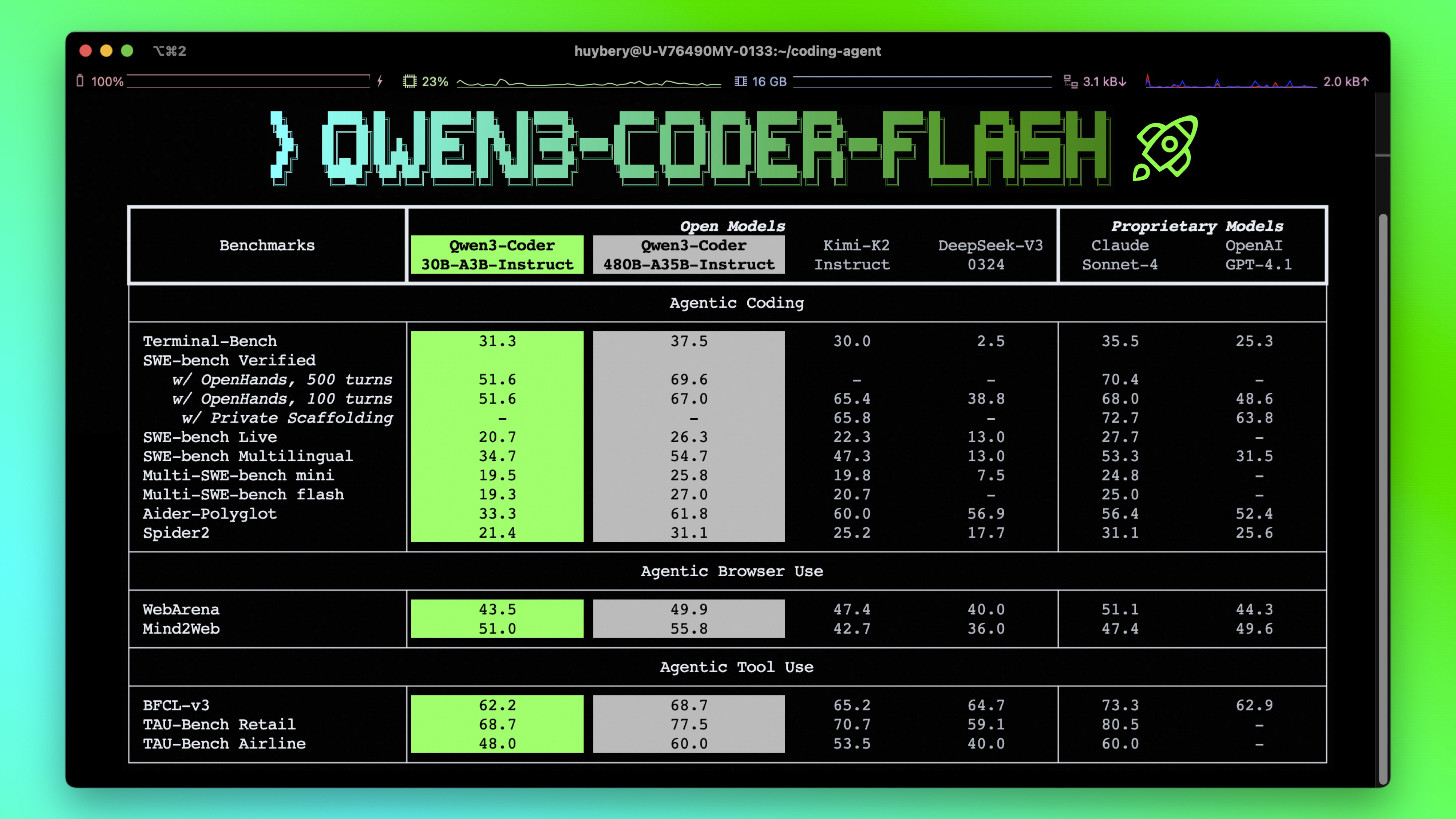
Qwen3-Coder is available in multiple sizes. Today, we're excited to introduce Qwen3-Coder-30B-A3B-Instruct. This streamlined model maintains impressive performance and efficiency, featuring the following key enhancements:
Significant Performance among open models on Agentic Coding, Agentic Browser-Use, and other foundational coding tasks.
Long-context Capabilities with native support for 256K tokens, extendable up to 1M tokens using Yarn, optimized for repository-scale understanding.
Agentic Coding supporting for most platform such as Qwen Code, CLINE, featuring a specially designed function call format.
image/jpeg
Model Overview
Qwen3-Coder-30B-A3B-Instruct has the following features:
Type: Causal Language Models
Training Stage: Pretraining & Post-training
Number of Parameters: 30.5B in total and 3.3B activated
Number of Layers: 48
Number of Attention Heads (GQA): 32 for Q and 4 for KV
Number of Experts: 128
Number of Activated Experts: 8
Context Length: 262,144 natively.
NOTE: This model supports only non-thinking mode and does not generate <think></think> blocks in its output. Meanwhile, specifying enable_thinking=False is no longer required.
For more details, including benchmark evaluation, hardware requirements, and inference performance, please refer to our blog, GitHub, and Documentation.
Quickstart
We advise you to use the latest version of transformers.
With transformers<4.51.0, you will encounter the following error:
KeyError: 'qwen3_moe'
The following contains a code snippet illustrating how to use the model generate content based on given inputs.
python
1from transformers import AutoModelForCausalLM, AutoTokenizer
23model_name ="Qwen/Qwen3-Coder-30B-A3B-Instruct"45# load the tokenizer and the model6tokenizer = AutoTokenizer.from_pretrained(model_name)7model = AutoModelForCausalLM.from_pretrained(8 model_name,9 torch_dtype="auto",10 device_map="auto"11)1213# prepare the model input14prompt ="Write a quick sort algorithm."15messages =[16{"role":"user","content": prompt}17]18text = tokenizer.apply_chat_template(19 messages,20 tokenize=False,21 add_generation_prompt=True,22)23model_inputs = tokenizer([text], return_tensors="pt").to(model.device)2425# conduct text completion26generated_ids = model.generate(27**model_inputs,28 max_new_tokens=6553629)30output_ids = generated_ids[0][len(model_inputs.input_ids[0]):].tolist()3132content = tokenizer.decode(output_ids, skip_special_tokens=True)3334print("content:", content)
Note: If you encounter out-of-memory (OOM) issues, consider reducing the context length to a shorter value, such as 32,768.
For local use, applications such as Ollama, LMStudio, MLX-LM, llama.cpp, and KTransformers have also supported Qwen3.
Agentic Coding
Qwen3-Coder excels in tool calling capabilities.
You can simply define or use any tools as following example.
python
1# Your tool implementation2defsquare_the_number(num:float)->dict:3return num **245# Define Tools6tools=[7{8"type":"function",9"function":{10"name":"square_the_number",11"description":"output the square of the number.",12"parameters":{13"type":"object",14"required":["input_num"],15"properties":{16'input_num':{17'type':'number',18'description':'input_num is a number that will be squared'19}20},21}22}23}24]2526import OpenAI
27# Define LLM28client = OpenAI(29# Use a custom endpoint compatible with OpenAI API30 base_url='http://localhost:8000/v1',# api_base31 api_key="EMPTY"32)3334messages =[{'role':'user','content':'square the number 1024'}]3536completion = client.chat.completions.create(37 messages=messages,38 model="Qwen3-Coder-30B-A3B-Instruct",39 max_tokens=65536,40 tools=tools,41)4243print(completion.choice[0])
Best Practices
To achieve optimal performance, we recommend the following settings:
Sampling Parameters:
We suggest using temperature=0.7, top_p=0.8, top_k=20, repetition_penalty=1.05.
Adequate Output Length: We recommend using an output length of 65,536 tokens for most queries, which is adequate for instruct models.
For all settings used for this model (including specifics for its "class"), including example generation(s) and for advanced settings guide (which many times addresses any model issue(s)), including methods to improve model performance for all use case(s) as well as chat, roleplay and other use case(s) please see:
However I went in a completely different direction from what was outlined in this paper.
What is "Brainstorm" ?
The reasoning center of an LLM is taken apart, reassembled, and expanded.
In this case for this model: 20 times
Then these centers are individually calibrated. These "centers" also interact with each other.
This introduces subtle changes into the reasoning process.
The calibrations further adjust - dial up or down - these "changes" further.
The number of centers (5x,10x etc) allow more "tuning points" to further customize how the model reasons so to speak.
The core aim of this process is to increase the model's detail, concept and connection to the "world",
general concept connections, prose quality and prose length without affecting instruction following.
This will also enhance any creative use case(s) of any kind, including "brainstorming", creative art form(s) and like case uses.
Here are some of the enhancements this process brings to the model's performance:
Prose generation seems more focused on the moment to moment.
Sometimes there will be "preamble" and/or foreshadowing present.
Fewer or no "cliches"
Better overall prose and/or more complex / nuanced prose.
A greater sense of nuance on all levels.
Coherence is stronger.
Description is more detailed, and connected closer to the content.
Simile and Metaphors are stronger and better connected to the prose, story, and character.
Sense of "there" / in the moment is enhanced.
Details are more vivid, and there are more of them.
Prose generation length can be long to extreme.
Emotional engagement is stronger.
The model will take FEWER liberties vs a normal model: It will follow directives more closely but will "guess" less.
The MORE instructions and/or details you provide the more strongly the model will respond.
Depending on the model "voice" may be more "human" vs original model's "voice".
Other "lab" observations:
This process does not, in my opinion, make the model 5x or 10x "smarter" - if only that was true!
However, a change in "IQ" was not an issue / a priority, and was not tested or calibrated for so to speak.
From lab testing it seems to ponder, and consider more carefully roughly speaking.
You could say this process sharpens the model's focus on it's task(s) at a deeper level.
The process to modify the model occurs at the root level - source files level. The model can quanted as a GGUF, EXL2, AWQ etc etc.