We have evaluated both our and existing models on the CoRal test set as well as the
Danish Common Voice 17 test set. To ensure as robust an evaluation as possible, we have
bootstrapped the results 1000 times and report here the mean scores along with a 95%
confidence interval (lower is better; best scores in bold, second-best in
italics):
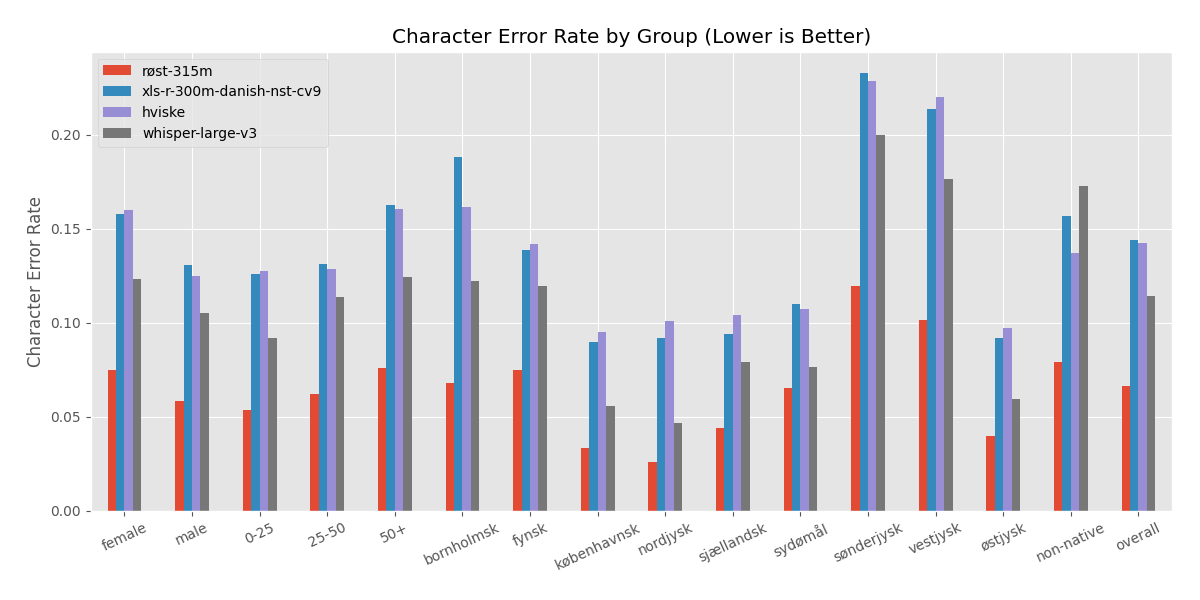
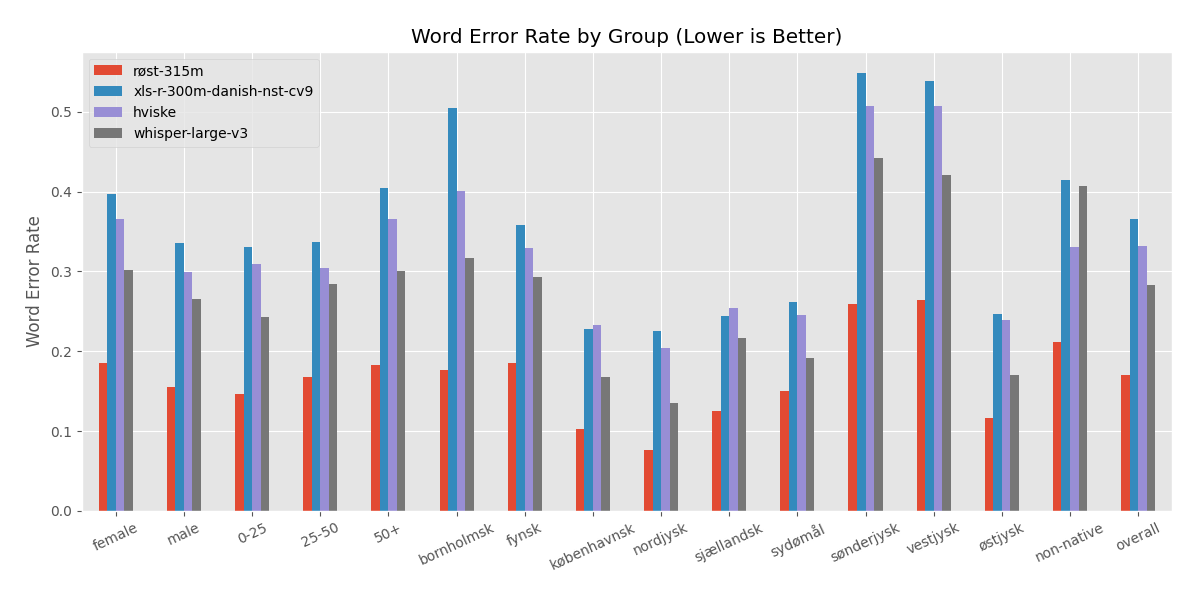
Detailed Evaluation Across Demographics on the CoRal Test Set
CER comparison plot
WER comparison plot
Training Data
This model is the result of four different stages of training:
"Pretraining" on 436,000 hours of unlabelled multilingual publicly available data,
13,628 hours of which is Danish. Pretraining here means that the model learnt to
"fill in" gaps of raw audio - no transcriptions were used (or available) during
this process. The pretraining data is distributed as follows:
372,000 hours from VoxPopuli, being
speeches from the European Parliament in 23 European languages.
This includes 13,600 hours of Danish speech.
51,000 hours from Multilingual
LibriSpeech, being audiobooks in
8 European languages. This does not include any Danish speech.
7,000 hours from Common Voice 6,
being read-aloud speech in 60 diverse languages. This does not include any Danish
speech.
6,600 hours from VoxLingua107,
being audio from YouTube videos in 107 languages. This includes 28 hours of
Danish speech.
1,000 hours from BABEL, being
conversational telephone speech in 17 African and Asian languages. This does not
include any Danish speech.
"Finetuning" on 373 hours of labelled Danish publicly available data. "Finetuning"
indicates that this stage of training was supervised, i.e. the model was trained on
both audio and transcriptions to perform the speech-to-text task (also known as
automatic speech recognition). The finetuning data is as follows:
The read-aloud training split of the CoRal
dataset (revision
fb20199b3966d3373e0d3a5ded2c5920c70de99c), consisting of 361 hours of Danish
read-aloud speech, diverse across dialects, accents, ages and genders.
An n-gram language model has been trained separately, and is used to guide the
transcription generation of the finetuned speech recognition model. This n-gram
language model has been trained on the following datasets:
Danish
Reddit
(approximately 5 million comments).
Note that all samples from the CoRal test dataset have been removed from all of
these datasets, to ensure that the n-gram model has not seen the test data.
The final product is then the combination of the finetuned model along with the n-gram
model, and this is what is used when you use the model as mentioned in the Quick Start
section above.
Intended use cases
This model is intended to be used for Danish automatic speech recognition.
Note that Biometric Identification is not allowed using the CoRal dataset and/or derived
models. For more information, see addition 4 in our
license.
The dataset is licensed under a custom license, adapted from OpenRAIL-M, which allows
commercial use with a few restrictions (speech synthesis and biometric identification).
See
license.
Creators and Funders
The CoRal project is funded by the Danish Innovation
Fund and consists of the following partners:
We will submit a research paper soon, but until then, if you use this model in your
research or development, please cite it as follows:
bibtex
1@dataset{coral2024,
2  author    = {Dan Saattrup Nielsen, Sif Bernstorff Lehmann, Simon Leminen Madsen, Anders Jess Pedersen, Anna Katrine van Zee, Anders Søgaard and Torben Blach},
3  title     = {CoRal: A Diverse Danish ASR Dataset Covering Dialects, Accents, Genders, and Age Groups},
4  year      = {2024},
5  url       = {https://hf.co/datasets/alexandrainst/coral},
6}